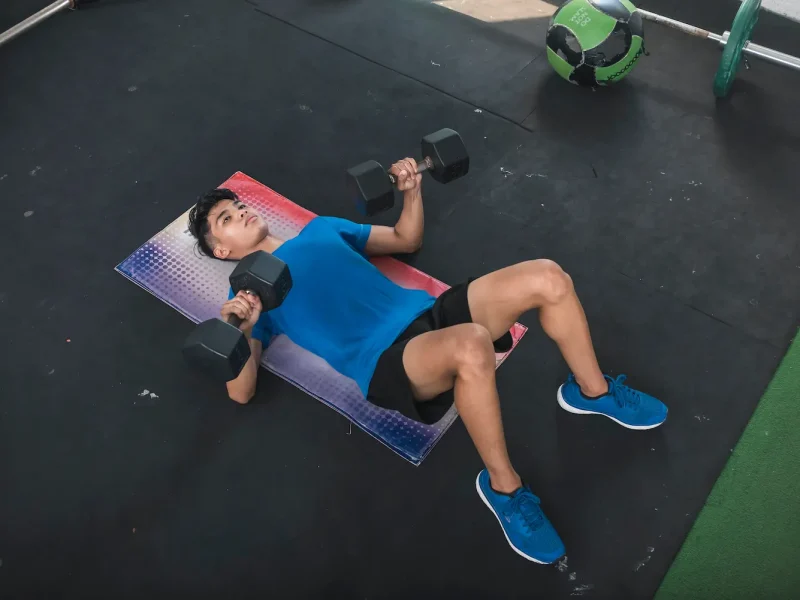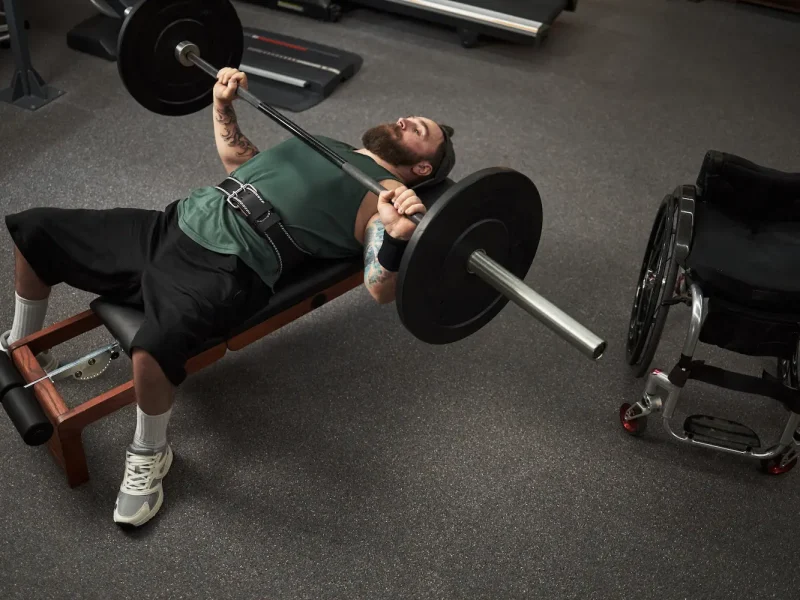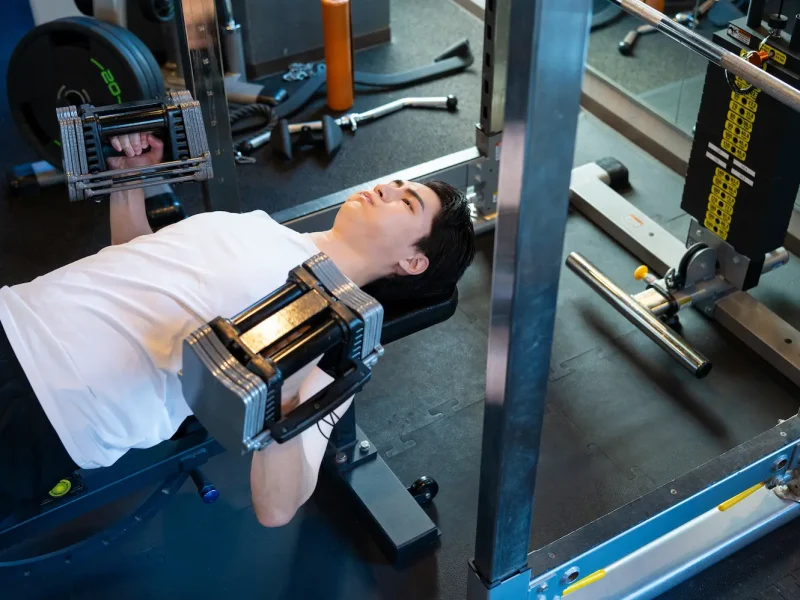

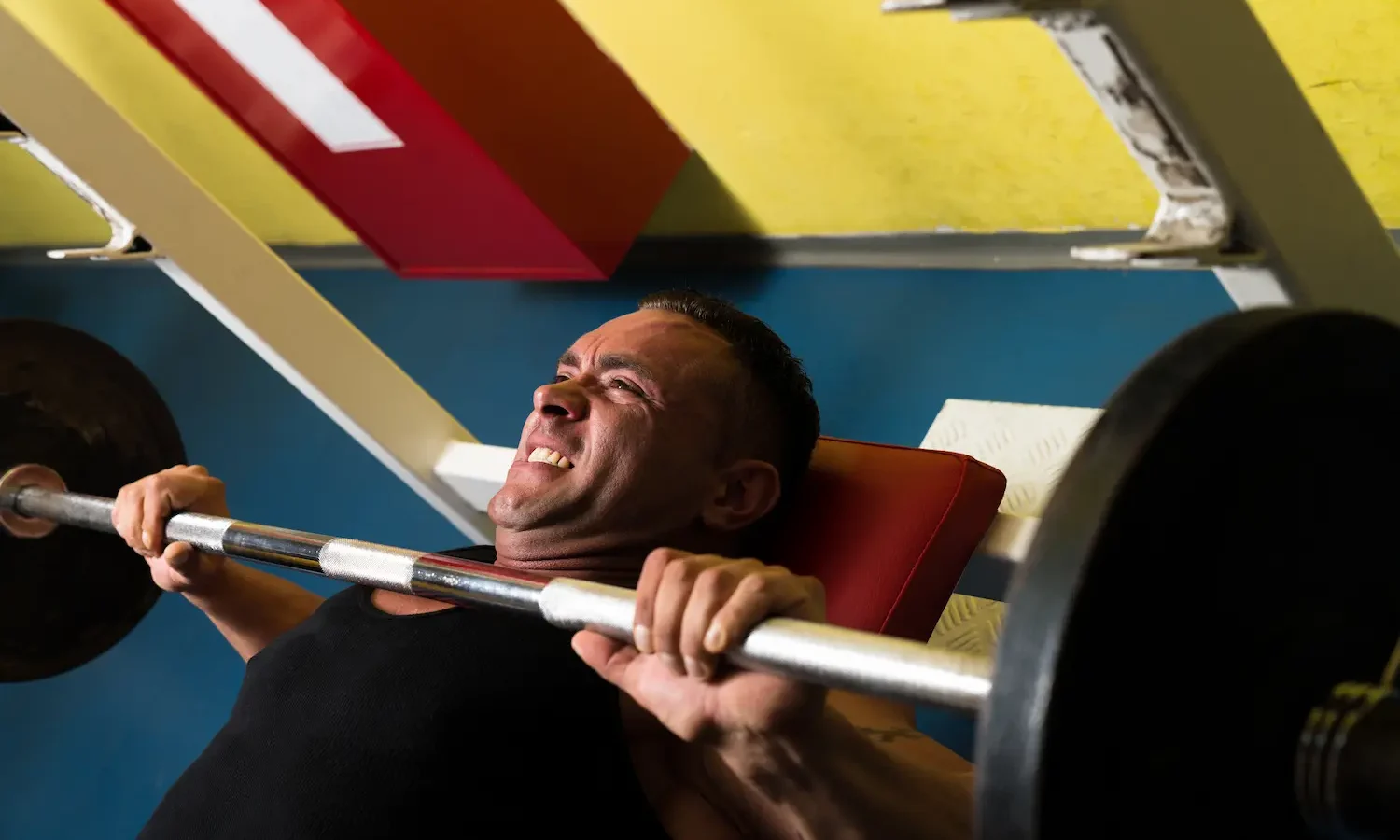
The pause bench press is the powerlifting-legal bench press: lower the bar to the chest, pause until still, then press up. It is exactly what you’ll be required to do at any meet — and even if you never compete, the pause bench is the most direct way to build raw chest pressing strength from a dead stop.
Touch-and-go bench training leverages the stretch reflex (the elastic rebound at the chest). The pause kills that rebound and forces the lifter to grind out the rep from zero velocity. Stronger pause bench = stronger touch-and-go bench, always.
What is the pause bench press?
The pause bench press is a barbell bench press variation in which you lower the bar to the chest, **pause motionless for 1-3 seconds**, then press back up to full lockout. Both the descent and the press follow standard bench technique; only the pause at the chest differs.
The pause builds three qualities: starting strength from the chest (zero stretch reflex assistance), bracing endurance under load, and meet-legal technique. Most committed pressers run a pause-bench block at least once or twice a year.
Muscles worked
| Muscle group | Role | Contribution |
|---|---|---|
| Pectoralis major | Primary mover, horizontal press | ~45 % |
| Triceps brachii | Elbow extension | ~25 % |
| Anterior deltoid | Shoulder flexion | ~15 % |
| Lats, traps, scapular stabilisers | Bar path stabilisation | ~10 % |
| Core, glutes, legs (leg drive) | Full-body bracing, leg drive | ~5 % |
Same primary muscles as the standard bench press, but with more triceps and starting-strength demand because the stretch reflex contribution is zero.
How to pause bench press: 5 steps
-
Set up tight on the bench
Lie on the bench, retract scapulae hard, slight arch in upper back, feet planted firmly. Grip slightly wider than shoulder-width. Unrack with the help of a spotter if possible.
-
Lower with control
Lower the bar in 2-3 seconds in a curved path, touching the **lower chest / sternum**. Elbows tucked at ~45-60° from the torso. Keep the back tight, lats engaged.
-
Touch and PAUSE
**Bar rests motionless on the chest for 1-3 seconds.** Don't let it sink. Don't release tension. Maintain leg drive, grip, scapular position. The pause is the exercise.
-
Press from a dead stop
**Drive the bar up explosively** — no rebound. Pec, triceps, and shoulders all fire together. Bar travels in a slight backward arc back toward the eyes/face.
-
Lock out at the top
Full elbow extension at the top, shoulders still pinned back. Reset the brace, take a fresh breath if doing singles or low-rep sets. Begin the next rep.
Common mistakes to avoid
Variations
- Close-grip pause bench. Hands shoulder-width. Triceps emphasis with all the pause-bench benefits.
- Incline pause bench. Pause on an incline bench. Upper-pec emphasis.
- Long-pause bench (3-5 sec). Brutal — tests bracing endurance.
- Pin press. Bar starts on safety pins at chest height. Even more strict starting-strength work.
- Dead bench press. Bar from a dead stop on the chest, no eccentric. The ultimate starting-strength bench.
- Standard bench press. The base lift.
Sample workout: 4-week pause bench block
Use pause benches as the main bench day during a strength block. Load is typically 80-90 % of standard bench 1RM.
| Week | Sets × reps | Pause length | Load (% of 1RM) |
|---|---|---|---|
| 1 | 4 × 5 | 2 sec | 80 % |
| 2 | 4 × 4 | 2 sec | 82.5 % |
| 3 | 5 × 3 | 3 sec | 85 % |
| 4 (deload) | 3 × 5 | 2 sec | 72.5 % |
Frequently asked questions
How long should the pause be?
Powerlifting meets typically require ~1 second (judged “command bench”). For training, 2-3 seconds is the standard — it removes any stretch reflex assistance and builds extra bracing. Longer pauses (5+ sec) are accessory variations, not the main lift.
How much should I pause-bench vs regular bench?</h3
Most lifters pause bench 85-92 % of their touch-and-go max for the same reps. Trained powerlifters reach a ratio closer to 95 % because they pause bench heavy year-round. Aim for a small gap.
Is the bar supposed to sink into the chest?</h3
No. The bar rests motionless **on** the chest. Sinking = breaking form, losing tightness, often missing the lift. Touch and stop — the chest stays solid.
Do I need a spotter?</h3
For working sets near max, yes. The pause adds time at the hardest position. Safety bars/pins set at chest height are essential if benching alone heavy.
Pause bench or close-grip bench for triceps?</h3
Different goals. Close-grip bench directly targets triceps via grip change. Pause bench builds starting strength regardless of grip width. Run them both — close-grip on one day, pause on another.
Related exercises
- Bench Press: the standard lift
- Close-Grip Bench Press: triceps-focused variation
- Pause Squat: the lower-body equivalent
- Dips: bodyweight pressing accessory
- Skull Crusher: direct triceps work
Published by: Jay — Writer covering chest exercises
Reviewed, corrected and approved by: Martin Wood — Editor-in-chief
Updated on September 29, 2026