
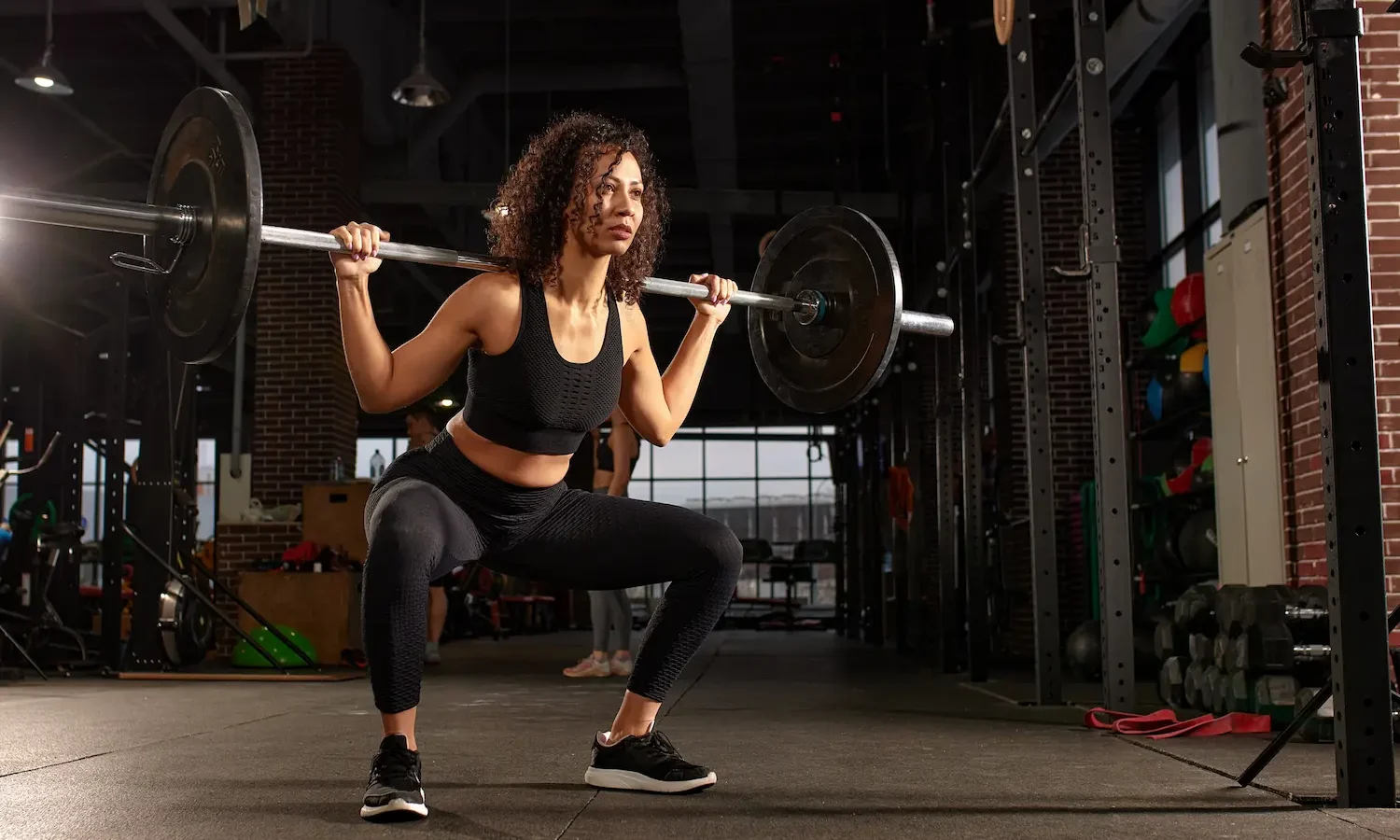
The pause squat is the standard back squat with a 2-3 second pause at the bottom. That pause eliminates the stretch reflex (the elastic rebound from fast lifts), forcing the lifter to grind out the concentric from a dead stop. Strength gained from pause squats transfers directly to heavier non-paused squats — most powerlifters use them in the off-season for exactly this reason.
If your squat has a weak bottom (you lose tension at depth and miss heavy attempts), the pause squat is the most direct fix.
What is the pause squat?
The pause squat is a barbell back squat variation with a deliberate 2-3 second pause at the bottom position before standing up. The pause is fully relaxed in terms of stretch reflex but fully tense in terms of bracing — you hold maximum core and leg tension while the elastic rebound dissipates.
It builds three specific qualities: starting strength from a dead stop, position awareness at depth, and bracing endurance. All three matter for raw powerlifting and for any lifter whose squat stalls in the bottom third of the lift.
Muscles worked
| Muscle group | Role | Contribution |
|---|---|---|
| Quadriceps | Primary mover, knee extension | ~40 % |
| Glutes | Hip extension | ~25 % |
| Hamstrings | Hip extension support, stabilisation | ~15 % |
| Core, erector spinae | Bracing, spinal stabilisation | ~15 % |
| Adductors | Hip stabilisation | ~5 % |
The pause squat works the same muscles as the standard back squat, but with greater time-under-tension and reduced help from the stretch reflex. Translation: more quad and glute recruitment per rep.
How to pause squat: 5 steps
-
Unrack and set the brace
Set up exactly as a standard back squat: bar on upper back, feet shoulder-width, toes slightly out. Unrack, step back, take a big breath into the belly, brace 360°.
-
Descend with control
Lower in 2-3 seconds — same depth as your standard squat (hip crease below knee or just at). **Don't bounce, don't rush.** The pause is the point of the exercise.
-
Hit depth and PAUSE
**At the bottom, freeze for 2-3 seconds.** Maintain full body tension — abs braced, knees out, chest up. The pause feels longer than it sounds. Don't rest, don't breathe out; hold the brace.
-
Drive up from a dead stop
After the full pause, **explode upward** — no rebound, no bounce. The legs and glutes do all the work. Keep the chest tall, knees tracking over toes.
-
Lock out at the top
Stand fully, hips and knees locked. Reset the brace, breathe. Begin the next rep from the top.
Common mistakes to avoid
Variations
- Front pause squat. Pause squat with a front-rack position. More upright, more quad-dominant.
- Safety-bar pause squat. Easier on the shoulders. Same training effect.
- Box pause squat. Pause on a box for fixed depth. Eliminates ambiguity about depth.
- Long-pause squat (5 sec). 5+ second pauses. Brutal — for strength-endurance and bracing.
- Tempo squat. Slow eccentric + pause. More total time under tension.
- Standard back squat. The base lift. Use pause squats as accessory.
Sample workout: 4-week pause squat block
Run pause squats as the main squat day during an off-season block, or as a secondary squat day after heavy squats earlier in the week. Load is typically 75-85 % of standard squat 1RM.
| Week | Sets × reps | Pause length | Load (% of 1RM) |
|---|---|---|---|
| 1 | 4 × 5 | 2 sec | 75 % |
| 2 | 4 × 4 | 2 sec | 80 % |
| 3 | 5 × 3 | 3 sec | 82.5 % |
| 4 (deload) | 3 × 5 | 2 sec | 70 % |
Frequently asked questions
How long should the pause be?
2-3 seconds is the standard. Long enough to eliminate the stretch reflex, short enough to maintain bracing. 1 second isn’t really a pause. 5 seconds is a different exercise (strength-endurance and bracing focus).
How much should I pause-squat compared to my regular squat?</h3
Most lifters pause squat 80-85 % of their standard squat 1RM for the same reps. So if your regular 5-rep is 140 kg, your pause-squat 5-rep is typically 115-120 kg. Build that ratio over time — at peak, paused = ~90 % of standard.
Does the pause squat fix my weak bottom position?</h3
Yes — this is its primary purpose. If you crumble forward at the bottom of heavy squats, pause squats train you to hold tension there. The fix shows up within 4-6 weeks.
Should I include them year-round?</h3
Off-season and early prep yes. In the final 4-6 weeks before a meet, drop them in favour of meet-style squats. The pause squat is a strength-building tool, not a peaking tool.
Pause squat or front squat for quad work?</h3
Different goals. Front squat emphasises quads and an upright torso. Pause squat targets bottom-position strength regardless of bar position. Strong powerlifters use both — front squats early in the week, pause back squats later.
Related exercises
- Back Squat: the base lift
- Front Squat: quad-emphasis squat
- Pause Bench Press: the upper-body equivalent
- Box Squat: fixed-depth alternative
- Leg Press: machine quad accessory
Published by: Jay — Writer covering quad exercises
Reviewed, corrected and approved by: Martin Wood — Editor-in-chief
Updated on September 29, 2026