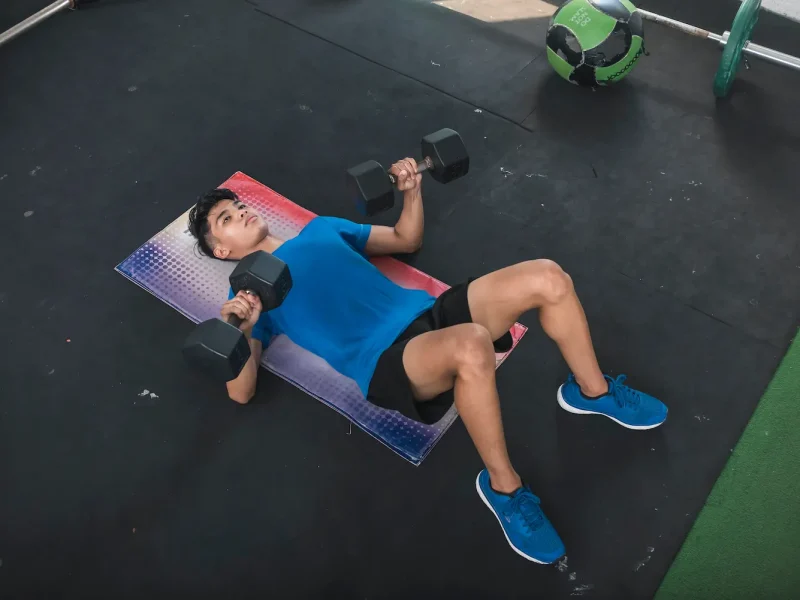

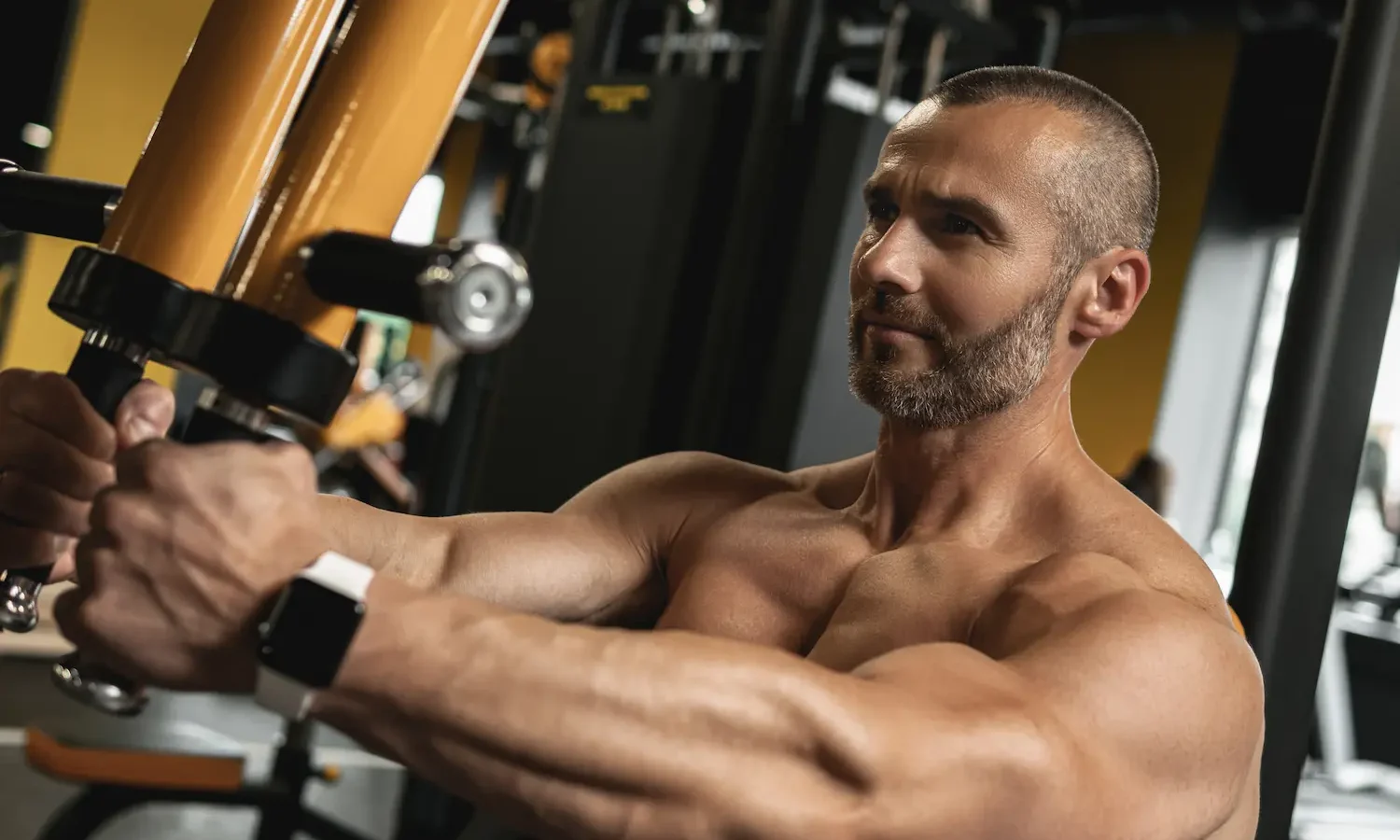
The pec deck (also called chest fly machine or butterfly machine) is the most strict chest isolation exercise in any commercial gym. Where the bench press and dips involve triceps and shoulders heavily, the pec deck does one thing: bring the arms together against resistance. The chest does almost all the work.
This guide covers the standard pec deck machine. The dumbbell fly is a similar exercise with free weights and is covered briefly at the end.
What is the pec deck?
The pec deck is a chest isolation exercise performed on a dedicated machine, in which you sit with your back against a pad, place your forearms (or hands) on padded levers, and bring the levers together in front of your chest by squeezing the pectorals. The motion is shoulder horizontal adduction.
Compared to the dumbbell fly, the pec deck has the safety advantage — the machine controls the path, and you can’t drop a dumbbell on yourself. The disadvantage: less stabilisation work, and you’re locked into the machine’s path which may not suit all body types.
Muscles worked
| Muscle group | Role | Contribution |
|---|---|---|
| Pectoralis major (chest) | Primary mover, horizontal adduction | ~85 % |
| Anterior deltoid | Slight assistance | ~10 % |
| Biceps · Forearms | Stabilisation | ~5 % |
The pec deck loads the chest in a stretched-then-contracted pattern unique among chest exercises. While the bench press primarily trains pressing strength, the pec deck specifically trains the chest’s adduction function — bringing the arms across the body.
How to pec deck: 5 steps
-
Set up the machine
Adjust the seat so that when you place your forearms on the pads (or grip the handles), your elbows are at chest level — same height as your shoulders. Back firmly against the pad.
-
Set the body position
Sit upright, chest proud. Pull shoulder blades back and down, pin them to the back pad. Slight bend in the elbows (about 10°), maintained throughout.
-
Bring the arms together
Squeeze the chest to bring the pads/handles toward each other in front of your body. **The motion comes from the chest** — feel the pectorals contracting. Don't pull with the shoulders.
-
Pause and squeeze
When the arms meet (or nearly meet) in front, pause for 1 second. **Squeeze the chest hard.** Peak contraction is at the centre.
-
Lower in 2-3 seconds
Controlled eccentric. Open the arms slowly until you feel a chest stretch — but don't go so far back that the shoulder is over-extended. Reset, repeat.
Common mistakes to avoid
Variations
- Dumbbell fly. Lying flat on a bench with two dumbbells. Same motion pattern, free-weight stabilisation.
- Incline dumbbell fly. On a 30° incline bench. Bias upper chest.
- Cable fly. At a cable crossover with two D-handles. Constant tension throughout.
- Low cable fly. Cables from low pulleys, hands meet up high. Upper chest emphasis.
- High cable fly. Cables from high pulleys, hands meet down low. Lower chest emphasis.
- Single-arm pec deck. One arm at a time. Asymmetry-fixing.
Sample workout: 4-week chest hypertrophy block
Pec deck 1-2 times per week, after main pressing work as a chest finisher.
| Week | Sets × reps | Tempo |
|---|---|---|
| 1 | 3 × 12 | 2 sec eccentric + 1 sec squeeze at top |
| 2 | 4 × 10 | 3 sec eccentric + 1 sec squeeze |
| 3 | 4 × 10 + 1 dropset | 3 sec eccentric + 2 sec squeeze |
| 4 (deload) | 3 × 10 | Smooth |
Frequently asked questions
Pec deck or dumbbell fly?
Both work. Pec deck is safer (no risk of dropping weight), more strict, easier to load progressively. Dumbbell fly demands more stabilisation. Many lifters use the pec deck for hypertrophy and the dumbbell fly for chest stretch.
Why does my front shoulder hurt during pec deck?
Either you’re going too far back at the stretch position (over-extending the shoulder) or the elbow position is wrong. Stop the back motion when your elbows are at chest level (not behind the body). Slight bend in the elbows throughout.
How heavy should I pec deck?
Light to moderate. Pec deck is a hypertrophy and squeeze exercise. The right weight lets you do 10-15 strict reps with a slow tempo and full squeeze. Going too heavy turns the lift into a press with rounded shoulders.
Should I touch the pads/handles together at the top?
Yes, light touch. The peak contraction is at the centre, when arms are fully crossed in front. Don’t bash the pads together — gentle contact and squeeze.
Pec deck for upper or lower chest?
Mostly mid-chest with the standard machine. For upper chest, use low cable flys. For lower chest, use high cable flys. The pec deck is more general.
Related exercises
- Dumbbell Fly: free-weight equivalent
- Cable Fly: constant tension version
- Bench Press: foundational chest compound
- Incline Bench Press: upper chest pressing
- Dips: bodyweight chest compound
Published by: Jay — Writer covering chest exercises
Reviewed, corrected and approved by: Martin Wood — Editor-in-chief
Updated on September 29, 2026