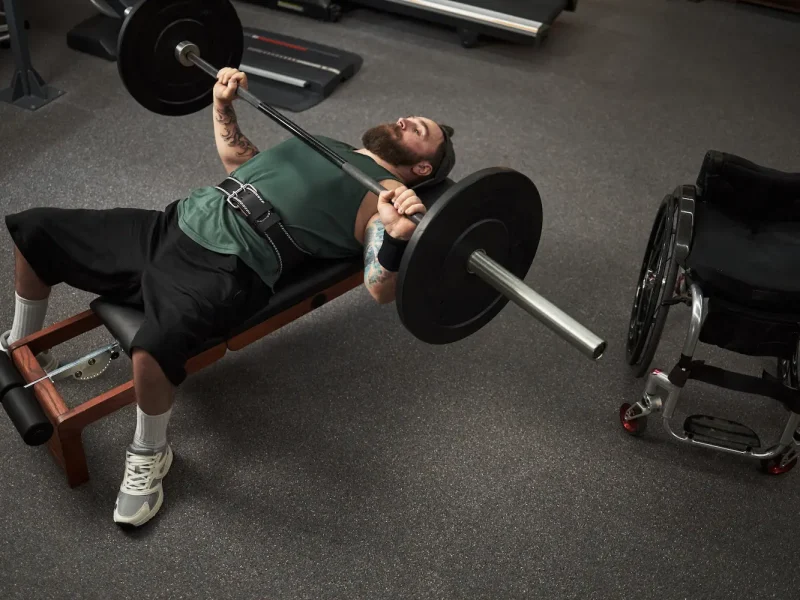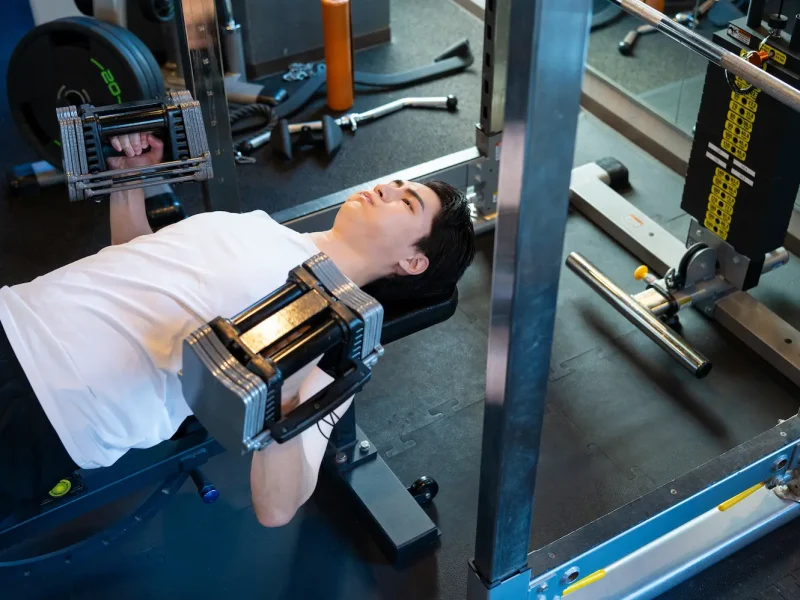


The dead bench press is the strictest possible bench-press variation. The bar rests fully on safety pins at chest height between every rep — the lifter completely releases tension, then re-braces and presses the bar from a true dead stop. No eccentric, no stretch reflex, no carryover tension from rep to rep. Pure starting-strength work.
What it is
The dead bench press is a pin-supported bench press variant where the lifter fully releases the bar onto the safety pins between reps. After the press to lockout and lowering back to the pins, the lifter relaxes entirely — drops the brace, releases shoulder retraction. Then they reset everything: re-brace, re-retract scapulae, and press again from zero. Each rep is essentially a fresh single.
Muscles worked
| Muscle | Contribution |
|---|---|
| Pectoralis major | ~40 % |
| Triceps brachii | ~30 % |
| Anterior deltoid | ~15 % |
| Lats, traps, core | ~15 % |
How to dead bench press: 5 steps
-
Set up the rack
Set safety pins inside a power rack at **chest-touch height**. Load the bar to working weight resting on the pins.
-
Get tight, brace, retract
Lie on the bench, **retract scapulae hard**, slight arch, feet planted, **brace core**. Grip the bar.
-
Press from a dead stop
**Drive the bar straight up from the pins** — pure concentric, no eccentric. Lock out at the top.
-
Lower back to pins and FULLY RELEASE
Lower the bar back to the pins with control. **Release ALL tension** — drop the brace, relax shoulders, let the bar rest fully on the pins. Take a breath, reset.
-
Re-brace, re-retract, press again
**Re-tighten everything** — scapulae back, core brace, deep breath. Now press the bar again from a true dead stop. Each rep is a fresh single. After the set: re-rack with help or lower the bar onto the lowest pins.
How it differs from pin bench press
- Full tension release between reps. Pin press allows maintained tension between reps. Dead bench requires resetting everything — full brace, full scapular retraction, full setup — between every single rep.
- Each rep is a fresh single. No carryover from rep to rep. This is the maximum-strict starting-strength test.
- Even lighter loads required. Most lifters dead-bench 70-80 % of their pin-press load — the full tension reset eliminates any rep-to-rep momentum.
- Longer rest between reps. Each rep takes 10-15 seconds of setup. Sets become very long; rest between sets typically increases.
Common mistakes
When to use this variation
Use dead bench when your bench press misses at the chest specifically because you lose tension on the descent or at the pause, or when you want absolutely strict starting-strength training. It’s a niche tool — most lifters benefit more from pause bench or pin bench. Use 1-2 dead bench sessions per month, not as a weekly main exercise.
FAQ
How is this different from a single-rep cluster?
Dead bench reps happen in close succession (10-15 sec setup between reps). Single-rep clusters use longer rests (30-60 sec). Dead bench is more demanding because the upper body never fully recovers between reps.
How heavy should I dead bench?
70-80 % of bench 1RM for 3-5 reps. The strictness makes even light loads feel heavy. Don’t chase numbers; the value is in the strict reset between reps.
How many sessions per month?
1-2 max. Dead bench is taxing on the nervous system because each rep requires full max effort from a dead stop. Use it as an occasional accessory, not as your weekly main bench.
Related exercises
- Pin Bench Press: less strict pin-supported variant
- Pause Bench Press: chest-pause variant
- Spoto Press: mid-air pause
- Bench Press: standard touch-and-go
Published by: Jay — Writer covering chest exercises
Reviewed, corrected and approved by: Martin Wood — Editor-in-chief
Updated on May 21, 2026