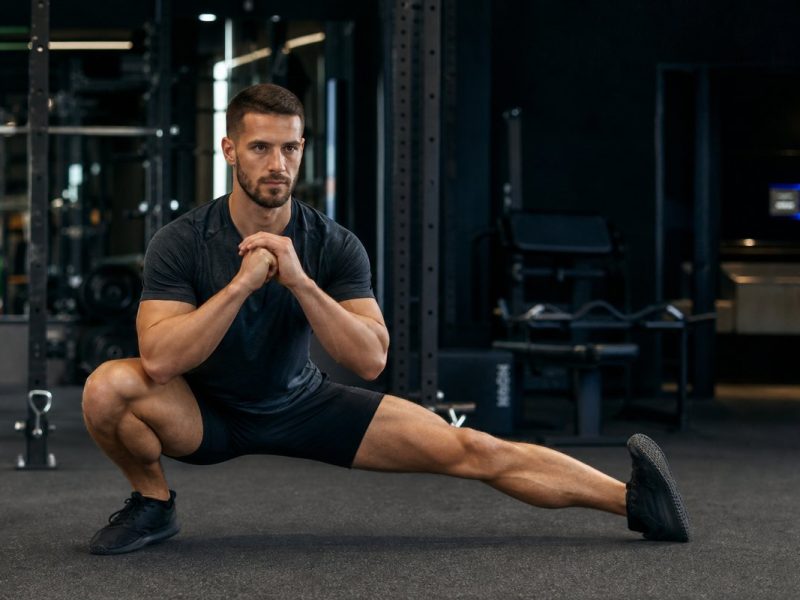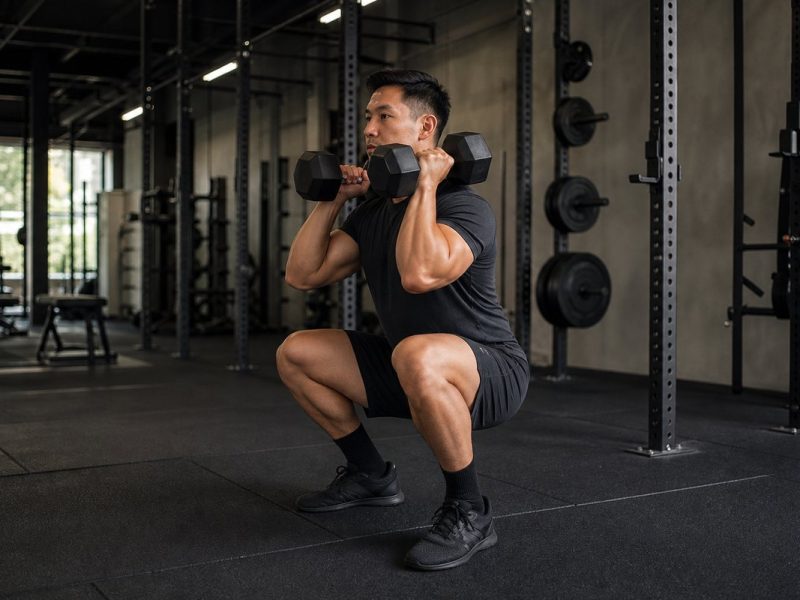


The walking lunge is the lunge done in motion — alternating legs as you walk forward across the gym floor. It looks simple. The day after, your legs will tell you it isn’t. Walking lunges produce more delayed-onset muscle soreness (DOMS) per minute than nearly any other exercise. They also build serious unilateral leg strength and athletic carryover.
This guide covers the strict version — strict step length, knee tracking, and tempo. Done sloppily, walking lunges become a sweaty waddle. Done strict, they’re transformative.
What is the walking lunge?
The walking lunge is a dynamic unilateral lower-body exercise in which you take long forward steps, lower into a lunge with both knees at ~90°, then drive forward to bring the back leg through to take the next step. Each rep is a step on alternating legs, traveling forward across the floor.
Compared to the stationary forward lunge, walking lunges add momentum, balance demands, and significantly more total work because you don’t rest at the top. Compared to the Bulgarian split squat, they’re less intense per rep but better for athletic carryover.
Muscles worked
| Muscle group | Role | Contribution |
|---|---|---|
| Quadriceps (front leg) | Knee extension on each step | ~40 % |
| Glutes (front leg) | Hip extension | ~30 % |
| Hamstrings, adductors | Hip extension support, stabilisation | ~15 % |
| Calves, core, hip flexors | Balance, drive, posture | ~15 % |
Walking lunges train the same muscles as the stationary lunge, but with a meaningful additional element: the leg drive that brings the back foot through to take the next step. That trains explosive hip extension and rear-leg engagement that stationary lunges miss.
How to walking lunge: 5 steps
-
Set up the start position
Stand tall, feet hip-width apart. Hold dumbbells at sides if loading. Look straight ahead, chest proud, core braced. You need clear floor space ahead — typically 8-10 metres.
-
Step forward into the lunge
Take a long step forward — about 60-90 cm. Plant the front foot flat. Let the back heel rise as both knees bend. Lower until both knees form ~90° angles.
-
Reach depth
Front knee tracks over the foot (not collapsing inward, not past the toes). Back knee hovers just above the floor. **Front shin stays vertical.** Brief pause at the bottom.
-
Drive through the front foot
Push through the front heel to drive yourself forward and up. The back foot lifts off the floor and swings forward to take the next step. **Don't step back to standing first** — keep moving.
-
Continue alternating legs
The leg that just stepped forward becomes the standing leg; the trailing leg now steps forward. Continue alternating across the floor for the prescribed reps. Maintain upright torso throughout.
Common mistakes to avoid
Variations
- Dumbbell walking lunge. Two dumbbells held at sides. Standard loaded version.
- Barbell walking lunge. Barbell across the upper back. Heavier loads, harder balance.
- Goblet walking lunge. Single dumbbell at chest. Forces upright torso.
- Walking lunge with rotation. Rotate the torso toward the front leg at the bottom of each lunge. Adds oblique work.
- Reverse walking lunge. Step backward instead of forward. Easier on the knees, often easier balance.
- Stationary lunge. Forward lunge from one spot, no walking. Easier to learn.
Sample workout: 4-week unilateral block
Walking lunges 1-2 times per week. Reps below are per leg.
| Week | Sets × reps/leg | Load |
|---|---|---|
| 1 | 3 × 10 | Bodyweight |
| 2 | 3 × 10 | Light dumbbells (5-10 kg) |
| 3 | 4 × 10 | Moderate dumbbells (12-18 kg) |
| 4 (deload) | 3 × 8 | Light dumbbells |
Frequently asked questions
Walking lunge or stationary lunge?
Walking lunges add explosive forward drive and continuous work; stationary lunges allow more focused control per rep. For athletic carryover, walking. For learning the pattern, stationary first.
How many walking lunges should I do?</h3
10 reps per leg per set is standard. Doing 30+ reps per set turns it into endurance work — fine for conditioning but not for strength/hypertrophy. Stick to 8-12 reps per leg with progressive load.
Why is the next-day soreness so brutal?</h3
Walking lunges produce significant eccentric loading on the front leg as you decelerate the descent. Eccentric loading is the primary driver of DOMS. The first time you do walking lunges, you’ll feel it for 3-4 days. By the third or fourth session, the body adapts.
How heavy should I walking lunge?</h3
Most lifters max out around 20-25 kg per dumbbell for 10 reps per leg. Past that, balance becomes the limiting factor. For heavier loading, switch to barbell back rack.
How long should the step be?</h3
Long enough that, at the bottom of the lunge, your front shin is roughly vertical and your back knee hovers just above the floor. Too short = knee shoots past toes. Too long = stretching the hip flexors instead of working the leg.
Related exercises
- Stationary Lunge: foundational forward lunge
- Bulgarian Split Squat: hardest unilateral leg
- Step-Up: single-leg drive variant
- Reverse Lunge: knee-friendly variant
- Lateral Lunge: frontal-plane variant
Published by: Jay — Writer covering quad exercises
Reviewed, corrected and approved by: Martin Wood — Editor-in-chief
Updated on May 10, 2026