
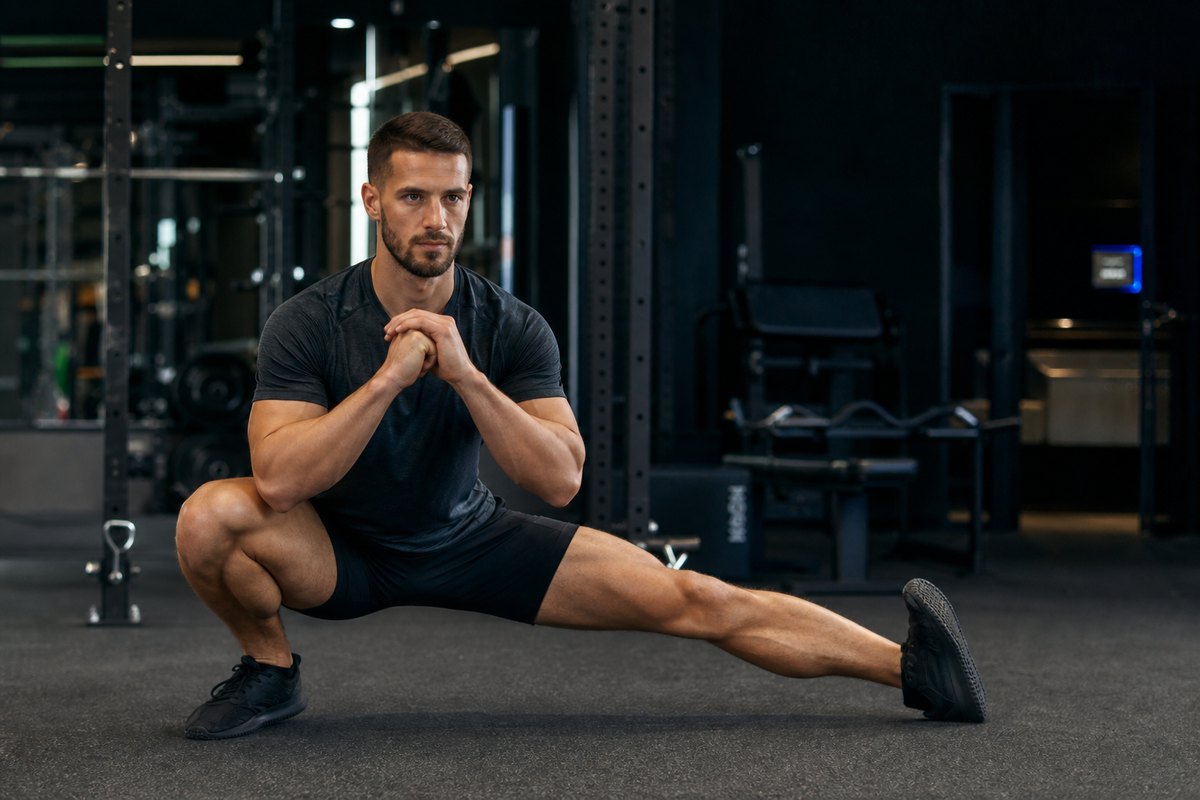
The Cossack squat is a deep lateral squat — like a lateral lunge but sitting all the way down to full depth on one side while the other leg stays extended. Traditional in Russian dance and strongman training, it’s an unbeatable hip mobility and single-leg strength builder.
What it is
The Cossack squat is a deep lateral squat: the lifter shifts weight to one side and descends into a full deep squat on that leg, while the other leg extends straight out to the side, heel on the floor. Then the lifter shifts to the other side without standing. Trains mobility, unilateral strength and adductor flexibility.
Muscles worked
| Muscle | Contribution |
|---|---|
| Quadriceps | ~35 % |
| Adductors, glutes | ~35 % |
| Hamstrings | ~20 % |
| Core, calves | ~10 % |
How to Cossack squat: 5 steps
-
Stand wide
**Wide stance, wider than shoulder-width, toes forward.**
-
Shift and descend
**Shift weight to one side, descend into deep squat on that leg,** other leg extends.
-
Deep position
**Butt near heel, straight leg heel down, toe up,** back neutral.
-
Shift to other side
**Without standing, shift weight across** to squat on the other leg.
-
Continue
Continue side-to-side or stand between reps depending on protocol.
How it differs from lateral lunge
- Full deep squat. Lateral lunge stops at parallel; Cossack goes all the way down.
- Extended leg heel down. Straight leg’s heel stays planted throughout.
- No returning to stand between sides. Weight shifts side-to-side at depth.
- Maximum hip mobility demand. Advanced flexibility required.
Common mistakes
When to use this variation
Use Cossack squats for hip mobility, unilateral strength and functional flexibility. Program 3 sets of 5-8 reps per side (or continuous side-to-side). Excellent as a warm-up drill or accessory movement.
FAQ
Loaded or bodyweight?
Bodyweight to master, then light kettlebell in goblet position for strength progression.
How deep to squat?
As deep as mobility allows with heels down and back neutral. Full depth (butt near ankle) is the target.
Straight leg’s toe — up or down?
Toe pointing up (dorsiflexion) is the classic form. Adds ankle mobility challenge.
Related exercises
- Lateral Lunge: shallower lateral variant
- Pistol Squat: forward single-leg squat
- Bulgarian Split Squat: rear-elevated unilateral
- Goblet Squat: front-loaded standard squat
Published by: Martin Wood — Writer covering quad exercises
Reviewed, corrected and approved by: Martin Wood — Editor-in-chief
Updated on July 21, 2026