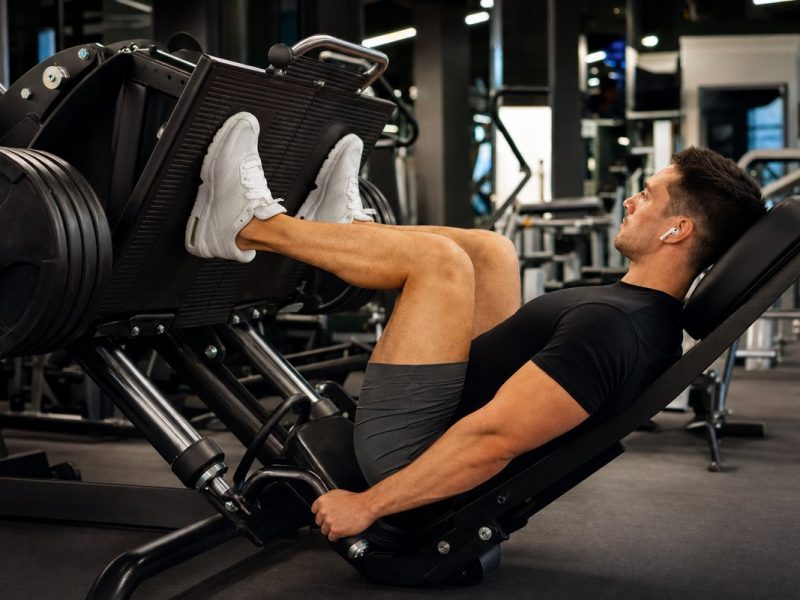

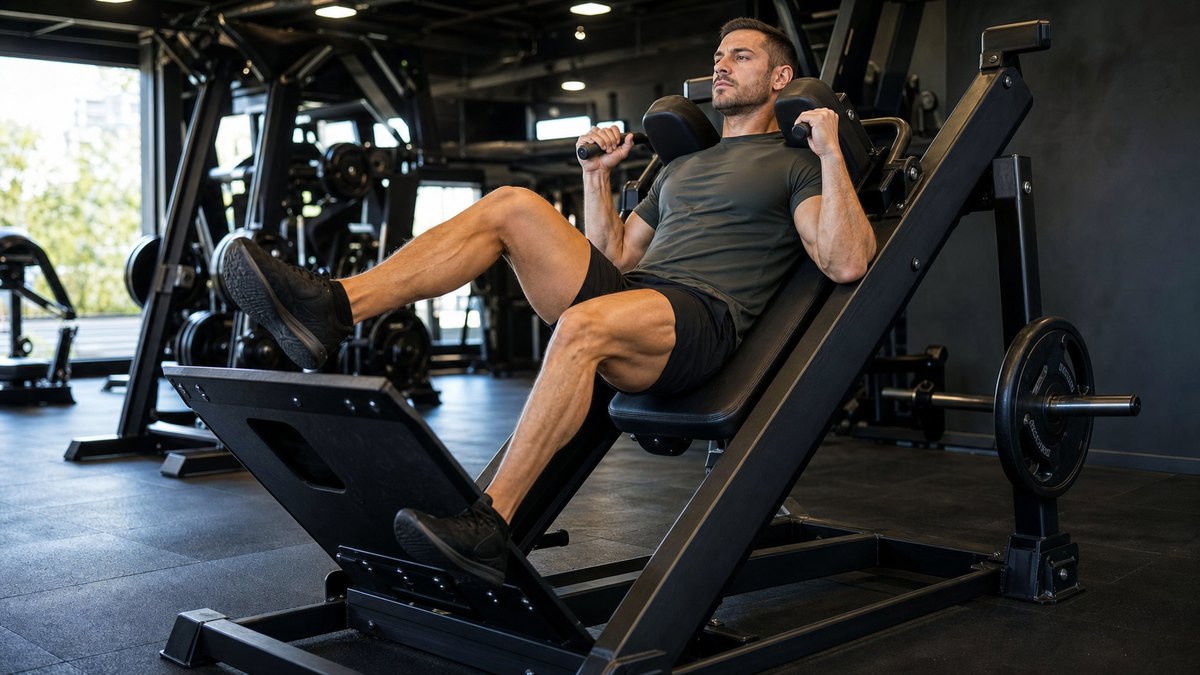
The single-leg hack squat uses the hack squat machine one leg at a time. It combines the guided safety of the machine with the imbalance-correcting focus of unilateral work. The hack squat’s angle biases the quads, and doing it one-legged doubles the stimulus per leg.
What it is
The single-leg hack squat is a hack squat performed with one foot on the platform at a time. The other foot rests off to the side. The guided sled path removes stability demands while forcing all the work through the single working leg.
Muscles worked
| Muscle | Contribution |
|---|---|
| Quadriceps | ~65 % |
| Glutes, hamstrings | ~20 % |
| Adductors, calves | ~10 % |
| Core | ~5 % |
How to single-leg hack squat: 5 steps
-
Set up hack squat
Shoulders under pads, **one foot centred on platform.**
-
Position free leg
**Other leg off to the side** — not on platform.
-
Descend
**Lower under control** to about 90° knee bend.
-
Drive up
**Push through working foot** to near lockout.
-
Complete reps, switch
Finish one side, then the other.
How it differs from bilateral hack squat
- One leg at a time. Corrects imbalances.
- Machine-supported unilateral. No balance demand — pure isolation.
- Half the load per leg. Each side handles all the weight alone.
- Deeper focus per rep. Only one quad to concentrate on.
Common mistakes
When to use this variation
Use single-leg hack squats to correct quad imbalances or add focused unilateral hypertrophy. Program 3 sets of 8-12 reps per leg. Pair after main compound leg work.
FAQ
Foot position on platform?
Middle of the platform, toes slightly out. Central so the movement stays on the sled path.
Non-working leg — where?
Off to the side of the platform, or resting on the machine frame if space allows. Not on the platform.
Single-leg hack or single-leg leg press?
Both work. Hack squat is more quad-dominant; leg press is more balanced. Choose by goal.
Related exercises
- Hack Squat: bilateral version
- Single-Leg Leg Press: leg press unilateral
- Bulgarian Split Squat: free-weight unilateral
- Pistol Squat: bodyweight unilateral
Published by: Martin Wood — Writer covering quad exercises
Reviewed, corrected and approved by: Martin Wood — Editor-in-chief
Updated on July 21, 2026