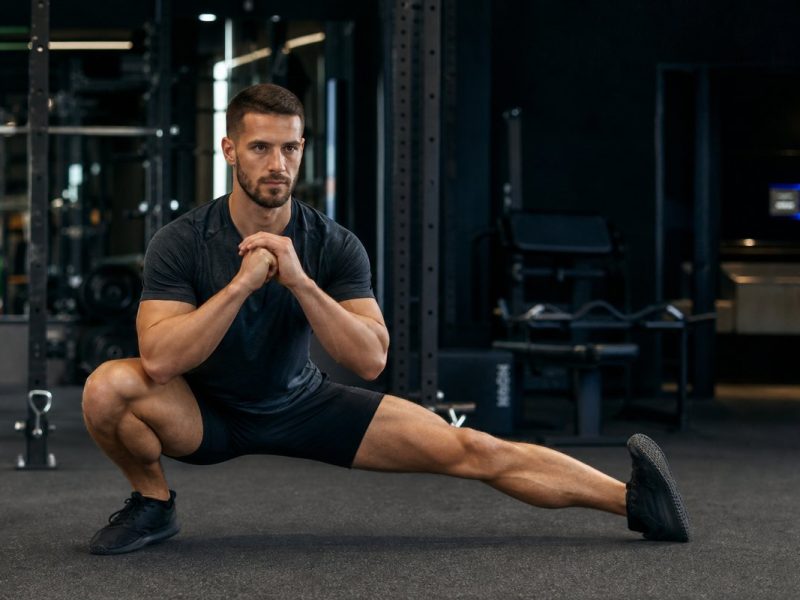

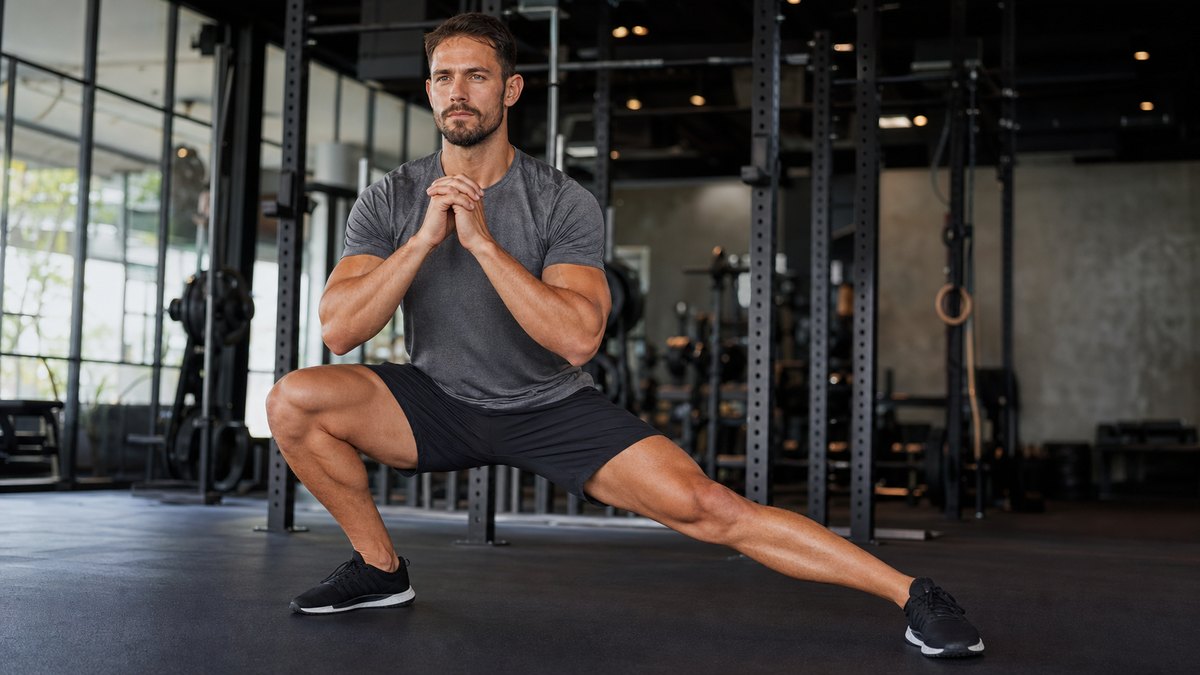
The lateral lunge steps to the side instead of forward. The sideways movement recruits the adductors and outer hip in ways forward-and-back lunges don’t. It’s excellent for hip mobility, ADL strength, and sports that require lateral cutting.
What it is
The lateral lunge is a unilateral lower-body exercise where the lifter steps to the side with one leg, sits the hip back into a side lunge with that leg bent and the other straight, then drives back to standing. It emphasises the adductors and glute medius.
Muscles worked
| Muscle | Contribution |
|---|---|
| Quads (bent leg) | ~30 % |
| Glutes, glute medius | ~30 % |
| Adductors (straight leg) | ~30 % |
| Hamstrings, core | ~10 % |
How to lateral lunge: 5 steps
-
Stand tall
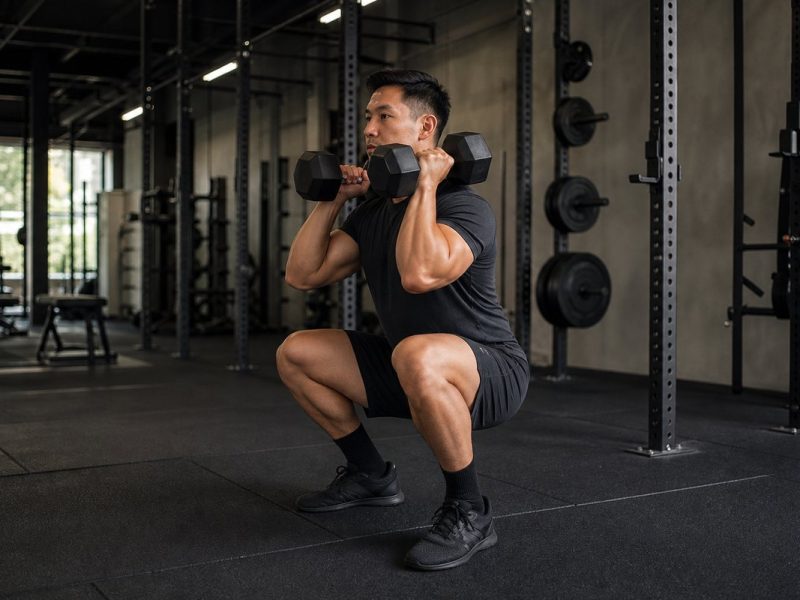
Feet hip-width, **dumbbells at sides** or in goblet position.
-
Step laterally
**Step wide to one side,** feet still facing forward.
-
Sit into lunge
**Sit hips back, bend the stepping leg,** other leg stays straight.
-
Bottom position
**Bent knee above ankle (vertical tibia),** feel adductor stretch on straight leg.
-
Drive back to standing
**Push through the bent leg** to return to start. Alternate sides.
How it differs from forward lunge
- Sideways step. Movement is in the frontal plane, not sagittal.
- Adductor engagement. The straight leg’s inner thigh stretches under load.
- Glute medius work. The bent leg’s lateral glute stabilises heavily.
- Requires hip mobility. Tight hips limit range.
Common mistakes
When to use this variation
Use lateral lunges for hip mobility, adductor development, and sports carryover for lateral cutting. Program 3 sets of 8-12 reps per leg. Excellent as a warm-up drill or accessory movement.
FAQ
How wide the step?
Wide enough that the working knee is above the ankle (tibia vertical). Usually 90-100 cm for most lifters.
Torso lean?
Slight forward lean at the hips is fine — helps balance. Don’t round the back.
Bodyweight or loaded?
Bodyweight for mobility work. Dumbbells or a goblet hold for strength/hypertrophy.
Related exercises
- Lunge: forward version
- Reverse Lunge: backward version
- Cossack Squat: deeper lateral variant
- Curtsy Lunge: crossed lateral variant
Published by: Martin Wood — Writer covering quad exercises
Reviewed, corrected and approved by: Martin Wood — Editor-in-chief
Updated on July 21, 2026