
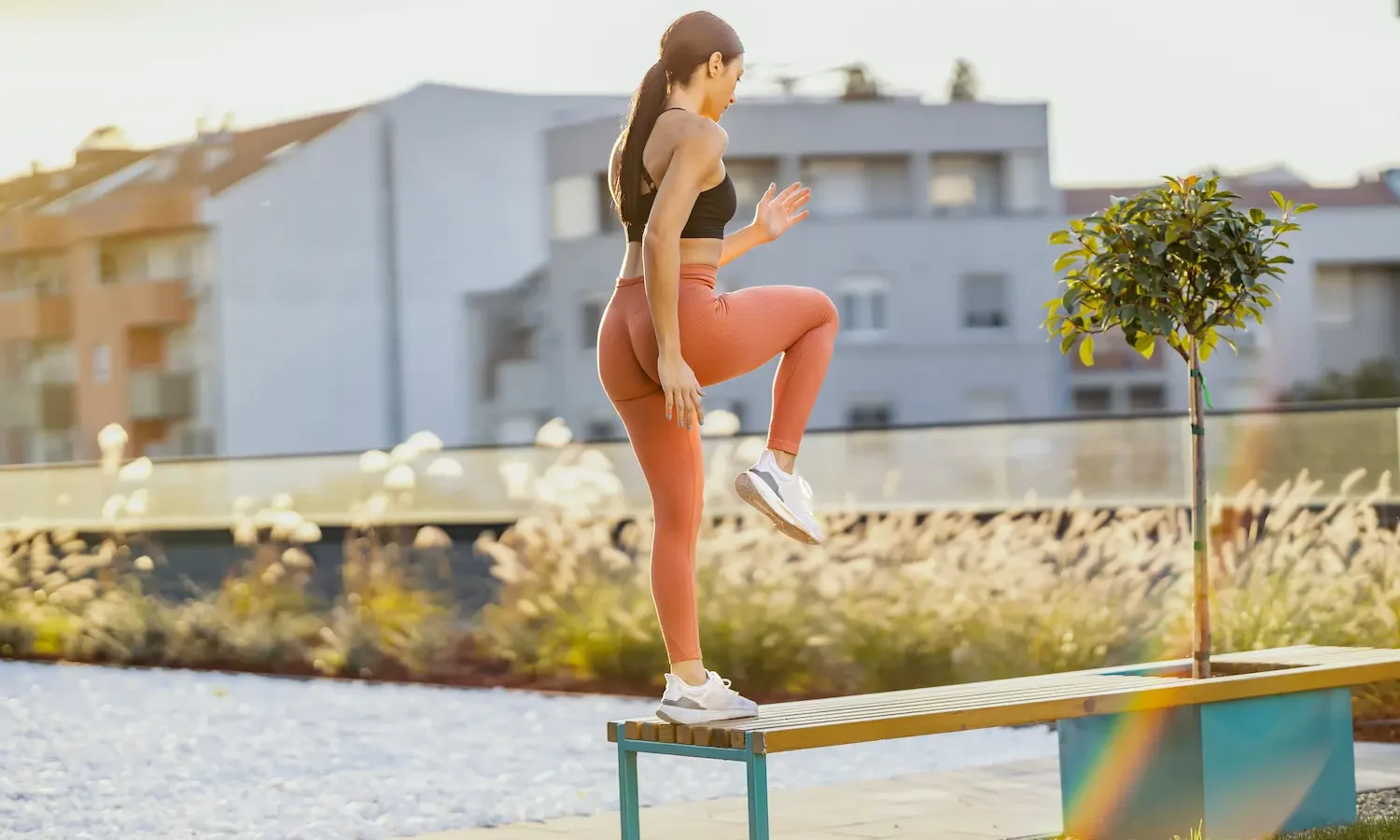
The step-up is the simplest, most effective unilateral leg exercise nobody does enough. Step onto a bench, drive up with one leg, step back down. That’s it. The exercise loads the quad and glute of the working leg with constant tension and forces single-leg balance — without the deep ROM and ankle mobility demand of a Bulgarian split squat.
For lifters with knee issues or limited mobility, the step-up is often the more comfortable unilateral leg option. For everyone else, it’s still excellent for athletic carryover — climbing, sprinting and any movement that requires single-leg force production.
What is the step-up?
The step-up is a unilateral lower-body exercise in which one foot is placed on a raised platform (bench, box, or step), and you drive up to standing on top of the platform by pushing through the front heel. The trailing leg lifts and lowers but does no work — all the load is on the working leg.
Box height matters: a low box (knee-height) trains the lift through a partial range with less hip flexion. A high box (mid-thigh height) demands more hip mobility and quad strength. For beginners, knee height. For intermediate, mid-thigh. Going much higher (above mid-thigh) starts demanding hip mobility most lifters don’t have.
Muscles worked
| Muscle group | Role | Contribution |
|---|---|---|
| Quadriceps (front leg) | Primary mover, knee extension | ~45 % |
| Glutes (front leg) | Hip extension | ~30 % |
| Hamstrings (front leg) | Hip extension support | ~10 % |
| Calves · Adductors · Core | Stabilisation, balance | ~15 % |
Like other unilateral exercises (lunge, Bulgarian split squat), the step-up exposes left-right asymmetries that bilateral squats hide. It also builds athletic carryover for stair climbing, sprinting and jumping.
How to step-up: 5 steps
-
Set up at the box
Stand in front of a sturdy bench or box (knee height for beginners). Hold dumbbells at your sides if loading. Stand tall, chest proud.
-
Place one foot on the box
Place the entire foot flat on the box — middle of the foot, not just toes. Knee tracks over the foot. Trailing leg stays on the floor.
-
Drive up through the front heel
Push through the **whole foot of the front leg** to drive your body up onto the box. **Don't push off the trailing leg.** The working leg does all the lifting.
-
Stand tall on the box
Top of the rep: both feet on the box, fully extended. Squeeze the glute of the working leg.
-
Lower with control
Step back down with the trailing leg first, then return to the start position. Slow descent — the working leg controls the eccentric. Switch legs (or alternate).
Common mistakes to avoid
Variations
- Dumbbell step-up. Holding two dumbbells at your sides. The standard loaded variant.
- Barbell step-up. Bar across the upper back. Allows much heavier loads but balance demand is higher.
- Lateral step-up. Stepping onto the box from the side. Bias glute medius and adductors.
- High-box step-up. Box at hip height. More demanding ROM, more glute. Advanced.
- Step-up with knee drive. At the top, drive the trailing knee up to hip height. Adds power and sport-specific carryover.
- Weighted vest step-up. Wearing a weighted vest. Frees the hands for balance.
Sample workout: 4-week unilateral block
Step-ups twice per week, on days you don’t squat heavy. Reps are per leg.
| Week | Sets × reps/leg | Load |
|---|---|---|
| 1 | 3 × 10 | Bodyweight |
| 2 | 3 × 10 | Light dumbbells (5-10 kg each) |
| 3 | 4 × 8 | Moderate dumbbells (12-20 kg each) |
| 4 (deload) | 3 × 8 | Bodyweight |
Frequently asked questions
How high should the box be?
For most lifters, knee height (about 45 cm). Higher boxes demand more hip flexion mobility — only go higher if your mobility allows. Going too high forces you to push off with the trailing leg, which defeats the purpose.
Step-up or lunge?
Both unilateral. Step-ups are gentler on the knees and emphasise the working leg with less hamstring stretch. Lunges have a stretching component (rear leg) that step-ups don’t. Use both.
Should I push off the trailing leg?
No — that defeats the purpose. **The working leg does all the lifting.** The trailing leg should hover or barely touch the floor for balance. If you have to push off, the box is too high or the load too heavy.
How heavy should I step up?
Start bodyweight. Build to 12-20 kg per dumbbell for 8-10 reps per leg. Heavier loads are possible but balance becomes the limiting factor before the legs do.
Why do my knees hurt during step-ups?
Either the box is too high (forcing excessive knee flexion) or you’re leaning forward (knee shoots past the toes). Lower the box or stand more upright.
Related exercises
- Lunge: dynamic unilateral
- Bulgarian Split Squat: hardest unilateral leg work
- Box Jump: explosive plyometric counterpart
- Squat: bilateral foundational lift
- Walking Lunge: continuous unilateral
Published by: Jay — Writer covering quad exercises
Reviewed, corrected and approved by: Martin Wood — Editor-in-chief
Updated on September 29, 2026