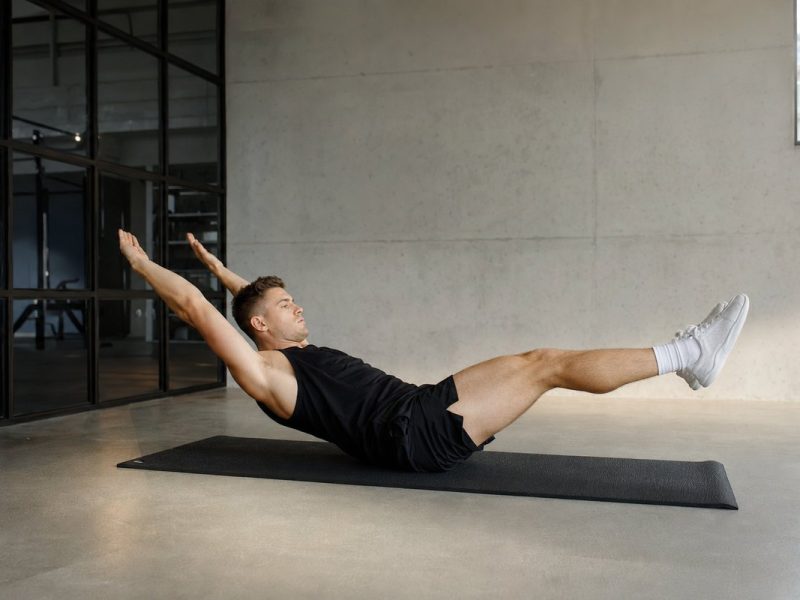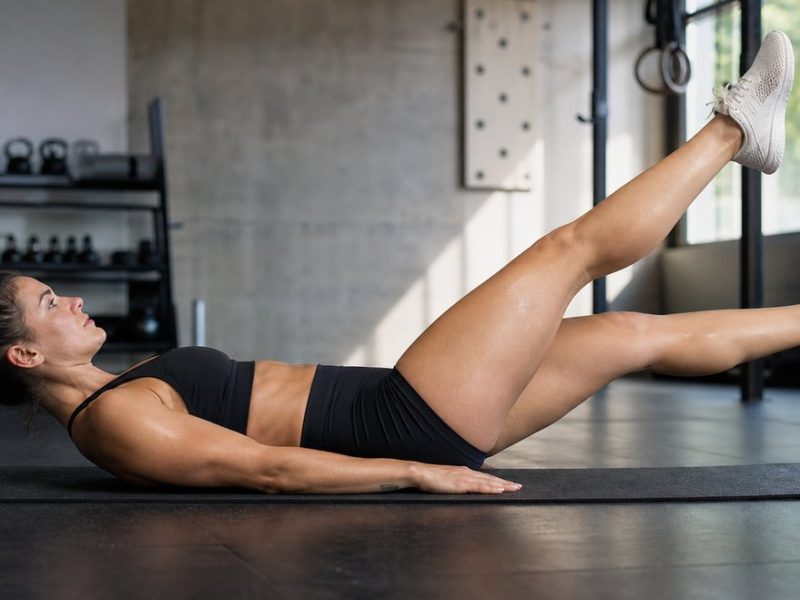

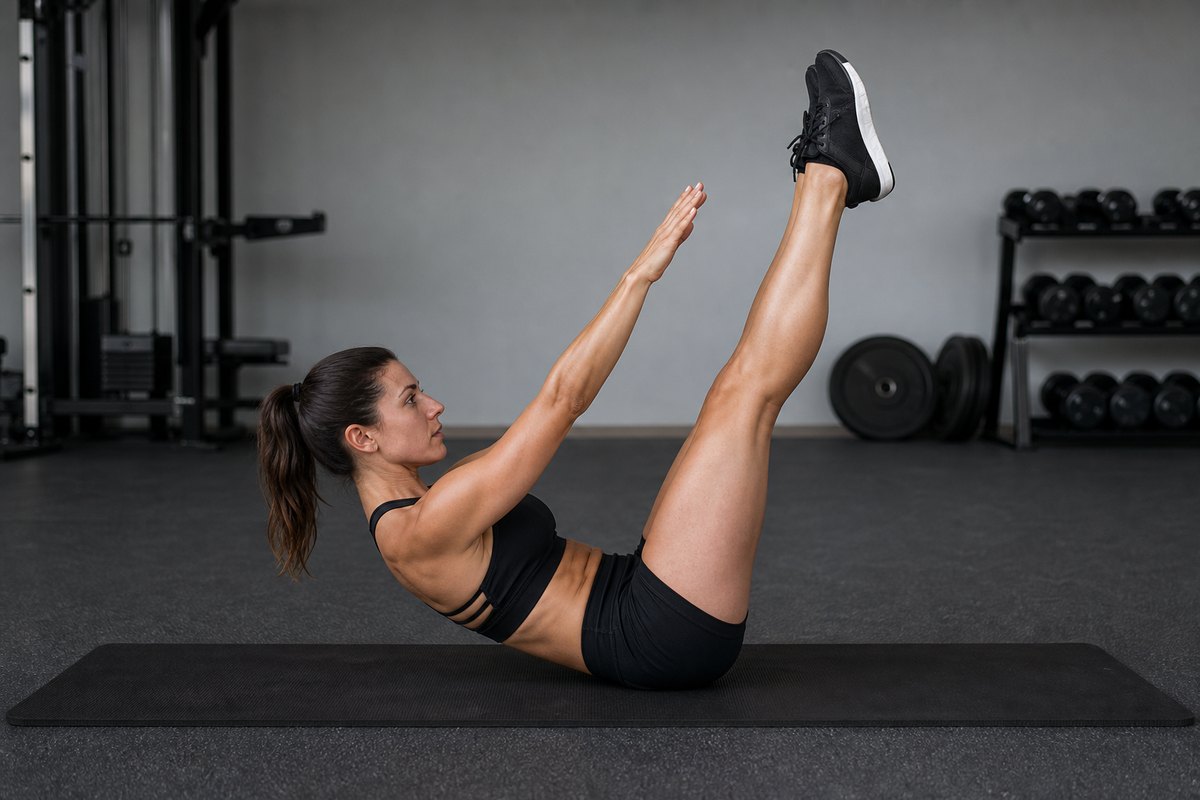
The V-up is a dynamic core exercise where the lifter, lying supine with arms overhead, simultaneously raises the torso and legs to meet in the middle in a V shape. It hits both the upper and lower abs in one movement — a favourite for high-rep conditioning.
What it is
The V-up is a full-range core exercise. Starting supine with arms extended overhead and legs straight on the floor, the lifter contracts the abs to lift both the upper and lower body simultaneously, meeting in the middle to form a V shape. Fingertips reach toward toes at the peak.
Muscles worked
| Muscle | Contribution |
|---|---|
| Rectus abdominis | ~55 % |
| Hip flexors | ~25 % |
| Obliques | ~15 % |
| Shoulders (stab) | ~5 % |
How to V-up: 5 steps
-
Lie supine extended
**Lie on back, arms extended overhead, legs straight.**
-
Brace
**Engage core, prepare for the lift.**
-
Lift into V
**Simultaneously lift torso and legs**, arms reach for toes.
-
Peak position
**Fingertips near toes, body forms V.**
-
Controlled descent
Lower back to starting position over 2 seconds.
How it differs from crunch
- Full-body motion. Crunch is upper-body only; V-up is both.
- Hip flexor involvement. Lifting the legs adds hip flexion demand.
- Bigger core engagement. Meeting in the middle requires higher core contraction.
- Balance component. Momentary balance on the sit bones adds control challenge.
Common mistakes
When to use this variation
Use V-ups as a core builder for high-rep sets or in metabolic conditioning circuits. Program 3 sets of 10-15 reps. Bodyweight is standard; advanced versions add a medicine ball or dumbbell.
FAQ
Fingertips touch toes?
Ideally yes. If flexibility is limited, aim for as high as possible with straight arms and legs.
V-up or sit-up?
V-up engages more musculature and is more athletic. Sit-up is easier but less complete.
Scaled version?
Tuck V-up: knees bend up as the torso comes up. Easier to execute for beginners.
Related exercises
- Crunch: upper-body version
- Hollow Rock: dynamic hollow position
- Reverse Crunch: lower-body version
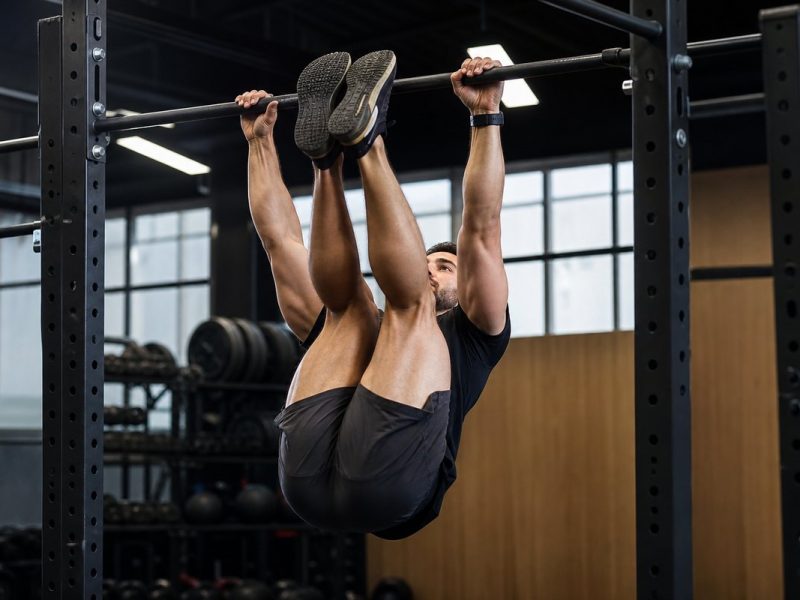
- Hanging Leg Raise: hanging equivalent