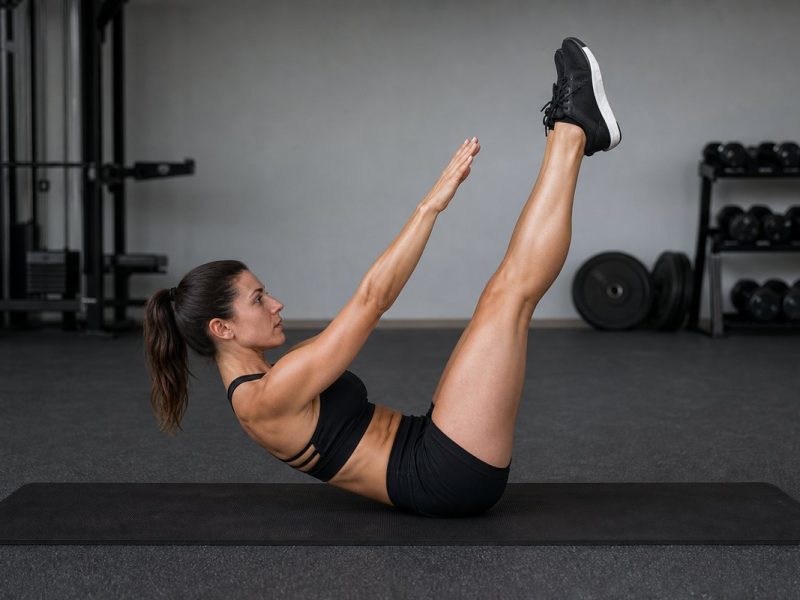

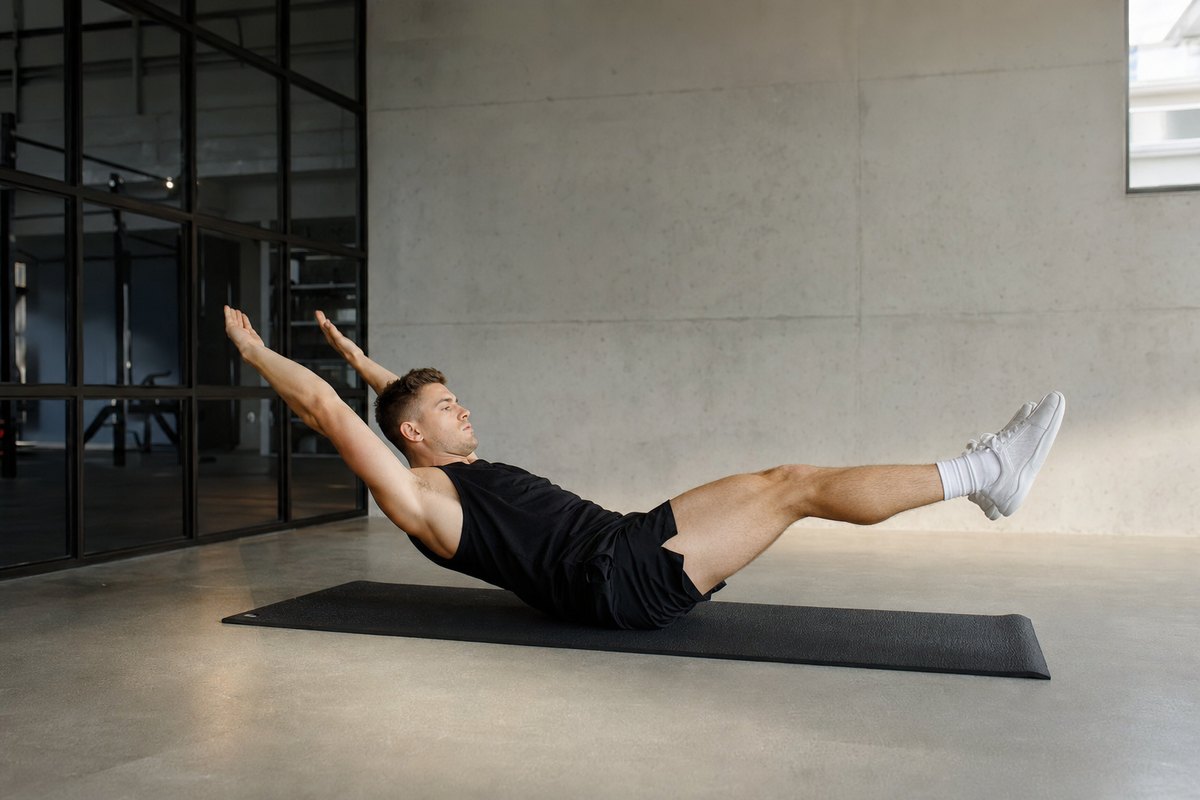
The hollow rock is the dynamic version of the hollow hold: from the banana-shape position, the lifter rocks gently back and forth on the lower back. The rocking maintains constant core tension while adding a rhythm challenge. Foundational gymnastic exercise for kipping pull-ups, toes to bar and more.
What it is
The hollow rock is a dynamic core exercise. Starting in the hollow hold position — supine, arms overhead, legs elevated, lower back pressed down — the lifter gently rocks back and forth along the length of the spine while maintaining the hollow shape. The rocking motion trains dynamic anti-extension.
Muscles worked
| Muscle | Contribution |
|---|---|
| Rectus abdominis | ~45 % |
| Hip flexors, quads | ~25 % |
| Obliques, transverse ab | ~20 % |
| Shoulders | ~10 % |
How to hollow rock: 5 steps
-
Set hollow position
**Supine, arms overhead, legs raised, lower back pressed to floor.**
-
Brace hard
**Core tight, glutes squeezed, hollow banana shape locked.**
-
Rock gently
**Rock back and forth along the spine** — small amplitude only.
-
Maintain shape
**Body shape doesn't change** — just the position on the floor.
-
Continue
Rhythmic rocking for target duration.
How it differs from hollow hold
- Dynamic rocking motion. Hollow hold is static.
- Rhythm and coordination. Requires timing to maintain shape.
- Trains kip mechanics. Foundational movement for gymnastic swings.
- Higher rep counts possible. Time-based sets (30-60 sec) rather than seconds of hold.
Common mistakes
When to use this variation
Use hollow rocks after mastering the hollow hold. Program 3 sets of 20-40 seconds. Prerequisite for kipping and gymnastic skills. Excellent daily gymnastic warm-up drill.
FAQ
How much to rock?
Small rocking — no more than a few degrees. Big swings break the shape.
Body shape breaking?
Reduce leverage: bend knees to tuck rock. Progress to full hollow rock as strength builds.
Hollow rock or hollow hold?
Learn hollow hold first, then progress to hollow rock. Both are useful; rocks add dynamic component.
Related exercises
- Hollow Hold: static prerequisite
- L-Sit: seated static core
- Kipping Pull-Up: uses hollow rock mechanic
- V-Up: dynamic full-range crunch
Published by: Martin Wood — Writer covering ab exercises
Reviewed, corrected and approved by: Martin Wood — Editor-in-chief
Updated on July 21, 2026