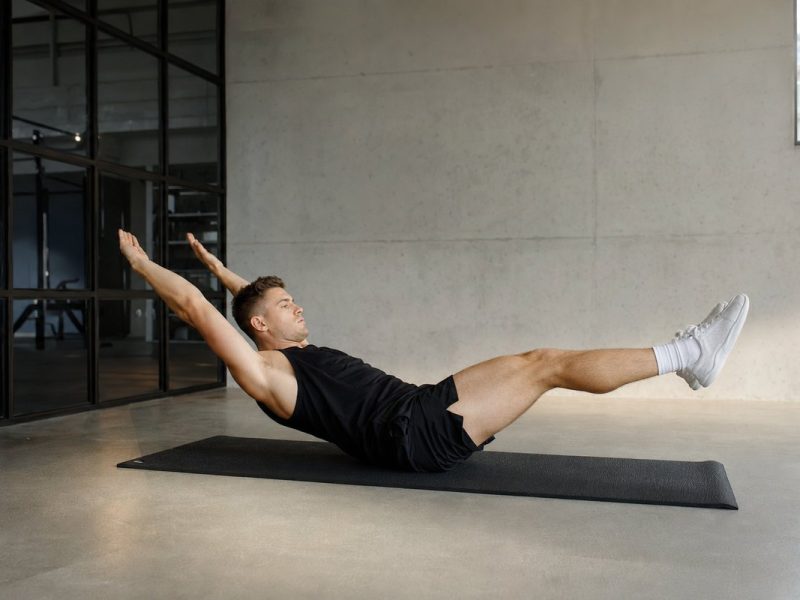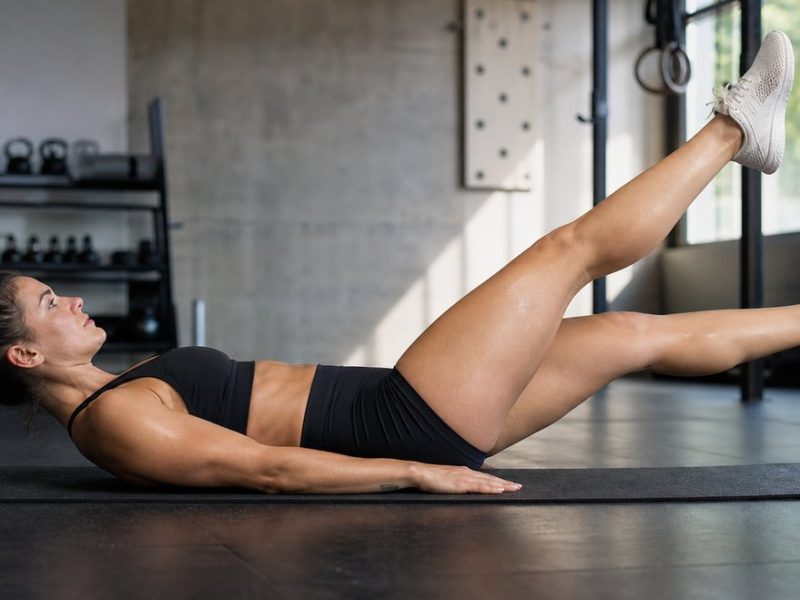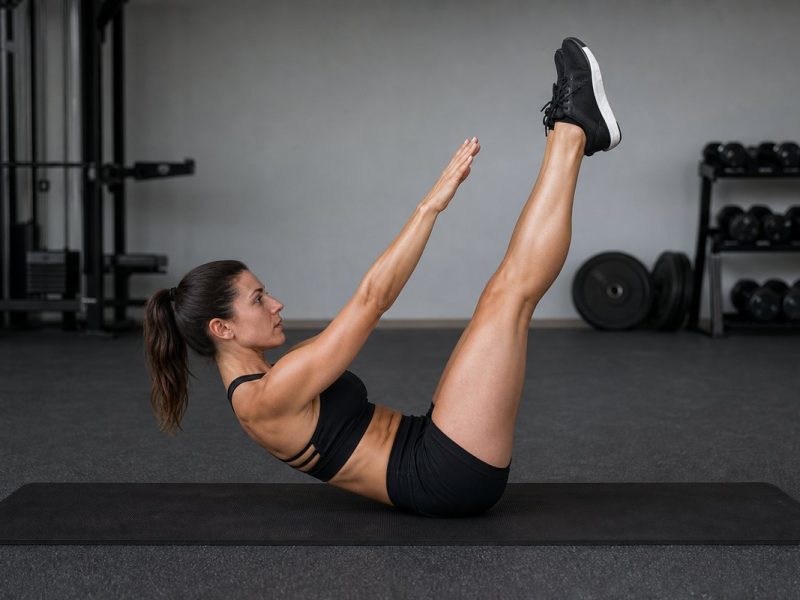

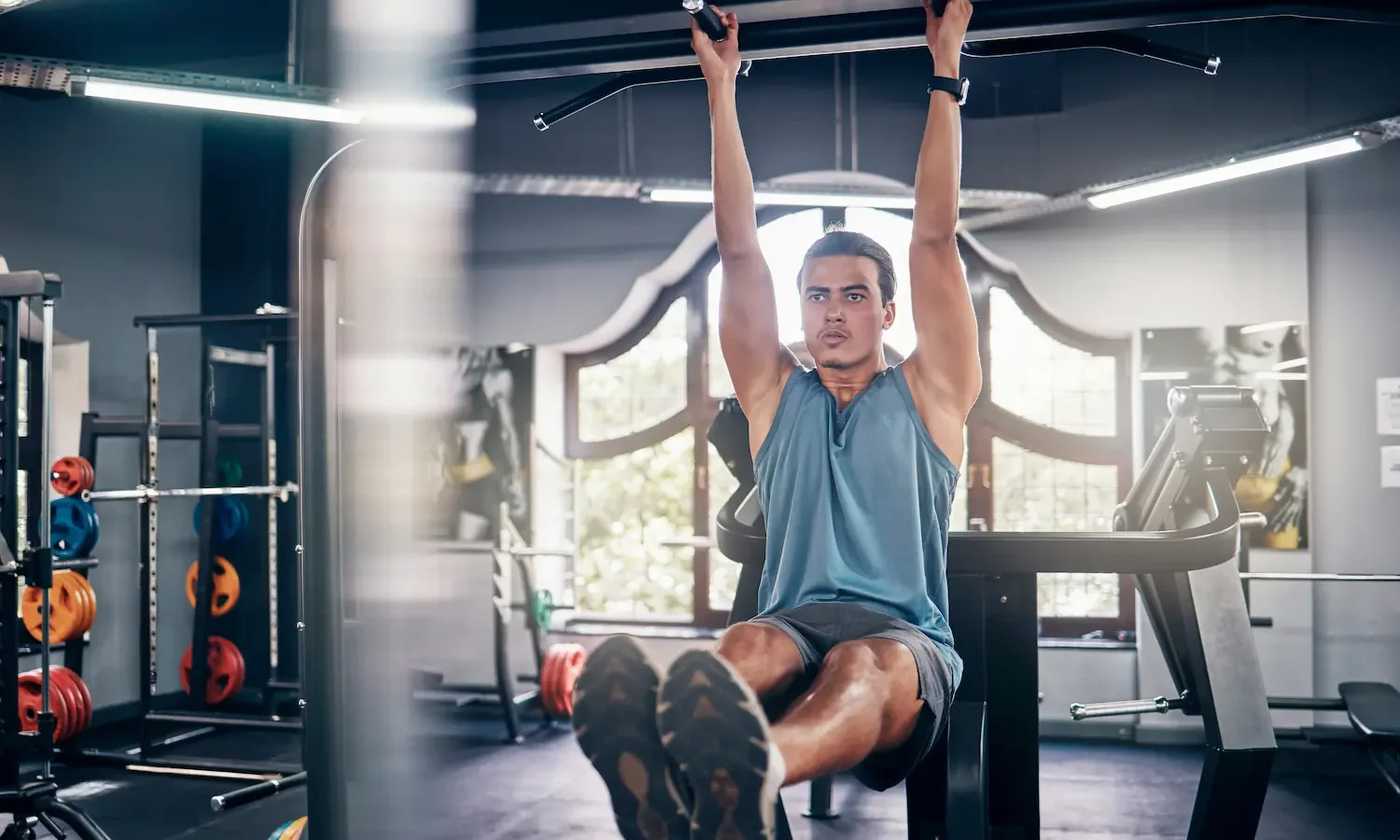
The hanging leg raise is the most demanding bodyweight ab exercise on earth. While the crunch trains the upper portion of the rectus abdominis and the plank trains anti-extension, the hanging leg raise hits the entire ab wall — particularly the lower abs that are notoriously hard to grow — under maximum load. It also brutalises the grip, the lats and the core stabilisers.
This guide covers the strict hanging leg raise. The version where people swing their legs up to the bar with momentum doesn’t count and won’t build abs. Strict means slow, controlled, no swing, full range. If you can do 10 strict hanging leg raises, you have a stronger core than nearly anyone in the gym.
What is the hanging leg raise?
The hanging leg raise is a dynamic ab exercise performed hanging from a pull-up bar, in which you raise your legs (straight or bent) from hanging to horizontal (90° at the hip) or beyond, then lower with control. The motion comes from the hips and the lower abs.
Several progressive variations exist. The easiest is the hanging knee raise (knees bent, raise to chest). The intermediate version is the straight-leg raise to 90° (legs straight, raise to horizontal). The advanced version is the toes-to-bar (raise the legs all the way until your toes touch the bar). Each step harder.
Muscles worked
| Muscle group | Role | Contribution |
|---|---|---|
| Rectus abdominis (especially lower abs) | Primary mover, spinal flexion | ~50 % |
| Hip flexors (iliopsoas) | Hip flexion | ~25 % |
| Obliques | Anti-rotation, stabilisation | ~15 % |
| Lats · Forearms · Grip | Holding the body still | ~10 % |
The hanging leg raise loads the lower abs better than nearly any other exercise. It also builds substantial grip strength as a bonus — many lifters can do hanging leg raises but their forearms give out before their abs do.
How to hanging leg raise: 5 steps
-
Set the dead hang
Jump up to a pull-up bar. Grip slightly wider than shoulder width, palms facing forward. Hang with arms fully extended. Engage the lats by pulling shoulder blades down and back (active hang). Body still — no swinging.
-
Brace the core
Pull the belly button toward the spine. Tilt the pelvis posteriorly (tuck the tailbone slightly under). Legs together, slight bend in the knees if doing the easier variant; legs fully straight for the standard version.
-
Raise the legs
**Curl the pelvis up** to bring the legs toward horizontal. Don't just lift the legs with the hip flexors — actively contract the abs. The motion comes from the lower core.
-
Pause at the top
Half-second pause at the top with the legs at 90° (parallel to the floor) or higher. Squeeze the abs hard. Don't bounce.
-
Lower in 2-3 seconds
Controlled descent. Don't let the legs drop. Resist gravity all the way back to the start. **No body swing** — if you swing, the next rep will use momentum, not muscle.
Common mistakes to avoid
Hanging leg raise variations
- Hanging knee raise. Knees bent, raise to chest. The beginner progression. Builds toward the straight-leg version.
- Captain’s chair leg raise. On a roman chair / captain’s chair (forearms supported). No grip demand — pure ab work.
- Toes-to-bar. Strict version raising the legs all the way to touch the bar. Brutal. The CrossFit favorite.
- Windshield wiper. From a hanging straight-leg raise position, rotate the legs side to side. Adds heavy oblique work.
- Dragon flag. Lying on a bench, supported only by the upper back, lift the entire body off horizontally. The “ultimate” ab exercise.
- L-sit. Static hold with legs raised to 90°. Isometric variation.
Progression to your first 10 strict hanging leg raises
If you can’t yet do 10 strict hanging leg raises, here’s the 4-week path. Train 2-3 times per week.
| Week | Exercise | Sets × reps |
|---|---|---|
| 1 | Hanging knee raise (slow) | 3 × 8 |
| 2 | Hanging knee raise + slow descent | 3 × 10 |
| 3 | Hanging straight-leg raise (slow) | 3 × 6 |
| 4 | Hanging straight-leg raise (target 8-10) | 3 × max |
Frequently asked questions
How many hanging leg raises is impressive?
10 strict reps is solid. 15+ is excellent. 20+ strict reps is rare. Anything past that, you’re probably swinging — slow down and re-test.
Why are my abs not sore but my hip flexors are?
You’re using the hip flexors to swing the legs up instead of contracting the abs to curl the pelvis. Try this: at the top of each rep, **tilt the pelvis posteriorly** (tuck the tailbone under) — that’s what activates the lower abs. The motion isn’t “lift the legs to horizontal”, it’s “tuck the pelvis up to meet the chest”.
My grip gives out before my abs — what should I do?
Three options. First, build grip strength with dead hangs and farmer’s carries. Second, use lifting straps to take the grip out of the equation. Third, switch to captain’s chair leg raises (forearms supported, no grip demand).
Hanging leg raise or crunch — which is better?
Both. Crunches train the upper rectus abdominis with high volume; hanging leg raises train the lower rectus abdominis with maximum load. Most balanced ab programs include both.
How often should I do hanging leg raises?
Twice a week is the sweet spot for most lifters. The exercise is intense and the abs need 48 hours to recover. More than that and you’ll plateau.
Related exercises
- Crunch: upper ab targeting
- Plank: anti-extension complement
- Hanging Knee Raise: easier progression
- Dragon Flag: ultimate advanced ab work
- L-Sit: isometric core hold
Published by: Jay — Writer covering ab exercises
Reviewed, corrected and approved by: Martin Wood — Editor-in-chief
Updated on September 29, 2026