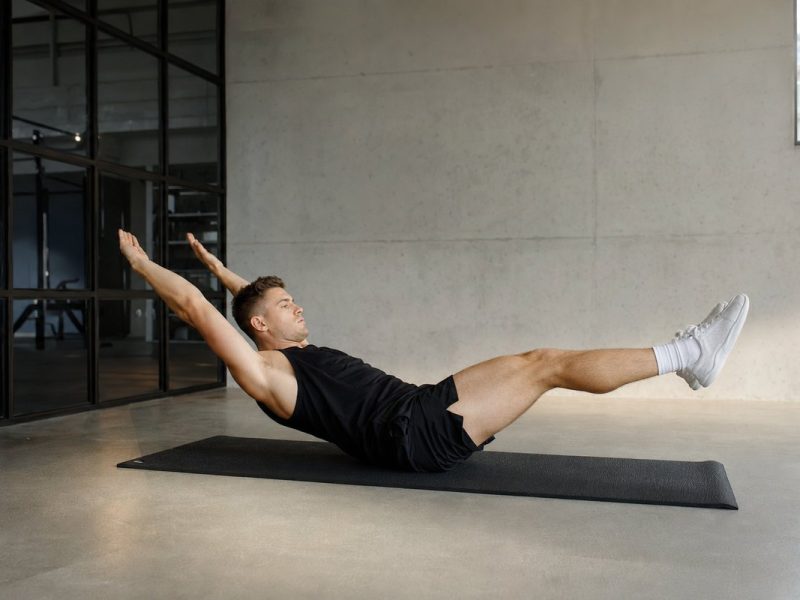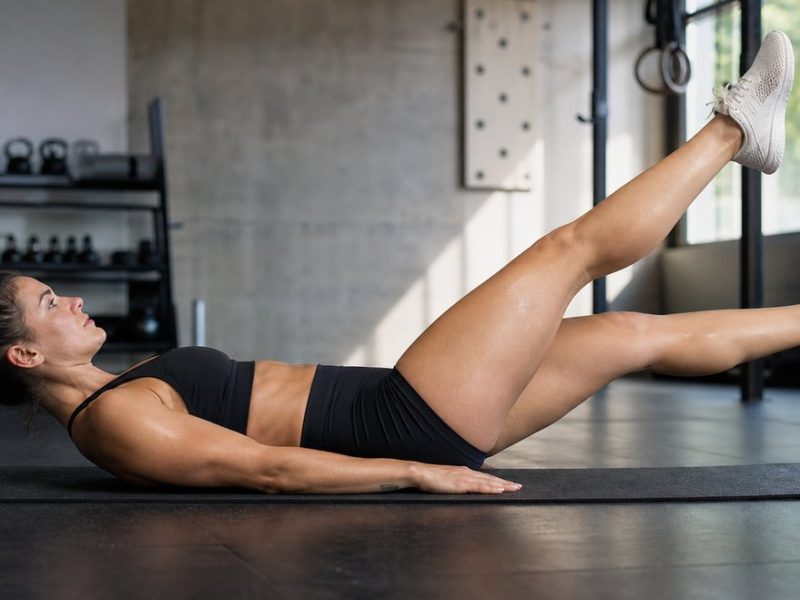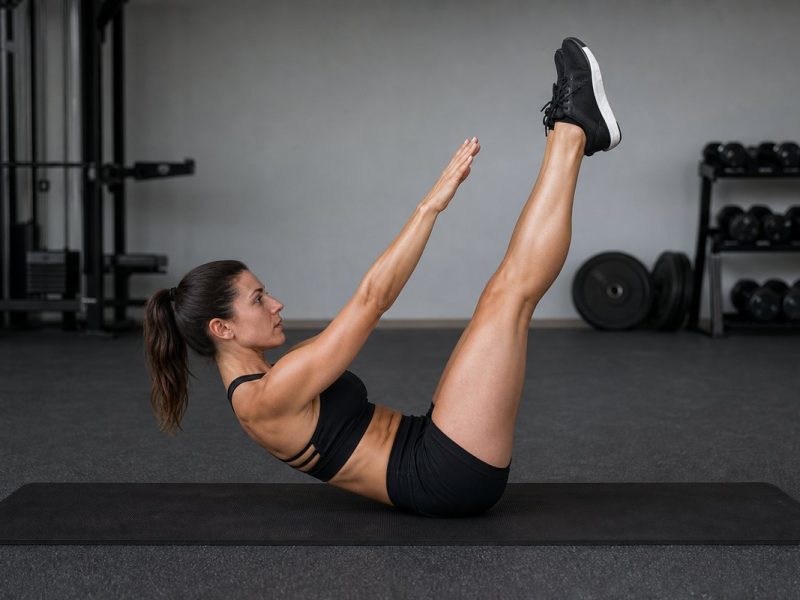

The crunch is the most maligned ab exercise in fitness — and not entirely without reason. Done badly, it produces neck pain, hip flexor strain, and zero visible abs. Done well, it’s an efficient targeted exercise for the rectus abdominis, the muscle responsible for the “six-pack” look.
The crunch isn’t a complete core workout — you also need anti-extension work like the plank and dynamic loading like the hanging leg raise. But within a balanced ab program, the crunch earns its place. This guide covers the strict version that actually works.
What is the crunch?
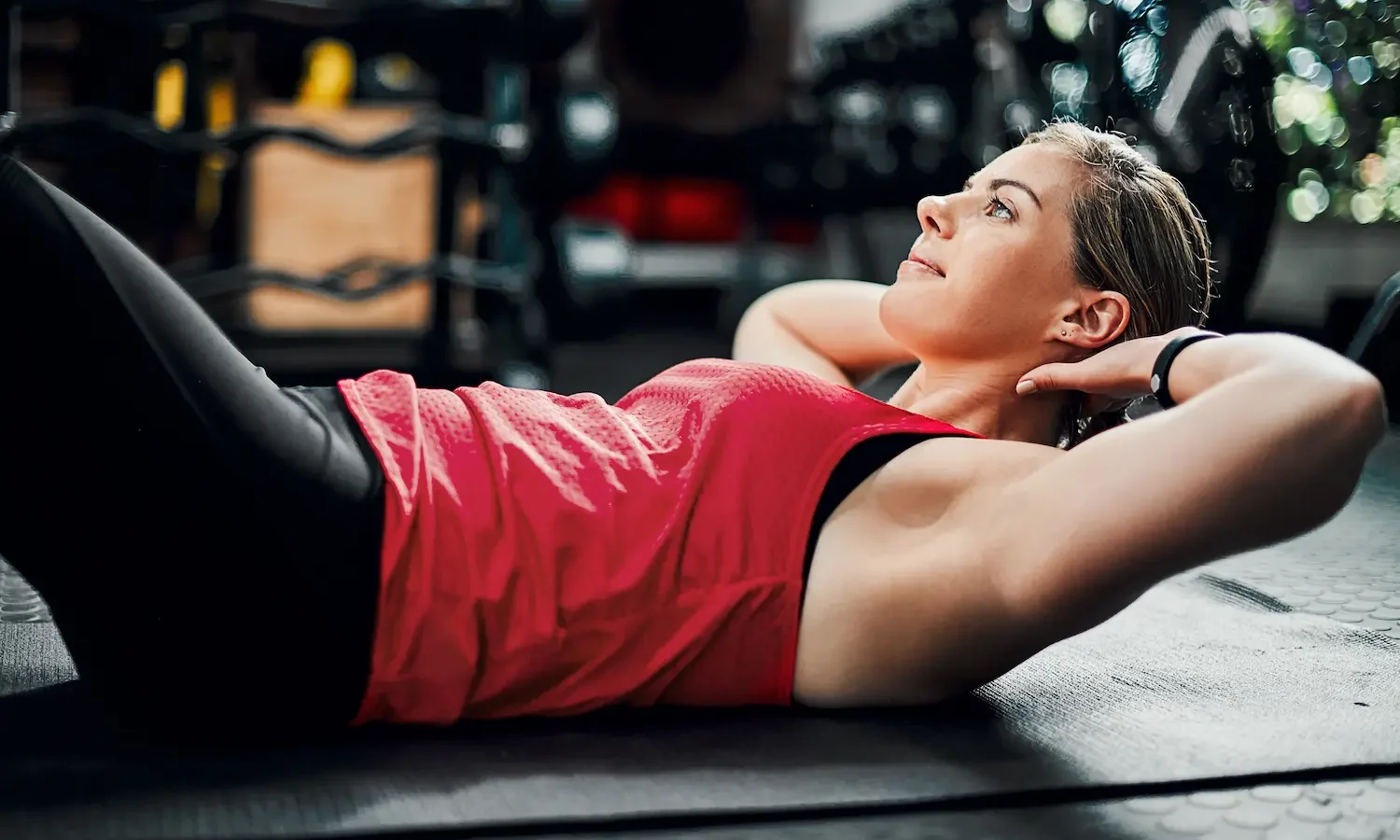
The crunch is a concentric ab exercise performed lying on your back with knees bent, in which you lift the head, neck and shoulders off the floor by contracting the abs — without lifting the lower back. The motion is short — about 30° of spinal flexion — and the goal is to feel the rectus abdominis squeeze.
The crunch differs from the sit-up. A sit-up brings the entire torso up to vertical, which mostly trains the hip flexors. A crunch keeps the lower back on the floor and trains only the abs. They look similar; they’re not the same exercise. Done well, the crunch is the strict version.
Muscles worked
| Muscle group | Role | Contribution |
|---|---|---|
| Rectus abdominis (front abs) | Primary mover, spinal flexion | ~80 % |
| Obliques | Stabilisation | ~15 % |
| Hip flexors | Stabilisation (minimal in strict crunch) | ~5 % |
The crunch isolates the rectus abdominis better than nearly any other exercise, especially in the upper portion (“upper abs”, though the muscle is technically one continuous unit). The lower abs are loaded primarily by leg raise variations.
How to crunch: 5 steps
-
Set the start position
Lie on your back on a mat. Knees bent at 90°, feet flat on the floor, hip-width apart. Hands gently behind the head — fingertips just touching the skull, not gripping.
-
Brace the core
Pull the belly button toward the spine. Lower back stays in contact with the floor throughout the rep — this is the most important cue.
-
Crunch up using the abs
Lift the head, neck and shoulders off the floor by **contracting the abs** — feel the rectus abdominis squeeze. Don't pull with the hands. Range of motion is small (about 30°), not a full sit-up.
-
Pause at the top
Half-second pause, abs fully contracted. Hold a "soccer ball under the chin" position to keep the neck neutral.
-
Lower in 2 seconds
Controlled descent. Don't crash the head back to the floor — control the eccentric. Reset, repeat.
Common mistakes to avoid
Crunch variations
- Decline crunch. On a decline bench, head down. Greater range of motion at the bottom for stretch.
- Cable crunch. Kneeling at a high cable with rope handle. Allows progressive loading — the only way to make crunches significantly harder.
- Bicycle crunch. Alternating elbow-to-opposite-knee. Hits the obliques alongside the rectus.
- Swiss ball crunch. Lying on a stability ball. Greater range of motion at the bottom (slight back extension), more demanding on stabilisation.
- Reverse crunch. Hips lifted off the floor, knees toward chest. Targets the lower portion of the rectus abdominis.
- Weighted crunch. Plate held on the chest. Adds resistance once bodyweight crunches feel easy.
Sample workout: 4-week ab block
Crunches 3 times per week as one of several ab exercises. Pair with planks for anti-extension and hanging leg raises for dynamic.
| Week | Sets × reps | Tempo |
|---|---|---|
| 1 | 3 × 15 | 2 sec eccentric |
| 2 | 3 × 18 | 2 sec eccentric + 1 sec pause at top |
| 3 | 4 × 15 | 3 sec eccentric + 1 sec pause |
| 4 (deload) | 3 × 12 | Smooth |
Frequently asked questions
Will crunches give me visible abs?
No — abs become visible at low body fat percentages, not from doing more crunches. Crunches build the muscle (which makes the six-pack thicker once visible), but the abs only show through if your body fat is around 10-12 % for men, 18-20 % for women. Diet does the showing; exercise does the building.
How many crunches should I do?
3-5 sets of 12-20 reps, 2-3 times per week. Doing 100 crunches a day doesn’t build abs faster — it builds endurance you don’t need. Once 20 strict reps feels easy, add load (weighted crunch, cable crunch).
Why does my neck hurt during crunches?
You’re pulling on it with your hands. Hands belong gently behind the head — they don’t lift you. Lift with the abs alone. Pretend you have a soccer ball under your chin throughout the rep.
Crunch or sit-up — which is better?
Crunch. Sit-ups bring the lower back off the floor, which heavily recruits the hip flexors and reduces ab isolation. Most fitness research finds crunches superior for ab development specifically.
Are crunches bad for my back?
Some research suggests repeated spinal flexion under load can stress the discs. For most healthy adults at moderate volume, this isn’t a problem. If you have existing back issues, replace crunches with anti-extension work (plank, dead bug) and ask a physio.
Related exercises
- Plank: anti-extension complement
- Hanging Leg Raise: dynamic ab loading
- Cable Crunch: progressive loading version
- Bicycle Crunch: oblique-emphasised variant
- Dead Bug: back-friendly anti-extension
Published by: Jay — Writer covering ab exercises
Reviewed, corrected and approved by: Martin Wood — Editor-in-chief
Updated on May 8, 2026