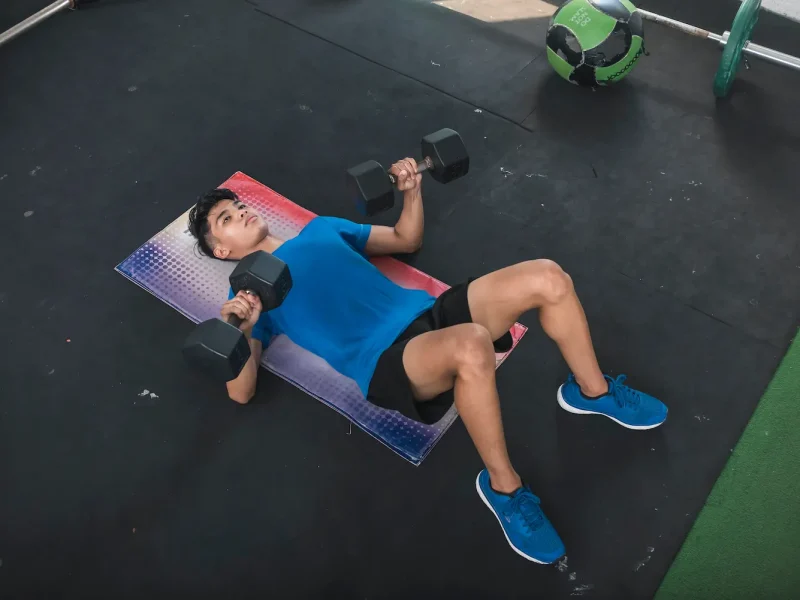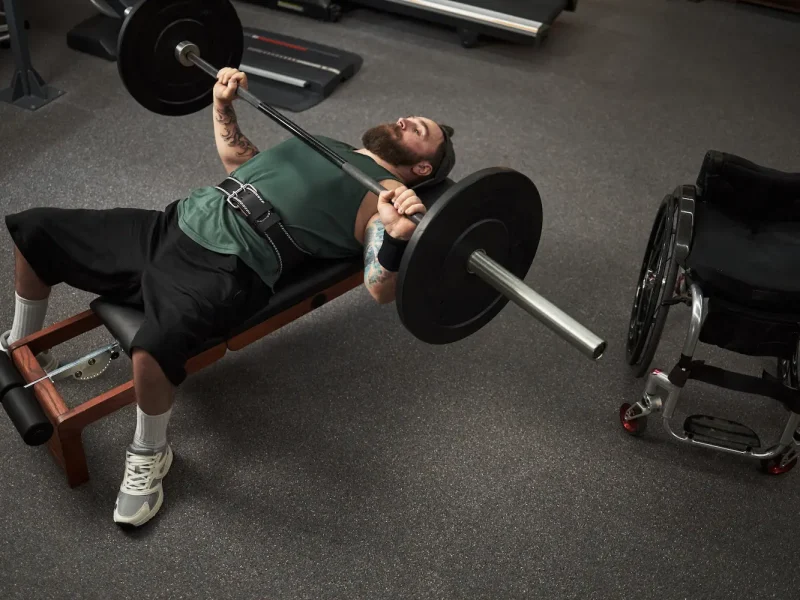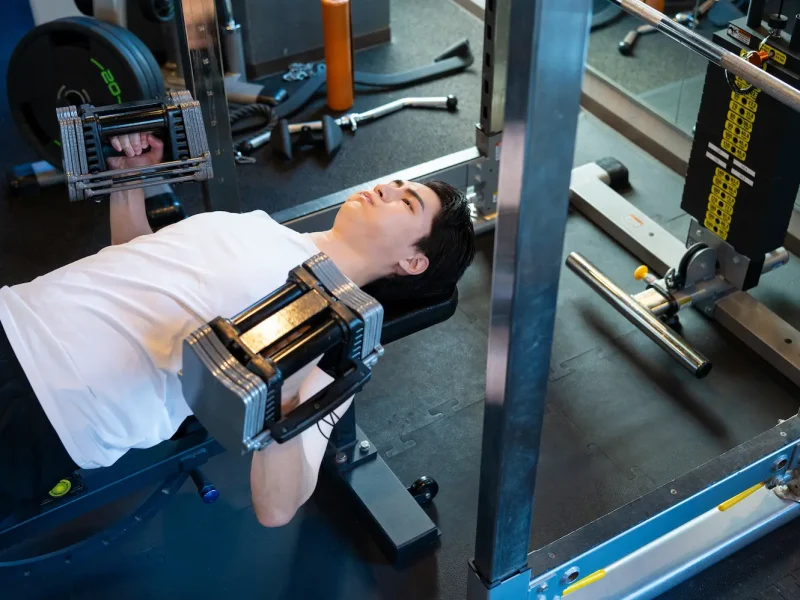

The board press is the bench press with a wooden board (typically 1-3 boards stacked, about 2-7 cm thick) resting on the chest. The board limits the bar’s descent — the lifter touches the board, pauses, then presses back up. The truncated range emphasises the lockout half of the press, the same way the floor press does, but at any depth from “just below standard touch point” to “almost at lockout”.
What it is
The board press is a bench press variation where 1-5 wooden boards (typically 2×4 or 2×6 lumber, stacked together) rest on the lifter’s chest. A spotter or training partner holds the boards in place, or the boards are strapped to a harness on the chest. The lifter presses normally — bar touches the boards (not the chest), pauses, then presses back up. The number of boards determines how much range is cut.
Muscles worked
| Muscle | Contribution |
|---|---|
| Triceps brachii | ~40 % |
| Pectoralis major | ~30 % |
| Anterior deltoid | ~15 % |
| Lats, traps, core | ~15 % |
How to board press: 5 steps
-
Set up the boards
Choose your board count (1-5). Have a training partner hold the boards in place on your chest, or attach a board harness. Bar loaded in the rack at standard height.
-
Get tight on the bench
Lie on the bench, retract scapulae, slight arch, feet planted. Grip slightly wider than shoulder-width. **Brace the core.**
-
Lower the bar to the boards
Lower the bar in 2-3 seconds — **touch the boards lightly**, no crashing. Maintain full body tension. Don't push the boards into the chest.
-
Pause on the boards
**1-2 second pause** with the bar resting lightly on the boards. Maintain shoulder retraction. No bouncing.
-
Press to lockout
**Drive the bar straight up** to full elbow extension. Lock out, reset breath, lower for the next rep. Have the partner remove/replace boards smoothly.
How it differs from bench press
- Adjustable range limitation. Number of boards controls how much range is cut — 1 board = small cut (about 5 cm), 3 boards = significant cut (about 15 cm), 5 boards = near-lockout-only work.
- Triceps emphasis grows with board count. More boards = more triceps, less chest. 1 board is essentially chest-touch with a slight pause; 3-5 boards is pure triceps lockout work.
- Allows heavier loads than standard bench. Most lifters can board press 10-25 % more than their full bench, depending on board count. Useful for overloading the upper portion of the press.
- Requires a partner or harness. Without a partner holding the boards or a chest harness, the boards fall off mid-set. Less convenient than other variations.
Common mistakes
When to use this variation
Use the board press when your bench press misses 5-15 cm above the chest (the classic sticking point), when you want to overload your bench with heavier-than-1RM weights at limited range, or as a triceps-emphasis accessory. The board press is a staple of geared powerlifting training; raw lifters use 1-2 boards mostly for sticking-point work.
FAQ
How many boards should I use?
Depends on your sticking point. 1 board (~5 cm above chest) trains the just-off-chest position. 2-3 boards trains the mid-press region. 4-5 boards is for lockout strength. Match the board count to where your bench fails on heavy attempts.
Board press or pin press?
Both train top-half strength. Pin press uses safety pins, allows full release on the pins. Board press uses chest boards, includes the eccentric down to the boards. Pin press is more strict, board press feels more like a bench press with limited range. Either works.
Can I board press alone?
With a chest harness (specialised equipment), yes. Otherwise no — a partner has to hold the boards in place. Without help, switch to pin presses or floor presses for similar training effects.
Related exercises
- Bench Press: full-ROM standard
- Pin Bench Press: pin-supported variant
- Floor Press: range-limited variant
- Close-Grip Bench Press: triceps emphasis