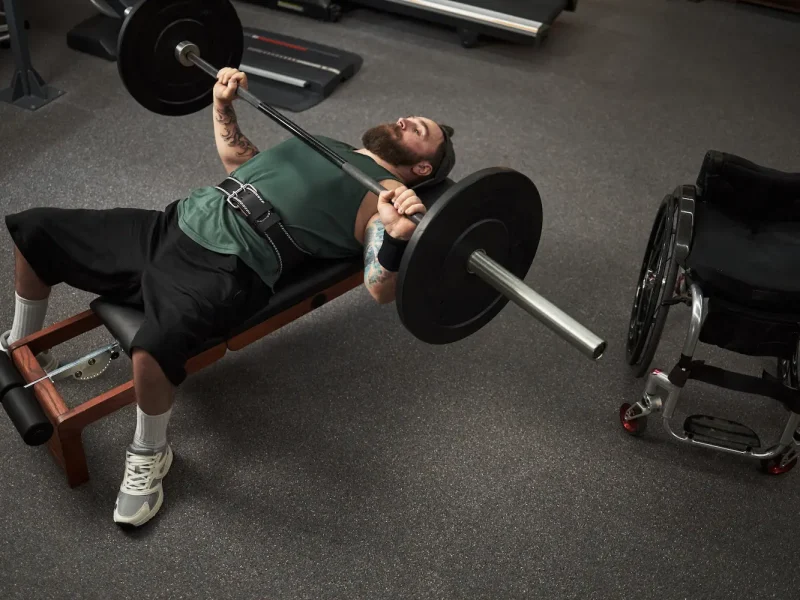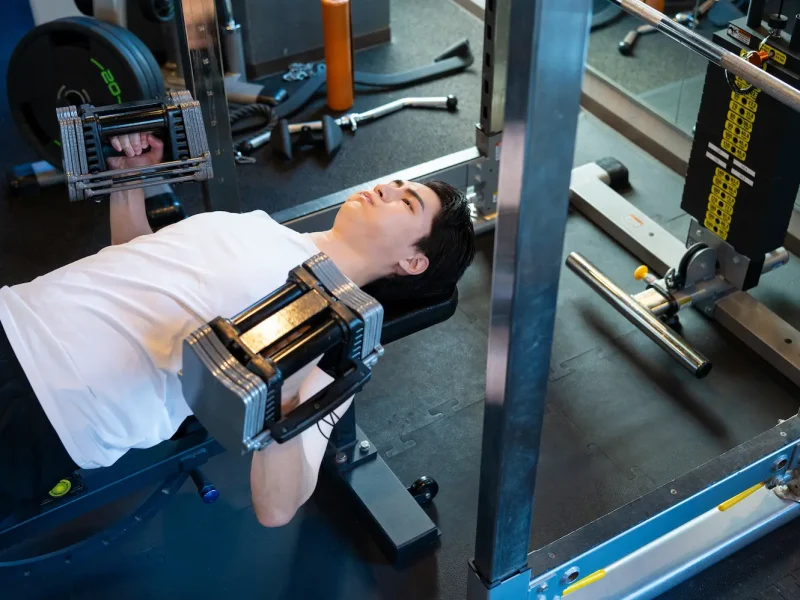

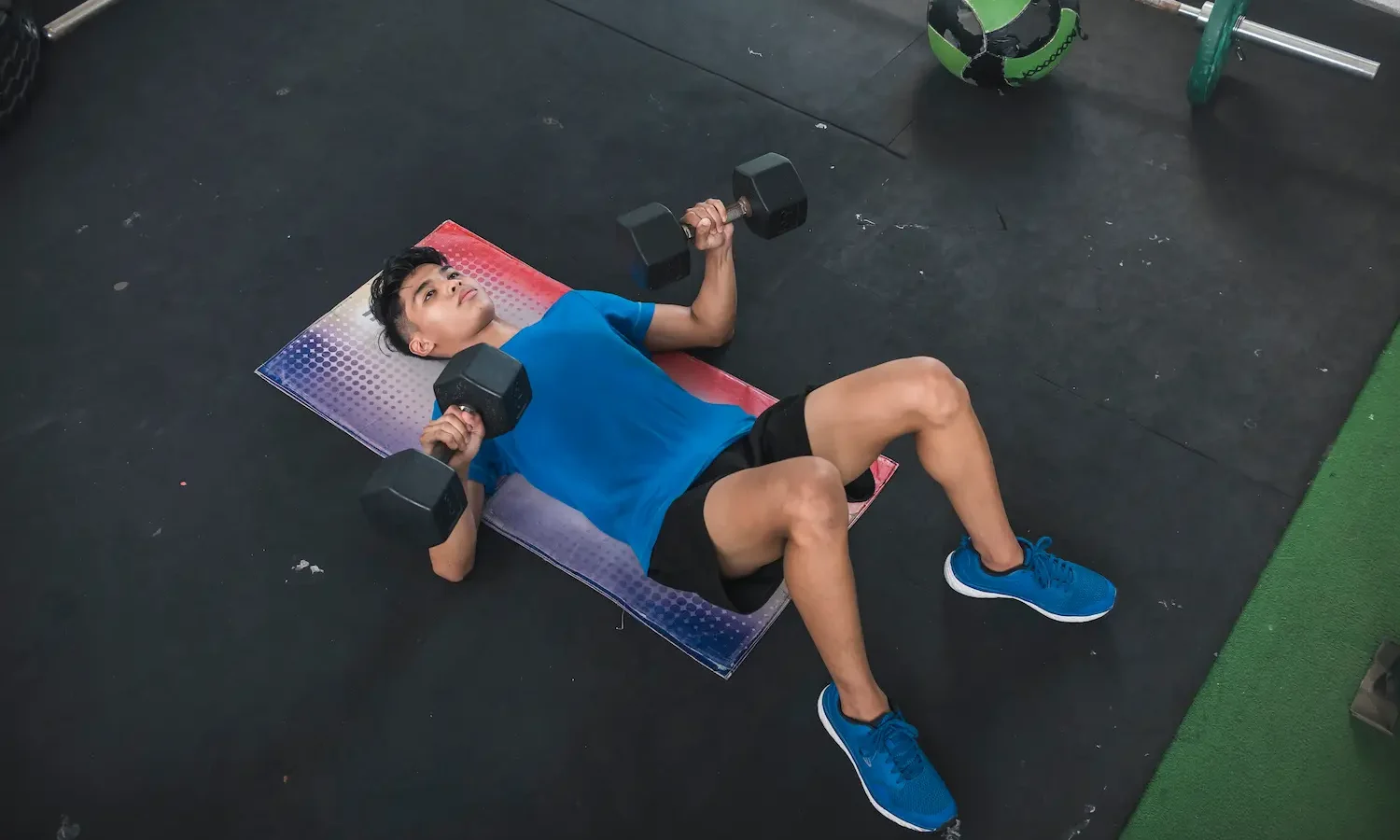
The dumbbell floor press is the barbell floor press with dumbbells — limited bottom range (upper arms touch the floor) but with the independence and freedom of dumbbells. The combination delivers triceps emphasis + shoulder-friendly range + unilateral work all in one exercise. No bench required.
What it is
The dumbbell floor press is a chest pressing exercise performed lying on the floor with a dumbbell in each hand. The dumbbells are lowered until the **back of the upper arms touches the floor** — at that point, the elbows are at roughly 90° and the dumbbells are paused. From this dead-stop position, the dumbbells are pressed back up to lockout. Like the barbell floor press, the deepest part of the press range is cut off, emphasising the top half.
Muscles worked
| Muscle | Contribution |
|---|---|
| Triceps brachii | ~40 % |
| Pectoralis major | ~30 % |
| Anterior deltoid | ~15 % |
| Stabilisers, core | ~15 % |
How to dumbbell floor press: 5 steps
-
Get the dumbbells into position
Sit on the floor with the dumbbells on your thighs. **Roll back onto your back** while bringing both dumbbells up to shoulder height (knee assist). End with both dumbbells held above the chest.
-
Set the floor position
Back flat on the floor (or slight arch). **Brace the core**, retract scapulae. Knees either flat or bent at 90°.
-
Lower until upper arms touch the floor
Lower the dumbbells in 2-3 seconds. **Stop when the back of the upper arms touches the floor.** Elbows at roughly 90°. Touch lightly — no crashing.
-
Pause briefly on the floor
**1-2 second pause** with upper arms resting on the floor. Maintain shoulder retraction. No bouncing.
-
Press up to lockout
**Drive both dumbbells up** to lockout. Triceps lead the press. Lock out, lower for the next rep. To finish: bring dumbbells to chest, sit up using legs to roll back to thighs.
How it differs from barbell floor press
- Independent dumbbell paths. Each side moves freely — left-right asymmetries are exposed and trained equally.
- More stabiliser demand. Dumbbells require more shoulder stability than a fixed bar.
- Accessible without a rack. Just need dumbbells and floor — perfect for home gyms without a power rack.
- Lower load than barbell. Most lifters can floor press 70-80 % of their barbell floor press as combined dumbbell weight.
Common mistakes
When to use this variation
Use the dumbbell floor press for home-gym training without a bench, when your barbell floor press exposes left-right asymmetries, or as an accessory for triceps-emphasis chest work. Particularly useful for lifters returning from shoulder injuries — the limited range protects the joint, and dumbbells allow naturally varying paths.
FAQ
How heavy can I dumbbell floor press?
Most lifters use 70-80 % of their barbell floor-press total. So a barbell floor press of 100 kg = about 35-40 kg per dumbbell.
How do I get heavy dumbbells into position?
Sit on the floor with dumbbells on your thighs, then **roll back as you kick the dumbbells into position** — like getting into a heavy dumbbell bench. Lie back smoothly with both dumbbells held over the chest.
Dumbbell floor press or bench press?
Different uses. Dumbbell bench press = full ROM, more chest stretch. Dumbbell floor press = limited range, triceps emphasis, shoulder-friendly. Use bench press for chest mass, floor press for triceps mass and joint-saver work.
Related exercises
- Floor Press: barbell version
- Dumbbell Bench Press: full-ROM DB press
- Close-Grip Bench Press: barbell triceps emphasis
- Skull Crusher: triceps isolation
Published by: Jay — Writer covering chest exercises
Reviewed, corrected and approved by: Martin Wood — Editor-in-chief
Updated on September 29, 2026