
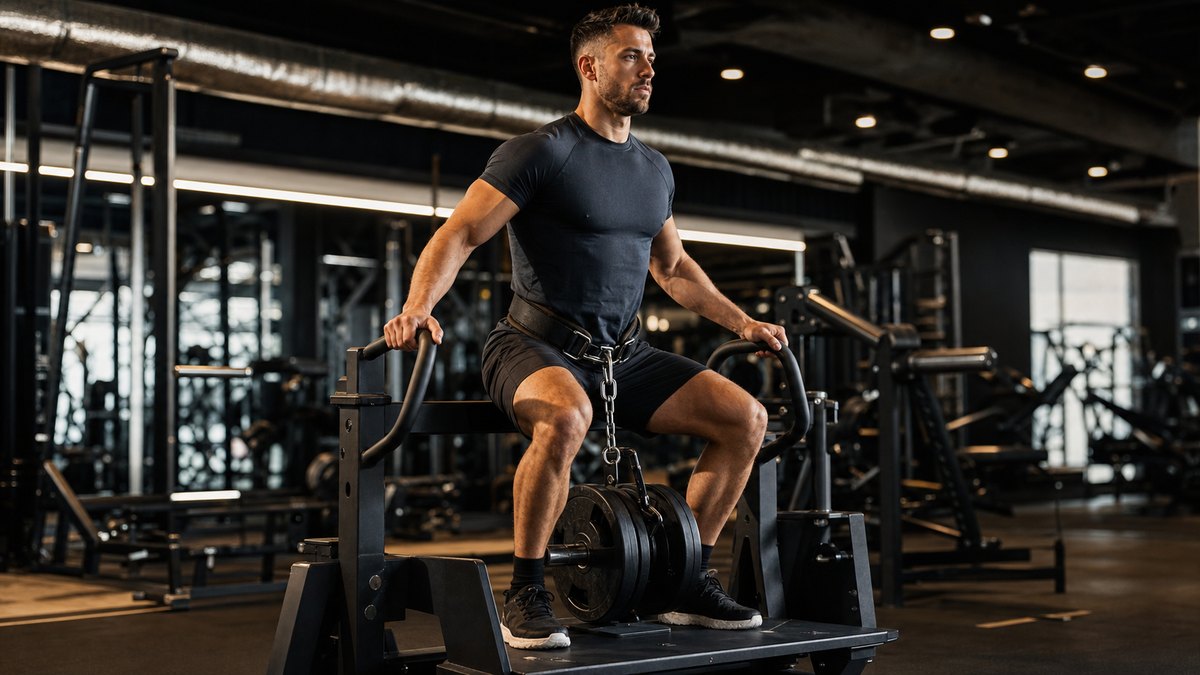
The belt squat loads the hips directly via a belt around the waist, with weights hanging from a strap. The spine bears no load, making it a favourite for lifters managing back issues or wanting to train legs without spinal fatigue.
What it is
The belt squat is a squat variation where the load is attached to a belt around the waist rather than resting on the shoulders or back. The lifter squats with the load pulling down from the belt, either using a specialised belt squat machine or a dip belt with plates suspended between the feet on a raised platform.
Muscles worked
| Muscle | Contribution |
|---|---|
| Quadriceps | ~50 % |
| Glutes, hamstrings | ~30 % |
| Adductors, calves | ~15 % |
| Core | ~5 % |
How to belt squat: 5 steps
-
Attach belt
Belt around waist, **load attached to belt** via strap or machine.
-
Set stance
Feet shoulder-width, **toes slightly out.**
-
Descend
**Squat down, hips back, knees track toes,** load pulls straight down.
-
Depth
**Hips crease below knees** or as low as mobility allows.
-
Drive up
Push through the floor, return to standing.
How it differs from back squat
- Load on hips, not back. Spine bears no compressive load.
- Back-friendlier. Ideal for lifters with lumbar issues.
- Same quad and glute work. Legs get essentially the same stimulus.
- Requires machine or belt setup. Not gym-universal.
Common mistakes
When to use this variation
Use belt squats when the lower back needs to recover but you still want leg work. Program 3-4 sets of 8-12 reps. Excellent for high-frequency leg training since it doesn’t tax the CNS as heavily as barbell squats.
FAQ
Machine or improvised setup?
A dedicated belt squat machine is best. Improvised: dip belt on a raised platform, plates hanging between the feet.
How heavy?
Belt squats often allow 20-30 % more weight than back squats — the spine doesn’t limit you.
Belt squat or leg press?
Belt squat has a more natural standing position and better carry-over to real-world movement. Leg press allows heavier absolute loads. Use both.
Related exercises
- Squat: back-loaded standard
- Leg Press: seated back-supported alternative
- Hack Squat: machine back-loaded
- Goblet Squat: front-loaded free weight
Published by: Martin Wood — Writer covering quad exercises
Reviewed, corrected and approved by: Martin Wood — Editor-in-chief
Updated on July 21, 2026