
The leg press is the squat without the squat. Same primary muscles — quads, glutes, hamstrings — but with the back supported, the bar replaced by a sled, and the balance demand removed. For lifters who want heavy quad volume without taxing the central nervous system the way the squat does, the leg press is the answer.
The leg press is also one of the most ego-loaded exercises in any gym. People stack 8 plates per side, do quarter-reps, and call themselves “strong”. Don’t be that person. This guide covers the strict full-range version that actually builds legs.
What is the leg press?
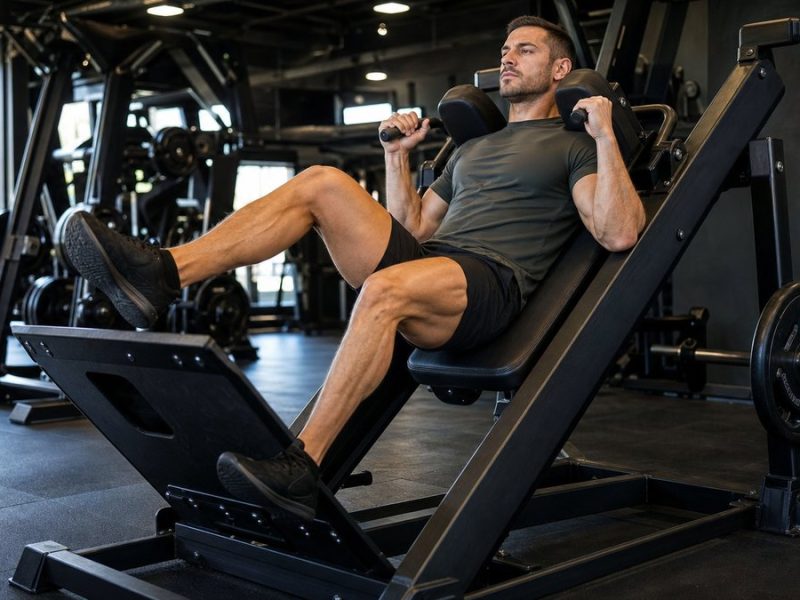
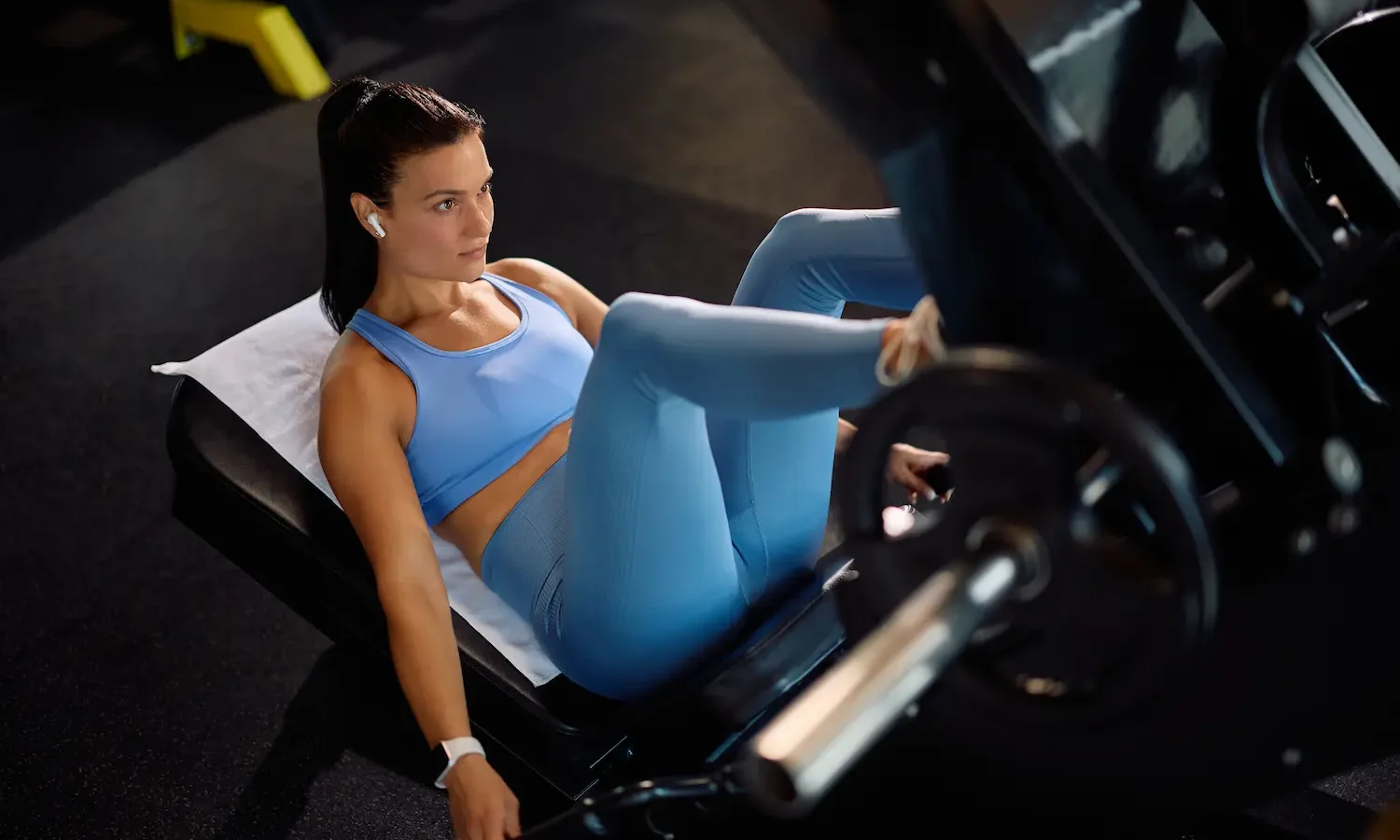
The leg press is a knee-extension exercise performed on a leg press machine, in which you sit (or recline) with your back supported, place your feet on a platform loaded with weight plates, and push the platform away by extending the knees and hips, then lower it back under control.
Two main machine types exist. The 45° leg press (most common in commercial gyms) has you reclining at 45° with the platform overhead. The horizontal leg press has you sitting upright with the platform in front. Both train the same pattern — choose what your gym has. This guide covers the 45° version.
Muscles worked
| Muscle group | Role | Contribution |
|---|---|---|
| Quadriceps | Primary mover, knee extension | ~55 % |
| Glutes | Hip extension | ~25 % |
| Hamstrings | Hip extension, knee stabilisation | ~15 % |
| Calves · Adductors | Stabilisation | ~5 % |
The leg press is more quad-dominant than the squat — the back support eliminates the need for postural muscles, and the load path biases knee extension. Foot position changes the muscle emphasis: feet high on the platform = more hamstring/glute; feet low = more quad; feet wide = more adductor/inner thigh.
How to leg press: 5 steps
-
Set up on the machine
Sit on the leg press machine with your back fully against the pad. Place feet on the platform shoulder-width apart, toes pointing slightly outward. Adjust seat so knees are at ~90° at the bottom of the rep.
-
Release the safety locks
Press the platform up slightly to relieve pressure, then release the safety handles to the side. Take a breath, brace the core.
-
Lower with control
Lower the platform in a 2-3 second controlled descent. **Lower back stays against the pad** — if it lifts, stop the descent. Knees track over the toes (don't let them cave inward).
-
Stop at depth
Stop when knees reach ~90° or just past. **Lower back must remain on the pad.** Brief turnaround at the bottom — no bounce.
-
Press up to soft lockout
Drive the platform up by extending knees and hips. **Soft lockout** at the top — knees nearly straight, not hyperextended. Reset breath, repeat.
Common mistakes to avoid
Variations
- Single-leg press. One foot on the platform, the other on the floor. Doubles the load, exposes asymmetries.
- High-foot leg press. Feet placed high on the platform. More glute and hamstring emphasis.
- Low-foot leg press. Feet low. More quad emphasis. Demanding on the knees — not for everyone.
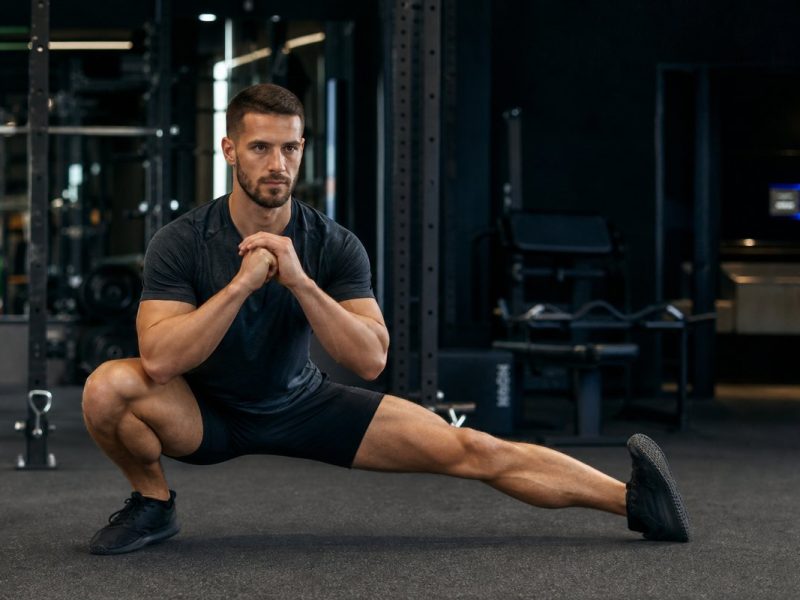
- Wide-foot leg press. Feet wider than shoulders. Bias inner thighs and glutes.
- Horizontal leg press. Seated upright machine variant. Same primary muscles, slightly different angle.
- Leg extension. Pure quad isolation alternative for high-rep work.
Sample workout: 4-week quad block
Leg press 1-2 times per week, after main squat / lunge work as a hypertrophy finisher.
| Week | Sets × reps | RPE |
|---|---|---|
| 1 | 3 × 12 | 7 |
| 2 | 4 × 10 | 7-8 |
| 3 | 4 × 8 + 1 dropset | 8-9 |
| 4 (deload) | 3 × 10 | 6 |
Frequently asked questions
Leg press or squat — which is better?
Different tools. The squat builds total-body strength, balance, and core. The leg press lets you load quads heavier without spinal stress. Most balanced lower-body programs include both.
How heavy should I leg press?
Most lifters can leg press 1.5-2.5 × their squat for the same reps because the back support and limited ROM make it easier per kilo. So if you squat 100 kg for 5, expect 150-250 kg leg press for 5. Don’t compare to other lifters — leg press numbers are inflated and meaningless across machines.
How deep should I go?
Until your knees are at about 90° (or slightly past) without your lower back lifting off the seat. Going too deep with the lower back rounding is the most common cause of disc injuries on the leg press. Stop the descent before that happens.
Why does my back hurt during leg press?
Almost certainly you’re going too deep and the lower back is rounding off the seat. Reduce the load, reduce the ROM, keep the lower back glued to the seat throughout. If the seat lifts you off, the weight is too heavy.
Should I lock out the knees at the top?
Soft lockout — knees nearly straight but not hyperextended. Hard lockout puts unnecessary strain on the knee joint. Stop just short of full extension and squeeze.
Related exercises
- Squat: foundational bilateral leg lift
- Hack Squat: machine quad-dominant
- Leg Extension: pure quad isolation
- Leg Curl: hamstring isolation complement
- Bulgarian Split Squat: unilateral leg work
Published by: Jay — Writer covering quad exercises
Reviewed, corrected and approved by: Martin Wood — Editor-in-chief
Updated on September 29, 2026