
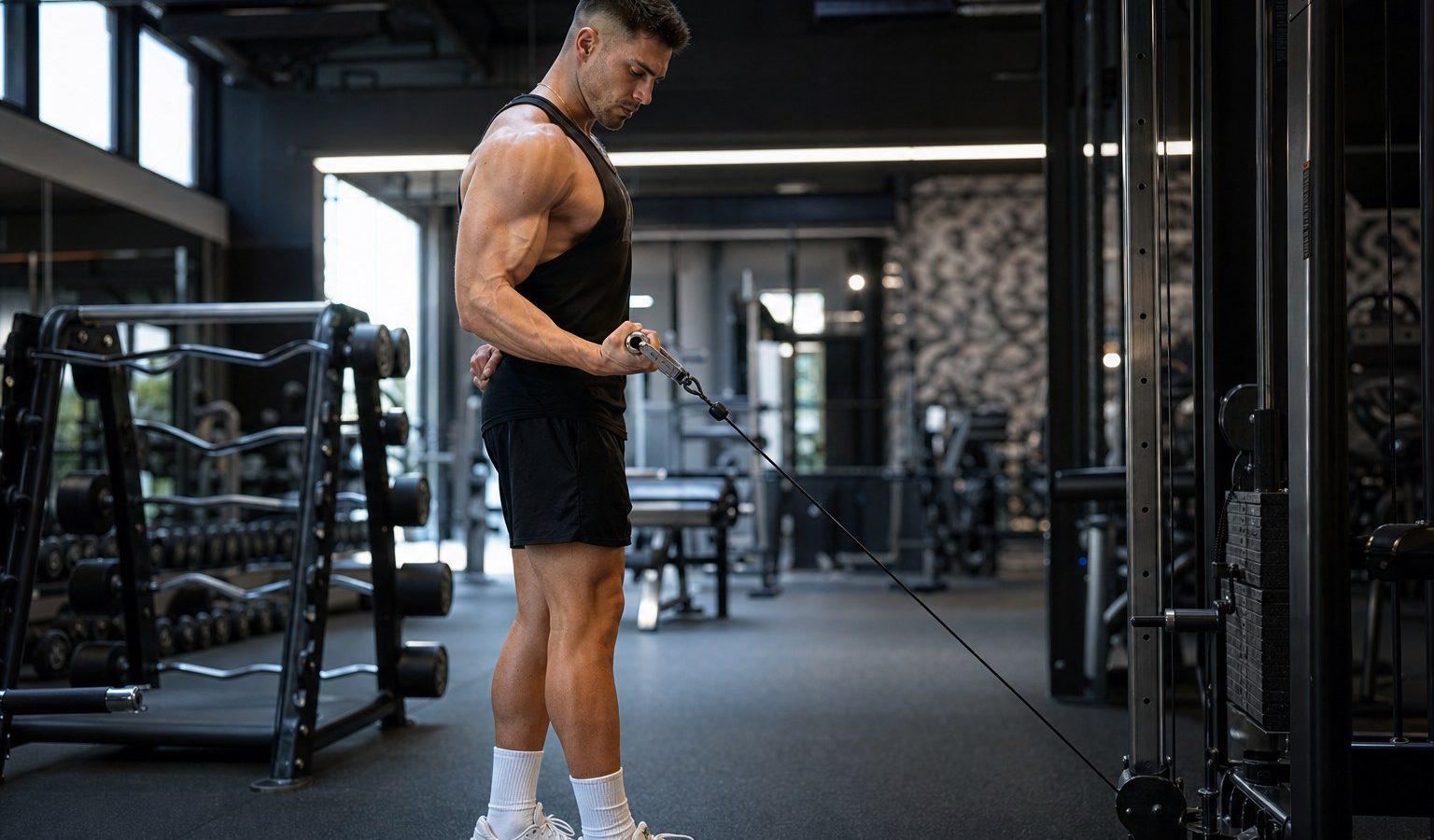
The Bayesian curl is a single-arm cable curl performed with the arm slightly behind the body. That behind-the-body setup is the whole point: it places the biceps in a stretched position at the shoulder while the cable keeps tension on the muscle from the bottom to the top of the rep.
For lifters searching for Bayesian curl, Bayesian cable curl or Bayesian curls, the key is not simply “doing a cable curl.” The exercise works best when the pulley is low, the shoulder stays extended, the elbow remains slightly behind the torso and the curl is controlled instead of turned into a front-delt swing.
What is a Bayesian curl?
The Bayesian curl is a cable curl variation where you stand a step in front of a low pulley, face away from the stack and let the working arm drift behind the body. From that stretched position, you curl a single handle forward and up while keeping the upper arm mostly fixed.
It is often compared with the incline dumbbell curl, because both place the shoulder in extension and stretch the long head of the biceps. The difference is resistance profile. A dumbbell depends on gravity, so tension changes a lot through the rep. A cable keeps pulling through the handle, which makes the Bayesian cable curl feel smoother and more constant.
Muscles worked
| Muscle | Role in the Bayesian curl |
|---|---|
| Biceps brachii long head | Main target because the arm starts behind the torso in a stretched shoulder position. |
| Biceps brachii short head | Assists elbow flexion throughout the curl. |
| Brachialis | Contributes to elbow flexion, especially in the middle of the rep. |
| Brachioradialis and forearms | Help stabilize the handle and wrist. |
| Rear delt and upper back | Light stabilization to keep the arm path controlled. |
The exercise is usually described as a long-head biceps movement because the long head crosses the shoulder joint. When the shoulder is extended behind the body, that head starts from a more lengthened position. This does not mean the short head is inactive; it means the setup gives the long head a stronger reason to work hard.
How to do a Bayesian cable curl
Use a single D-handle and a low pulley. Start lighter than you expect. The stretched bottom position is demanding, and the exercise loses its value if you compensate by twisting your torso or letting the elbow travel forward.
- Set the cable low. Attach a single handle to the lowest pulley setting.
- Step forward and face away. Stand far enough forward that the cable pulls your arm slightly behind your body.
- Set your shoulder and elbow. Keep the shoulder down, chest tall and elbow a little behind the torso.
- Curl without swinging. Bend the elbow and bring the handle forward/up while keeping the upper arm almost fixed.
- Control the stretch. Lower slowly until the biceps is stretched again, without letting the shoulder roll forward.
A useful cue is: let the cable stretch the biceps, then curl through the elbow — not through the shoulder. If your upper arm shoots forward on every rep, the movement becomes closer to a normal cable curl and loses the specific Bayesian curl benefit.
Best setup: pulley height, stance and cable angle
| Setup point | Best choice | Why it matters |
|---|---|---|
| Pulley height | Lowest setting | Creates a diagonal pull from behind and below, keeping tension in the stretched position. |
| Distance from stack | One to two steps forward | Enough to place the arm behind the torso without forcing the shoulder. |
| Torso angle | Mostly upright | Prevents turning the curl into a leaning row or shoulder swing. |
| Grip | Single D-handle | Lets the wrist rotate naturally and keeps the path clean. |
| Load | Moderate | Form and stretch matter more than max cable stack weight. |
Bayesian curl vs cable curl vs incline dumbbell curl
| Exercise | Main advantage | Best use |
|---|---|---|
| Bayesian curl | Long-head stretch plus constant cable tension | Hypertrophy-focused biceps work and finishing sets |
| Cable curl | Simple setup, stable tension, easy progression | General biceps volume and beginners |
| Incline dumbbell curl | Strong stretch with dumbbells | Home-gym or dumbbell-focused long-head work |
| Dumbbell curl | Easy to load and learn | Base biceps movement before more specific variations |
If you already do heavy barbell curls or EZ-bar curls, the Bayesian curl is a good accessory because it gives the biceps a different resistance profile rather than repeating the same standing curl pattern.
Common mistakes
- Standing too close to the stack. If the arm is not behind the body at the bottom, it is not really a Bayesian curl.
- Letting the elbow drift forward. A little natural movement is fine, but the upper arm should not turn the rep into a front raise.
- Going too heavy. Heavy loads usually shorten the range and remove the stretched position.
- Overextending the shoulder. You want a biceps stretch, not shoulder discomfort. Step closer if the shoulder feels pinchy.
- Curling with the wrist. Keep the wrist neutral and let the elbow flexion do the work.
Programming: sets, reps and when to use it
Use Bayesian curls after your heavier pulling or curling work, when the biceps is warm and you can focus on control. Most lifters do best with 2-4 sets of 10-15 reps per arm, using a slow eccentric and a full stretch at the bottom.
- For hypertrophy: 3 sets of 10-15 reps, 60-90 seconds rest between arms.
- As a finisher: 2 sets of 12-20 controlled reps after heavier curls.
- For weak long head: put it before preacher curls or concentration curls so you can train the stretched position fresh.
- For elbow comfort: keep the grip neutral and avoid aggressive shoulder extension.
Dumbbell Bayesian curl: does it exist?
People sometimes search for a “Bayesian curl dumbbell,” but the classic Bayesian curl is a cable exercise. You can mimic part of the position with an incline bench and dumbbells, which is why the incline dumbbell curl is the closest free-weight alternative. The cable version remains more specific because it keeps tension through the stretched part of the movement.
FAQ
What head do Bayesian curls work?
Bayesian curls emphasize the long head of the biceps because the arm starts behind the body. The short head, brachialis and forearms still contribute to the curl.
Why are they called Bayesian curls?
The name became popular in evidence-based hypertrophy circles and is associated with biomechanist Menno Henselmans. In practice, most lifters use the term to describe the behind-the-body single-arm cable curl.
Should the pulley be low or high?
Use a low pulley. A low cable angle lets the arm travel behind the body and keeps tension in the stretched bottom position.
Is the Bayesian curl better than a normal cable curl?
It is better for training the biceps in a stretched shoulder position. A normal cable curl is easier to learn and load. Use both if you want general biceps volume and long-head emphasis.
Can beginners do Bayesian curls?
Yes, but beginners should start with light weight and learn the setup slowly. If the position feels awkward, build basic curling strength first with a standard cable or dumbbell curl.
Related exercises
- Cable Curl: simpler cable-based biceps curl.
- Cable Rope Curl: cable curl variation with a rope attachment.
- Incline Dumbbell Curl: dumbbell alternative with a strong biceps stretch.
- Seated Dumbbell Curl: stricter dumbbell curl setup.
- Preacher Curl: short-position curl that pairs well with Bayesian curls.
- Concentration Curl: single-arm biceps isolation with strict control.