
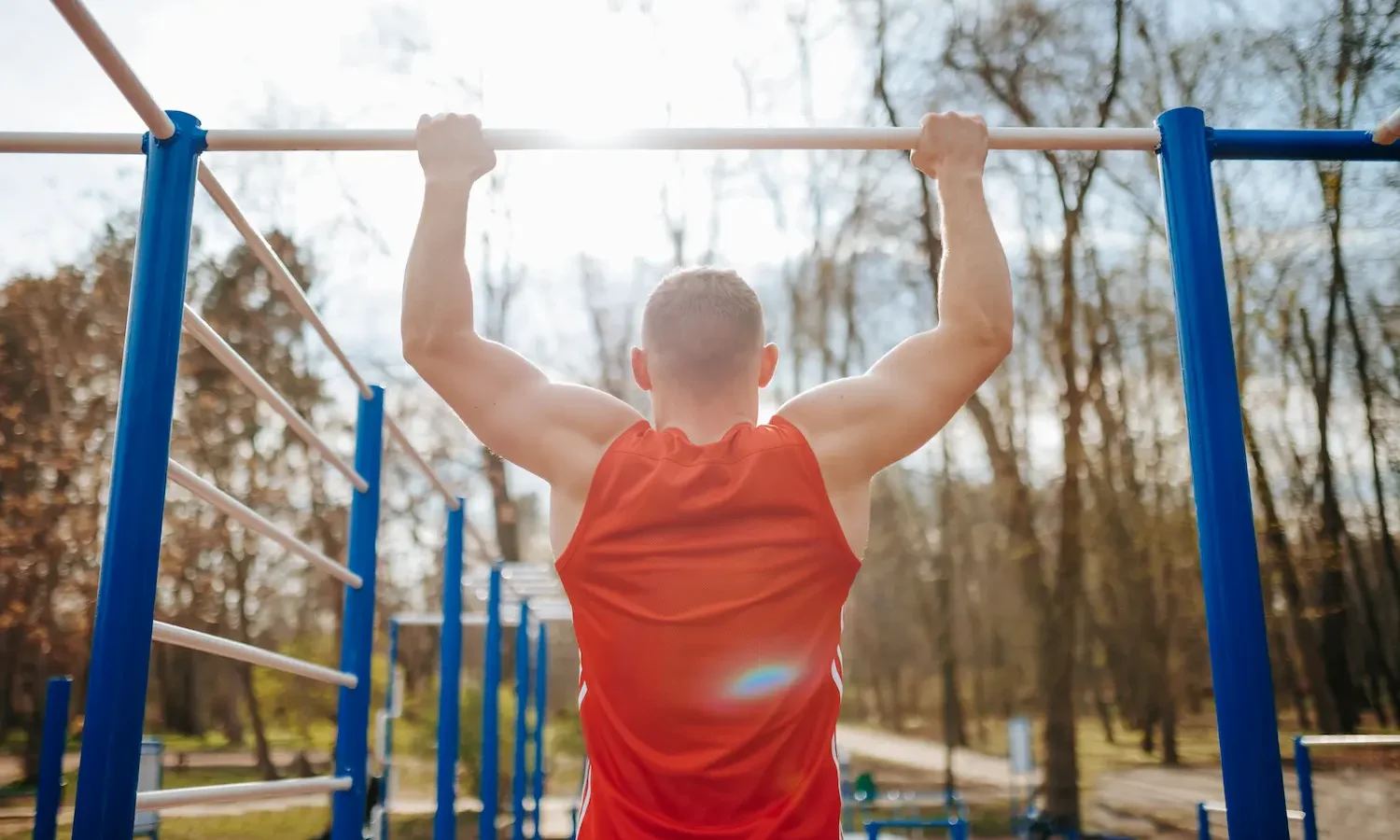
The archer pull-up is the bridge between a strict pull-up and a one-arm pull-up. You grip the bar wide; on the pull, one arm bends fully (doing most of the work) while the other arm stays straight, acting as a counterbalance and partial assist. The body slides toward the working-arm side at the top — like drawing a bow.
It’s the standard intermediate-to-advanced progression for athletes chasing the one-arm pull-up — and a powerful unilateral back exercise in its own right.
What is the archer pull-up?
The archer pull-up is a unilateral bodyweight pull-up variation performed with a wide overhand grip. As you pull, you shift your body sideways toward the working arm — that arm bends through full ROM while the other arm stays straight (just resting on the bar with some assistance through the lat). At the top, the chin is above the working hand, and the off-arm is extended sideways like an archer drawing a bow.
Most pull-up athletes can do roughly half as many archer pull-ups per side as standard pull-ups (e.g., 12 strict pull-ups → 5-7 archers per side). The straight-arm side provides some help but the working arm does roughly 75 % of the work.
Muscles worked
| Muscle group | Role | Contribution |
|---|---|---|
| Latissimus dorsi (working side) | Primary mover, adduction + flexion | ~40 % |
| Biceps brachii, brachialis (working) | Elbow flexion | ~20 % |
| Lats, teres (off side) | Partial assist, straight-arm pull | ~15 % |
| Core, obliques | Anti-rotation, body control | ~15 % |
| Posterior deltoid, rear traps | Scapular control | ~10 % |
Compared to a standard pull-up, the archer shifts most of the work onto the working-side lat and biceps. It’s also significantly more demanding on the core because the body shifts laterally during each rep.
How to archer pull-up: 5 steps
-
Set up the wide grip
Hang from a pull-up bar with a wide overhand grip — about 1.5x shoulder-width. Engage the lats (depress scapulae). Core braced.
-
Initiate the pull toward one side
**Pull the body up and toward one hand** — the working-side hand. The working-side elbow bends; the off-side elbow stays locked straight. Body shifts laterally toward the working side.
-
Reach the top position
Working arm fully flexed — **chin clears above the working hand**. Off-arm fully extended, supporting partial weight through the lat. Body laterally angled, like an archer drawing a bow.
-
Pause at the top
Brief pause at peak contraction. Squeeze the working-side lat and rhomboid. Don't let the body swing.
-
Lower with control
Lower in 2-3 seconds back to a dead hang. Maintain straight off-arm throughout. Reset, repeat. After the prescribed reps, switch sides — pull toward the other hand.
Common mistakes to avoid
Variations & progressions
- Typewriter pull-up. Pull-up to chest, then slide laterally side-to-side at the top. Combines archer with horizontal traversal.
- Band-assisted archer pull-up. Band around the foot or knee takes weight off. Strength-focused progression.
- Weighted archer pull-up. Weighted vest. The advanced loading.
- One-arm pull-up. The next progression — no off-arm assist at all.
- Wide-grip pull-up. Bilateral wide-grip variation.
- Standard pull-up. Foundational version.
- Chin-up. Biceps-emphasis pulling.
Sample workout: 8-week archer pull-up progression
Train 2-3 times per week. Prerequisite: 10+ strict pull-ups. Sets are per arm.
| Weeks | Progression | Sets × reps/arm |
|---|---|---|
| 1-2 | Band-assisted archer pull-up | 4 × 5 |
| 3-4 | Negative archer pull-up (5s descent) | 4 × 3 |
| 5-6 | Half-range archer pull-up | 4 × 4 |
| 7-8 | Full archer pull-up | 4 × 3-6 |
Frequently asked questions
How many archer pull-ups should I be able to do?
3-5 strict per arm = solid intermediate. 8+ per arm = advanced. 12+ per arm and you’re close to the one-arm pull-up.
Is the off-arm fully straight or slightly bent?</h3
Fully extended — straight elbow. Bent off-arm = the exercise becomes a wide-grip pull-up, not an archer. The straight off-arm is what shifts the load to the working side.
Archer pull-up or weighted pull-up?</h3
Different goals. Weighted pull-ups build bilateral pulling strength. Archers build unilateral strength + lateral core stability and progress toward the one-arm pull-up. Use both if pursuing maximum back strength.
Why does my body rotate during the rep?</h3
Anti-rotation core weakness. The body wants to twist as one arm pulls harder. Brace obliques throughout. Side planks and hanging knee raises build this directly.
How wide should the grip be?</h3
Wider than standard pull-up — typically 1.5x shoulder-width or more. Wider grip = more dramatic body shift, more lat work. Find the grip width where the chin can reach above the working hand at full pull.
Related exercises
- Pull-Up: bilateral foundational
- Chin-Up: biceps-emphasis variation
- Muscle-Up: explosive pull-and-press
- Front Lever: static pull-skill
- Inverted Row: horizontal pulling complement
Published by: Jay — Writer covering back exercises
Reviewed, corrected and approved by: Martin Wood — Editor-in-chief
Updated on September 29, 2026