
The inverted row is the bodyweight horizontal pull that fills the gap between push-ups and pull-ups. While the push-up trains pushing strength and the pull-up trains vertical pulling, most adults skip horizontal pulling entirely. The result: rounded shoulders, weak mid-back, and shoulder pain.
The inverted row fixes that. It needs nothing more than a sturdy bar at hip height (gym Smith machine, suspension trainer, or even a dining table). It scales easily with body angle, and produces real back development with no equipment.
What is the inverted row?
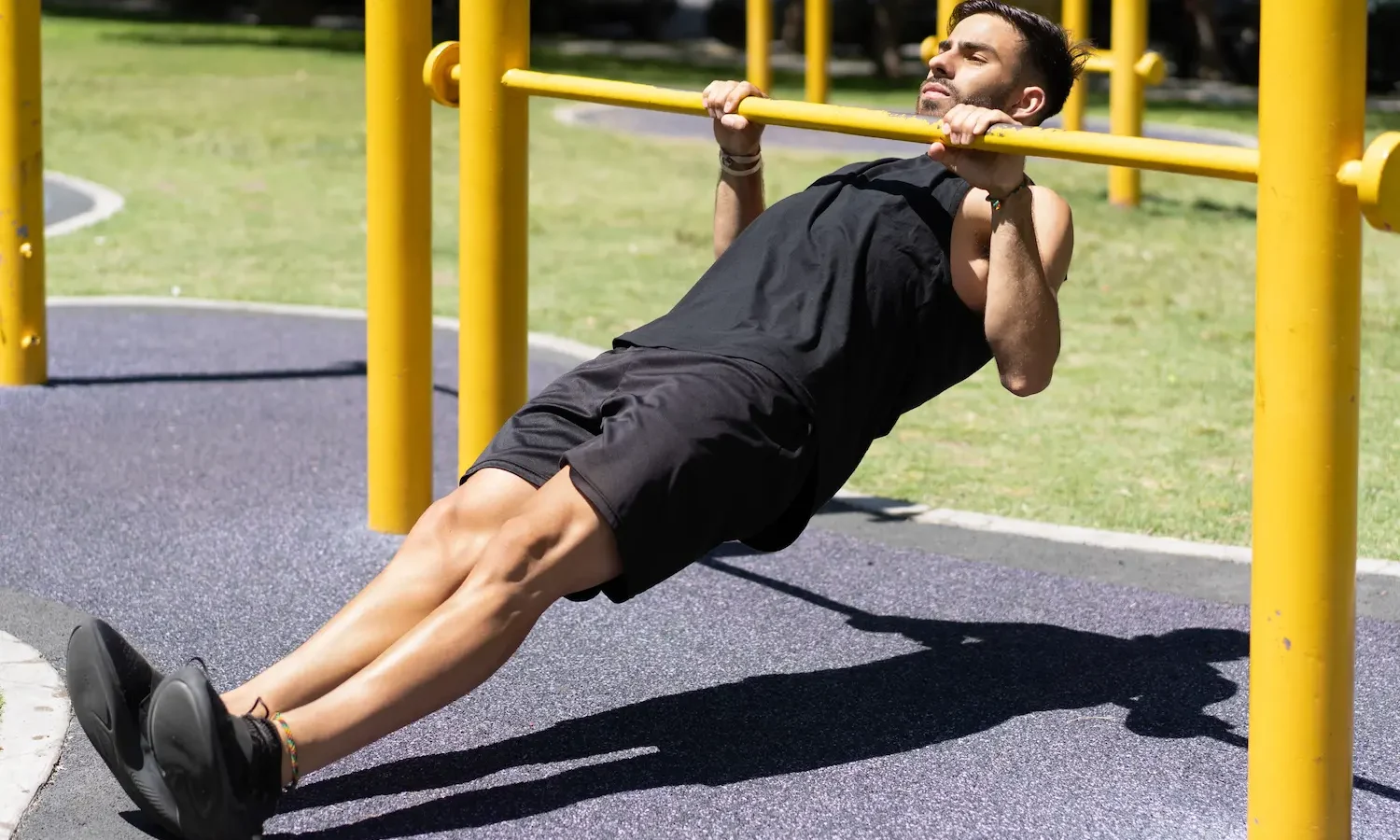
The inverted row is a horizontal pulling bodyweight exercise performed lying under a fixed bar (Smith machine, suspension trainer, dining table edge). You grip the bar overhead, hang with body straight, and pull the chest up to meet the bar by driving the elbows back. The motion is essentially a horizontal pull-up — same primary muscles, different angle.
The inverted row scales by body angle: the more vertical your body (closer to standing), the easier the row; the more horizontal (closer to lying flat), the harder. That makes it suitable for everyone from beginners (90° body angle) to advanced lifters (feet elevated above the head).
Muscles worked
| Muscle group | Role | Contribution |
|---|---|---|
| Mid-back (rhomboids, lower traps) | Primary mover, scapular retraction | ~40 % |
| Lats | Shoulder extension | ~25 % |
| Biceps brachii | Elbow flexion | ~20 % |
| Rear delts, forearms, core | Stabilisation | ~15 % |
The inverted row is one of the most useful back exercises for beginners and intermediate lifters because it trains the horizontal pulling pattern that desk-job postures specifically weaken. Done regularly, it counterbalances the front-of-shoulder work most lifters overdo.
How to inverted row: 5 steps
-
Set up under the bar
Set a Smith machine bar (or use a TRX, fixed bar, or sturdy table edge) at hip height. Lie on the floor underneath, grip the bar with hands slightly wider than shoulder width, palms forward.
-
Set the body position
Heels on the floor, legs straight. Body forms one straight line from shoulders to heels. **Squeeze the glutes and brace the core** so the body stays rigid throughout. Arms extended.
-
Engage the back
Pull shoulder blades down and back without bending the elbows. The chest rises 1-2 cm. This is the active hang position.
-
Pull the chest to the bar
**Drive the elbows back and down** to pull yourself up to the bar. Squeeze the shoulder blades together at the top. Bar should touch (or come close to touching) the chest.
-
Lower with control
Lower in 2-3 seconds back to the active hang. Don't crash down. Maintain the rigid body line throughout. Reset, repeat.
Common mistakes to avoid
Variations / progressions
- Bent-knee inverted row. Knees bent, feet flat. Easier than the straight-leg version. Beginner progression.
- Feet-elevated inverted row. Feet on a bench. Increases body load. Advanced progression.
- TRX row. On suspension trainer instead of a fixed bar. Adds instability.
- Single-arm inverted row. One arm at a time. Brutal — only for advanced.
- Wide-grip inverted row. Hands wider than shoulders. More rear delts and lats.
- Weighted inverted row. Plate or weighted vest. Once bodyweight feels easy.
Sample workout: 4-week back block
Inverted rows 2-3 times per week. Pair with push-ups for balanced upper-body work.
| Week | Sets × reps | Variation |
|---|---|---|
| 1 | 3 × 10 | Standard (legs straight, feet on floor) |
| 2 | 3 × 12 | Standard with 1 sec pause at top |
| 3 | 4 × 10 | Feet elevated |
| 4 (deload) | 3 × 10 | Standard |
Frequently asked questions
Inverted row or pull-up?
Different patterns. Pull-ups are vertical pulling. Inverted rows are horizontal. Most balanced programs include both. Inverted rows are also a good stepping stone to pull-ups for those who can’t yet do unassisted pull-ups.
How heavy can the inverted row get?</h3
Bodyweight + body angle. The closer to horizontal, the harder. Once that’s easy, elevate the feet. Once feet-elevated is easy, add a weighted vest or plate. Eventually progresses to single-arm rows for the most advanced.
Can I do this at home with no equipment?</h3
Yes. Use a sturdy dining table edge — slide under it, grip the edge with both hands. Or any low horizontal bar. A pull-up bar set low works. Pavers, broomsticks across two chairs, etc. — the bodyweight version is endlessly adaptable.
Why doesn’t my back feel sore the next day?</h3
Either the load is too light (body too vertical), or you’re pulling with biceps. Get more horizontal, focus on driving the elbows back, squeeze the shoulder blades together at the top.
How often should I do inverted rows?</h3
2-3 times per week as part of a balanced upper-body routine. Daily moderate volume is fine for most lifters — they’re bodyweight and easy on the joints.
Related exercises
- Pull-Up: bodyweight vertical pull
- Barbell Row: heavy free-weight horizontal pull
- Seated Cable Row: cable horizontal pull
- TRX Row: suspension trainer variant
- Face Pull: rear delt + posture
Published by: Jay — Writer covering back exercises
Reviewed, corrected and approved by: Martin Wood — Editor-in-chief
Updated on September 29, 2026