
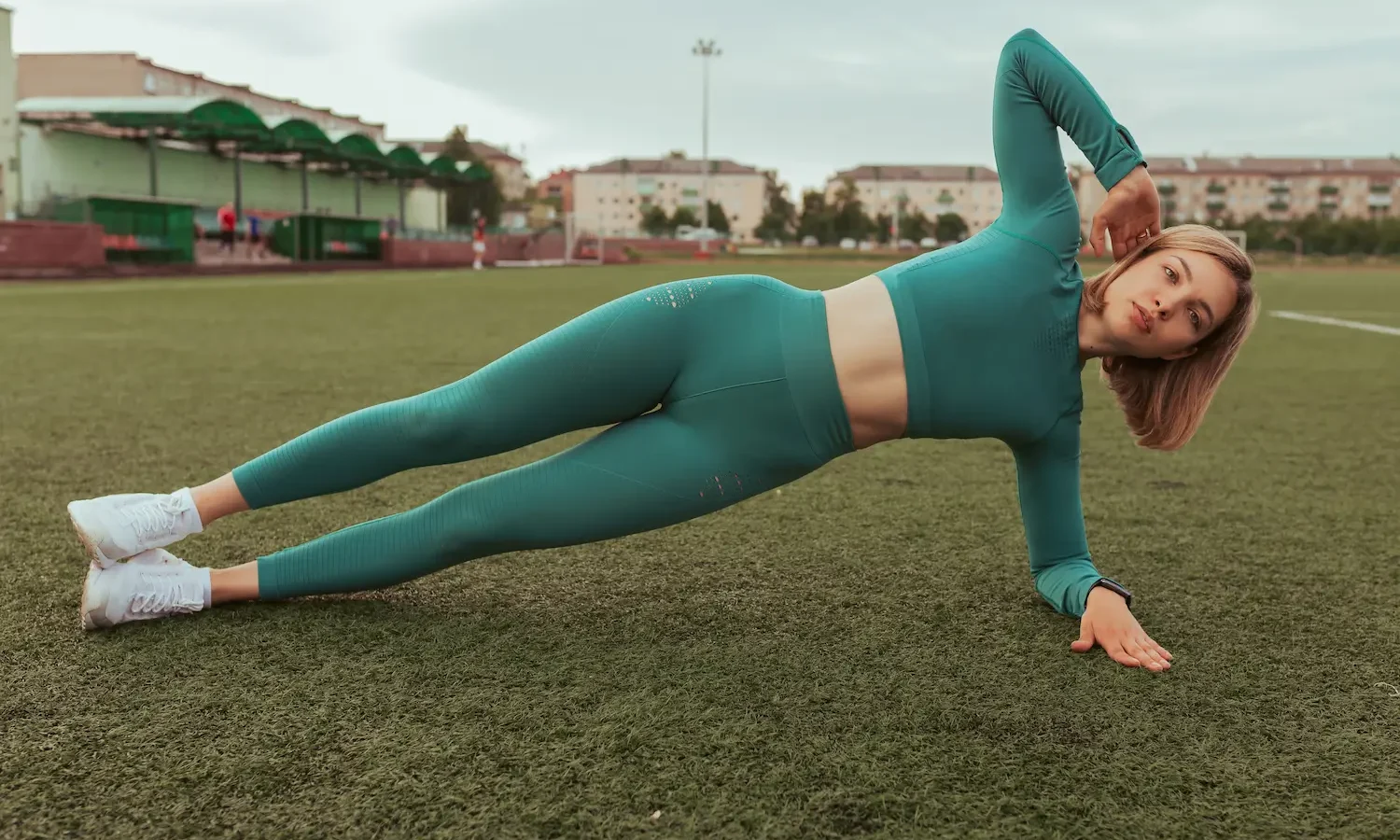
The side plank is the unsung counterpart to the regular plank. Where the front plank trains the rectus abdominis to resist extension, the side plank trains the obliques and lateral chain to resist sideways collapse. Together, they cover the two main “anti-something” core patterns.
Lifters who do front planks but skip side planks end up with strong abs but weak obliques. The result: poor lateral stability, slumped posture, and a core that’s strong in one plane but weak in another. Train both sides equally.
What is the side plank?
The side plank is an isometric core exercise performed lying on one side, supported on a forearm and the side of one foot, holding the body in a rigid line from head to feet. The hips are off the ground and the body forms a straight line in the frontal plane.
It’s an anti-lateral-flexion exercise — the obliques have to work to prevent the hips from sagging toward the floor. Done correctly, it builds a strong oblique chain that supports good posture and prevents lower-back pain.
Muscles worked
| Muscle group | Role | Contribution |
|---|---|---|
| Obliques (internal & external) | Anti-lateral-flexion | ~45 % |
| Quadratus lumborum (deep core) | Lateral spinal stabilisation | ~20 % |
| Glute medius (top side) | Hip abduction / stabilisation | ~15 % |
| Shoulder, lats | Holding the supporting arm | ~10 % |
| Adductors, transverse abdominis | Stabilisation | ~10 % |
The side plank also lights up the glute medius on the top side — the muscle that controls hip abduction and prevents the knees from caving inward during squats and lunges. Side plank is one of the few exercises that trains glute medius isometrically.
How to side plank: 5 steps
-
Set up on one side
Lie on your side with the supporting elbow directly under the shoulder. Forearm on the floor, hand in a fist or flat. Legs straight, feet stacked on top of each other (or staggered for easier balance).
-
Lift the hips off the floor
Push through the supporting forearm and the side of the bottom foot. Lift the hips so the body forms a **straight line** from head to heels. Top arm extended toward the ceiling or hand on hip.
-
Set the alignment
Body in one rigid line in the frontal plane. **No sagging hips, no piked hips.** Squeeze the glutes and obliques. Pull the supporting shoulder down and back (not shrugged up to the ear).
-
Brace and hold
Engage the core. Breathe normally. Look forward or down at the floor — neck neutral. The whole body is rigid.
-
Hold for time, then switch
Maintain the strict position for the prescribed duration. The moment hips drop or rise out of line, end the set. Switch sides.
Common mistakes to avoid
Variations
- Side plank with hip dips. Lower the hip toward the floor and back up. Adds dynamic oblique work.
- Side plank with leg lift. Lift the top leg while holding the plank. Major glute medius work.
- Copenhagen plank. Top leg supported on a bench, bottom leg lifted off the ground. Brutal adductor and oblique work.
- Side plank with rotation. Rotate the top arm under the body and back. Adds anti-rotation.
- Feet-elevated side plank. Feet on a bench. Increases load through reduced lever arm.
- Weighted side plank. Plate or dumbbell on the hip. The progression past bodyweight.
Sample workout: 4-week core block
Side planks 3 times per week. Pair with front planks for full anti-extension + anti-lateral-flexion coverage.
| Week | Sets × time/side |
|---|---|
| 1 | 2 × 20 sec/side |
| 2 | 3 × 30 sec/side |
| 3 | 3 × 45 sec/side |
| 4 (deload) | 2 × 20 sec/side |
Frequently asked questions
How long should I hold a side plank?
30 seconds per side is a healthy adult target. 60 seconds per side is solid. Past that, add load (weighted side plank) or progress to harder variations rather than extending duration.
Why does my supporting shoulder hurt during side plank?
Either you’re shrugging the supporting shoulder up to your ear (need to keep it pulled down and back), or your shoulder is genuinely weak. Reduce the hold time and build up gradually. If pain persists, switch to an elbow-only plank instead of the high plank version.
One side feels much harder than the other — is that normal?
Yes. Most adults have a strong side and a weak side, and side plank exposes it. Train the weaker side first each session, match the time to what the weaker side can hold, and add an extra set on the weaker side once a month.
Side plank or Copenhagen plank?
Different tools. Side plank works the obliques and lateral chain. Copenhagen plank (top leg on a bench, body suspended) is much harder and works the adductors hard. Use side plank as your foundational exercise; add Copenhagen as an advanced progression.
Should I touch the floor with my hip during the rep?
No, the standard side plank is held isometric — hip stays off the floor throughout. The “side plank with hip dips” variation lowers and lifts the hip dynamically, but that’s a different exercise.
Related exercises
- Front Plank: anti-extension complement
- Copenhagen Plank: advanced adductor + oblique
- Dead Bug: anti-extension supine
- Pallof Press: anti-rotation cable work
- Bird Dog: anti-extension + anti-rotation
Published by: Jay — Writer covering ab exercises
Reviewed, corrected and approved by: Martin Wood — Editor-in-chief
Updated on September 29, 2026