
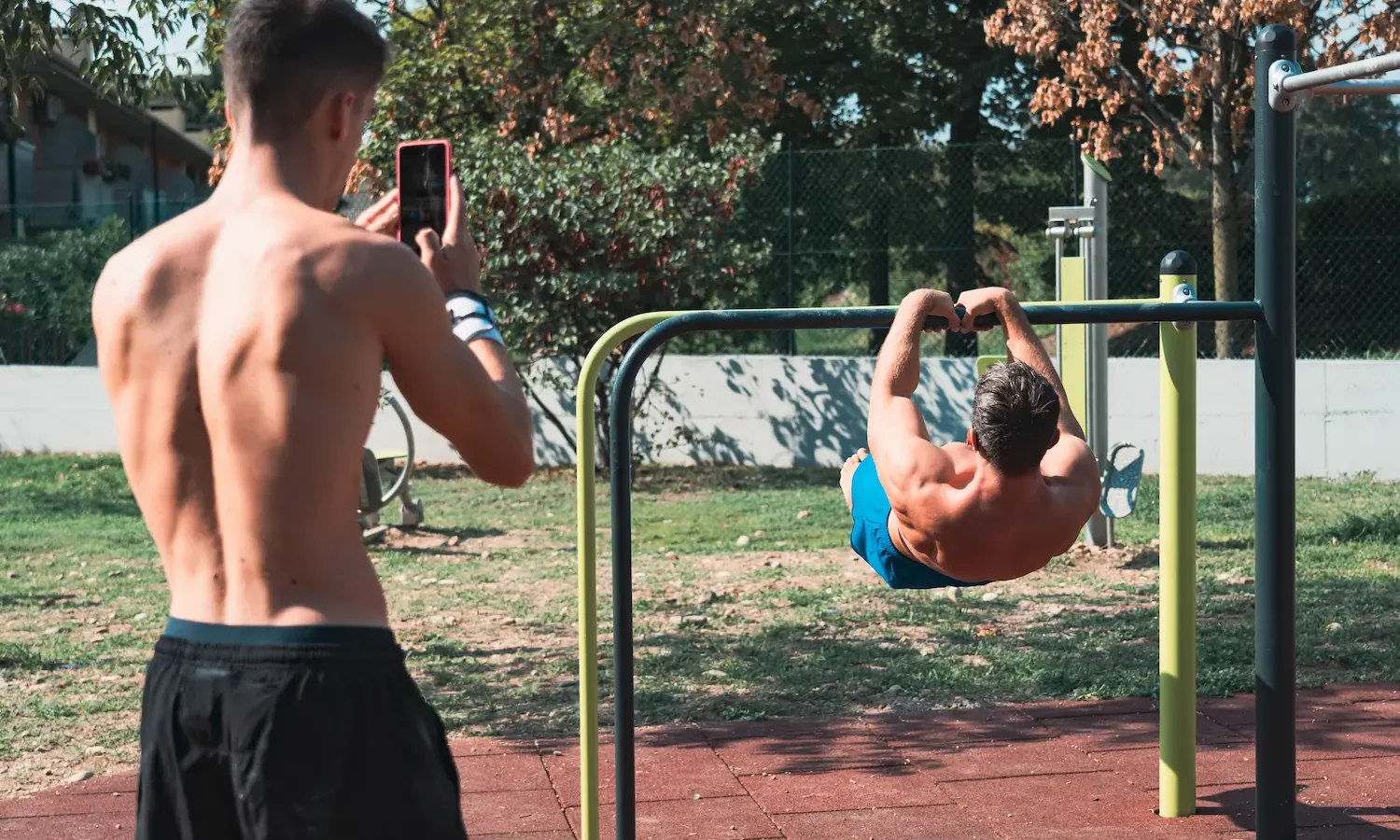
The front lever is gymnastics’ iconic pull-skill: hang from a bar, then lift your body until it is horizontal, parallel to the floor, face up. Hold it. The whole body forms a rigid plank in mid-air, supported only by straight-arm grip strength and a maxed-out back. It is the upper-body pulling equivalent of a planche.
If you can hold a clean front lever for 5 seconds, your back and core strength are elite-tier. This guide covers the strict bar front lever and the progression to get there.
What is the front lever?
The front lever is a static bodyweight hold performed on a pull-up bar or gymnastic rings. From a hang, you contract the lats, abs and posterior chain to lift the body to a horizontal position, face up. Body straight from shoulders to toes; arms straight from shoulders to grip. Hold.
The full front lever demands extreme straight-arm pulling strength (lats), maximum core anti-flexion stiffness, and the ability to hold body line under fatigue. It is one of the most respected calisthenics skills.
Muscles worked
| Muscle group | Role | Contribution |
|---|---|---|
| Latissimus dorsi | Primary mover, straight-arm pull | ~35 % |
| Rectus abdominis, obliques | Anti-flexion, body-line stabilisation | ~25 % |
| Posterior deltoid, teres | Shoulder extension, scapular control | ~15 % |
| Glutes, hamstrings | Hip extension, body line | ~15 % |
| Forearms, biceps (long head) | Grip, elbow stabilisation | ~10 % |
The front lever is dominated by the lats working in straight-arm shoulder extension — a pattern rarely trained elsewhere. It also forces the abs to resist hip drop with maximum effort, making it one of the toughest static ab exercises in existence.
How to front lever: 5 steps
-
Hang and engage
Hang from a pull-up bar with an overhand grip, shoulder-width. **Engage the lats** — depress scapulae, pull shoulders away from ears. Brace the core. Glutes tight.
-
Initiate the lever pull
Keep the arms **straight throughout** (this is a straight-arm pull). Push the bar away from you slightly while pulling your hips up. Body begins to lever back.
-
Lift to horizontal
Continue pulling until **the body is horizontal, face up, parallel to the floor**. Maintain straight body line from shoulders to toes. Toes pointed, glutes squeezed, core maximally braced.
-
Hold the line
Hold the horizontal position. Don't let the hips drop — fight gravity actively. Don't over-pull (rising above horizontal isn't the goal here either). Breathe through it.
-
Lower with control
Reverse the motion — lever the body back down to a hang with control (5+ seconds adds eccentric strength). Reset, repeat after full rest.
Common mistakes to avoid
Variations & progressions
- Tuck front lever. Knees pulled to chest. The first progression — much shorter lever.
- Advanced tuck front lever. Knees still bent but pulled away from chest. Mid-progression.
- Single-leg front lever. One leg extended, one tucked. Late progression.
- Straddle front lever. Legs apart in straddle. Reduces lever, achievable bridge to full.
- Front lever raise. Dynamic version — pull from hang up to lever and back.
- Ice cream maker. Combines pull-up at the top with a slow front lever descent. Brutal.
- Pull-up and inverted row: foundational components.
Sample workout: 12-week front lever progression
Train 2-3 times per week. Multiple short holds with full rest. Quality is everything — partial-range cheating won’t carry you to the full lever.
| Weeks | Progression | Sets × time |
|---|---|---|
| 1-3 | Tuck front lever | 5 × 10s |
| 4-6 | Advanced tuck front lever | 5 × 10s |
| 7-9 | Single-leg front lever | 5 × 8s per leg |
| 10-12 | Straddle / full front lever | 5 × 5-10s |
Frequently asked questions
How long does it take to learn the front lever?
6-24 months for most athletes. Even strong calisthenics practitioners typically take 1+ year. The front lever rewards consistent, patient progression — not bursts of intensity. Train it 2-3 times per week, every week.
Front lever or planche?</h3
Both are advanced static skills — front lever is the pull skill, planche is the push skill. Most athletes train them in parallel as a “back/front” pair. They take similar time to learn.
Bar or rings?</h3
Bar is mechanically simpler. Rings add a wobble factor and demand more shoulder stability — harder, but better carryover to gymnastics. Train the bar version first if you’re choosing one.
Why are my hips dropping?</h3
Either core anti-flexion strength is insufficient (regress the progression) or you’re not cueing the brace hard enough. The hips want to fall under gravity — fight that actively with abs, glutes and posterior chain tightness.
How many hold seconds count as “having” the front lever?</h3
5 seconds with clean form is the standard “I have it” benchmark. 10+ seconds = solid. 30+ seconds = elite. Hollywood-clean form, not banana arch.
Related exercises
- Pull-Up: foundational pulling
- Inverted Row: horizontal pulling
- Dragon Flag: dynamic anti-flexion ab work
- L-Sit: static compression hold
- Muscle-Up: explosive pull-and-press
Published by: Jay — Writer covering back exercises
Reviewed, corrected and approved by: Martin Wood — Editor-in-chief
Updated on May 12, 2026