
The one-arm dumbbell press is a unilateral overhead press. One arm at a time forces the core to resist rotation while the working shoulder does its job. It’s a favourite for athletes and anyone building anti-rotation core strength alongside shoulders.
What it is
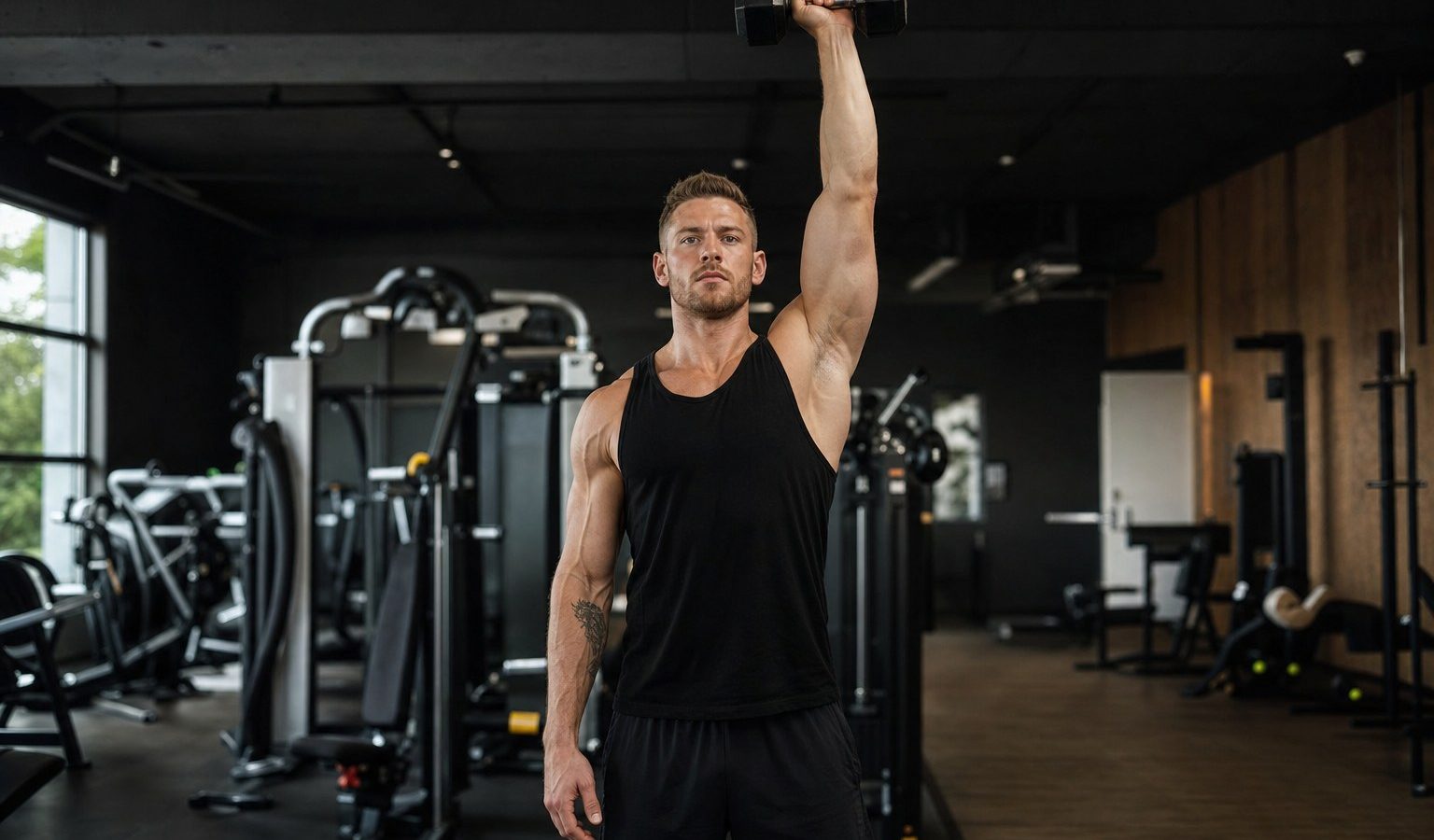
The one-arm dumbbell press is a standing shoulder press performed with a single dumbbell in one hand. The free hand stays at the side or on a rack for balance. The asymmetric load challenges the core to prevent trunk rotation while the shoulder presses. Standing standard; can also be done seated.
Muscles worked
| Muscle | Contribution |
|---|---|
| Anterior deltoid | ~40 % |
| Obliques, core | ~25 % |
| Triceps | ~20 % |
| Traps, lateral delt | ~15 % |
How to one-arm dumbbell press: 5 steps
-
Stand tall
Feet hip-width, **dumbbell at shoulder height in one hand.**
-
Brace anti-rotation
**Core tight, glutes squeezed, resist any body twist.**
-
Press up
**Press dumbbell straight up to lockout,** torso stays vertical.
-
Lock out
**Arm fully extended overhead, body straight.**
-
Lower and switch
Lower over 2 sec. Complete reps, switch arms.
How it differs from bilateral DB press
- Single dumbbell. One arm at a time.
- Anti-rotation core demand. Trunk must resist twisting under asymmetric load.
- Corrects side-to-side imbalances. Weak side can’t hide.
- Slightly lighter loads. Per-arm loading capped by core stability.
Common mistakes
When to use this variation
Use one-arm dumbbell presses for combined shoulder and anti-rotation core work. Program 3 sets of 8-12 reps per arm. Excellent for athletes and lifters correcting side-to-side imbalances.
FAQ
Free hand at side or on rack?
Free hand at side = maximum core challenge. Free hand on rack = reduced core demand, better shoulder focus. Choose by goal.
Palm forward or neutral?
Neutral (palm facing head) is easier on shoulders. Palm forward is more traditional.
Standing or seated?
Standing = full core challenge. Seated = pure shoulder isolation. Both work depending on goal.
Related exercises
- Standing DB Shoulder Press: bilateral
- Seated DB Shoulder Press: seated bilateral
- Landmine Press: unilateral landmine variant
- Suitcase Carry: another anti-rotation core builder
Published by: Martin Wood — Writer covering shoulder exercises
Reviewed, corrected and approved by: Martin Wood — Editor-in-chief
Updated on July 20, 2026