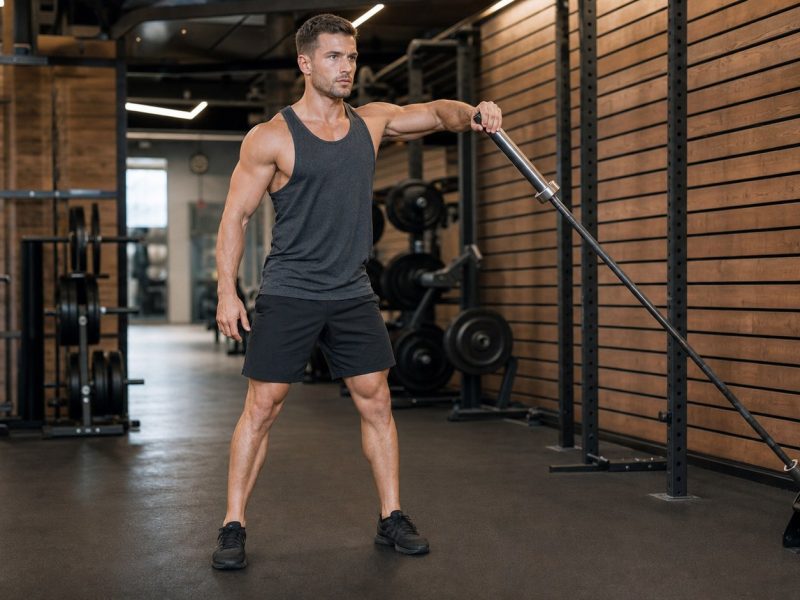

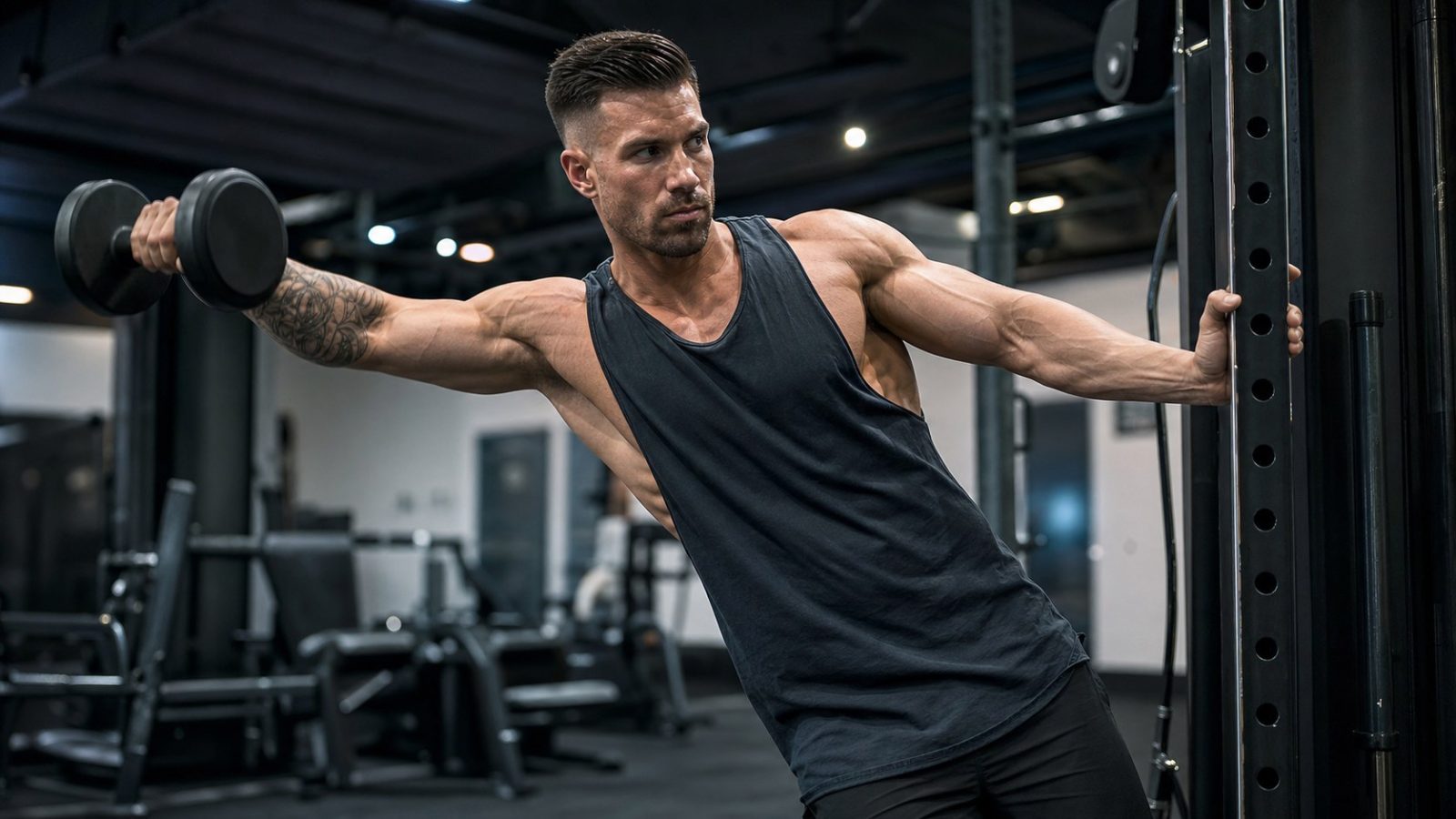
The leaning lateral raise is a unilateral lateral raise performed while holding a support with the free hand and leaning the body away from the pulling side. The lean lengthens the range of motion and creates constant tension on the lateral delt from the very bottom of the movement.
What it is
The leaning lateral raise is a single-arm lateral raise performed while gripping a pole or rack with the opposite hand and leaning away from that support. The lean shifts the body angle so the lateral delt is loaded even at the bottom of the movement — where standard lateral raises have no tension.
Muscles worked
| Muscle | Contribution |
|---|---|
| Lateral deltoid | ~80 % |
| Supraspinatus, upper trap | ~15 % |
| Core (anti-rotation) | ~5 % |
How to leaning lateral raise: 5 steps
-
Grip support
**Grip a stable vertical bar with one hand,** feet close to the base.
-
Lean away
**Lean the body away from support** at 15-25°. Working arm hangs free.
-
Raise dumbbell
**Raise dumbbell laterally to shoulder height,** thumb slightly down.
-
Peak position
**Brief hold at shoulder height,** feel lateral delt.
-
Controlled descent
Lower over 2 seconds. Complete reps, switch sides.
How it differs from standard lateral raise
- Body leans away from working side. Standard is vertical.
- Constant tension from bottom. Standard has zero tension at the very bottom.
- Longer range of motion. Raises the dumbbell higher relative to body position.
- Unilateral focus. One shoulder at a time — better connection.
Common mistakes
When to use this variation
Use leaning lateral raises for maximum lateral delt engagement, especially at the bottom of the range. Program 3 sets of 10-15 reps per arm. Pair after main pressing work or as the primary lateral delt lift.
FAQ
How much to lean?
15-25° from vertical. Too much lean stresses the wrist and shoulder joint of the supporting arm.
What to grip for support?
A stable vertical bar or rack upright. Height at hip to chest level works best.
Leaning or standard lateral raise?
Leaning has better tension curve but is single-arm and slower. Standard is faster and bilateral. Use leaning for hypertrophy focus, standard for volume.
Related exercises
- Lateral Raise: standard bilateral
- Cable Lateral Raise: cable equivalent
- Y Raise: Y-shaped raise for lower trap
- Landmine Lateral Raise: landmine version