
The cable lateral raise is the better lateral raise for most lifters. Where the dumbbell lateral raise loses tension at the bottom (the dumbbell hangs at the side), the cable provides constant tension throughout the entire range. For pure lateral deltoid hypertrophy, that’s a meaningful edge.
This guide covers the standard single-arm cable lateral raise. Variations with two arms simultaneously, or with the cable behind the back, are covered at the end.
What is the cable lateral raise?
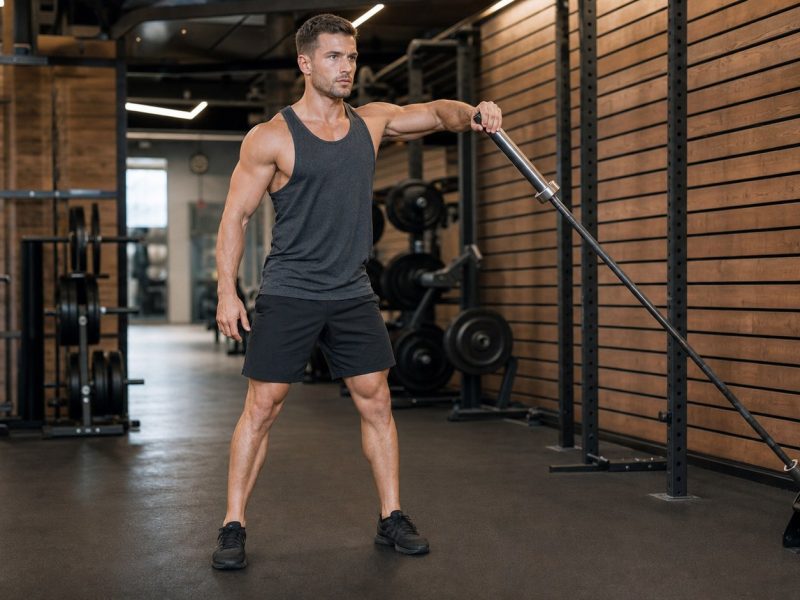
The cable lateral raise is an isolation exercise for the lateral deltoid performed at a low cable machine, in which you stand sideways to the cable, grip a D-handle with the far hand, and raise the arm out to the side until it reaches shoulder height. The cable provides constant resistance throughout — unlike the dumbbell version which loses tension at the bottom.
Most lifters can use significantly heavier loads on the cable lateral raise compared to dumbbells, because the constant tension keeps the muscle engaged through the full range. It’s also more strict — there’s less opportunity to swing the weight up.
Muscles worked
| Muscle group | Role | Contribution |
|---|---|---|
| Lateral (middle) deltoid | Primary mover, shoulder abduction | ~75 % |
| Anterior deltoid | Secondary mover | ~10 % |
| Trapezius (upper traps) | Stabilisation | ~10 % |
| Supraspinatus, core | Stabilisation | ~5 % |
The cable lateral raise loads the lateral deltoid more cleanly than the dumbbell version because the resistance vector is more horizontal — pulling the arm down and across the body, rather than just down. This matches the muscle’s line of pull better.
How to cable lateral raise: 5 steps
-
Set up at the low cable
Stand sideways to a low cable. The arm closest to the cable holds the cable post for stability (or hangs at side). The far arm reaches across the body to grip the D-handle.
-
Set the body position
Stand tall, slight forward lean, slight bend in knees. Pull shoulder blades down and back. Slight bend in the working elbow (10-15°), maintained throughout.
-
Raise the arm out to the side
Lead with the elbow. Raise the arm up and out to the side. **Stop when the upper arm is parallel to the floor** — past that, traps dominate.
-
Pause at the top
Half-second pause at the top, lateral delt fully contracted. Don't shrug — keep shoulder blades down.
-
Lower in 2-3 seconds
Controlled descent. The cable will pull the arm back across the body — control the resistance the whole way. Don't let the weight crash down.
Common mistakes to avoid
Variations
- Two-arm cable lateral raise. Standing in the middle of a cable crossover with both cables crossed in front. Both delts at once.
- Behind-the-back cable lateral raise. Cable runs behind your back. Greater stretch at the bottom.
- Leaning cable lateral raise. Holding the cable post with the free hand and leaning away. Greater range of motion through the full arc.
- Seated cable lateral raise. Sat on a bench. Eliminates lower-body cheat.
- Dumbbell lateral raise. Free-weight version, simpler equipment.
- Lateral raise machine. Dedicated machine option.
Sample workout: 4-week shoulder isolation block
Cable lateral raises 2-3 times per week, after main pressing work. High volume, controlled tempo. Reps are per side.
| Week | Sets × reps/side | Tempo |
|---|---|---|
| 1 | 3 × 12 | 2 sec eccentric |
| 2 | 4 × 12 | 2 sec eccentric + 1 sec pause at top |
| 3 | 4 × 10 + 1 dropset | 3 sec eccentric |
| 4 (deload) | 3 × 10 | Smooth |
Frequently asked questions
Cable lateral raise or dumbbell?
Cable for hypertrophy and strict form. Dumbbell for accessibility and lateral chain stabilisation. Most balanced shoulder programs include both. If you have to choose one, cable wins for pure lateral delt growth.
How heavy should I cable lateral raise?
For a healthy male intermediate: 10-15 kg on the cable for 12 strict reps. For females: 5-8 kg. Should be slightly heavier than your dumbbell variant for the same reps.
Should I raise above shoulder height?</h3
No. Past 90° abduction, the upper traps take over. Stop when the upper arm is parallel to the floor — that’s peak lateral delt contraction.
Why does my upper trap get sore?</h3
Either you’re shrugging during the rep (lifting shoulders to ears) or going past shoulder height. Pull shoulder blades down and back at the start, stop the raise at 90°.
Should I use a single-arm or two-arm setup?</h3
Single-arm for better mind-muscle and asymmetry-fixing. Two-arm for time efficiency. Single-arm is generally the better hypertrophy choice; two-arm is the practical choice when you’re short on time.
Related exercises
- Dumbbell Lateral Raise: free-weight foundational
- Overhead Press: foundational shoulder compound
- Face Pull: rear delt + posture
- Front Raise: anterior delt isolation
- Rear Delt Fly: posterior delt isolation
Published by: Jay — Writer covering shoulder exercises
Reviewed, corrected and approved by: Martin Wood — Editor-in-chief
Updated on May 10, 2026