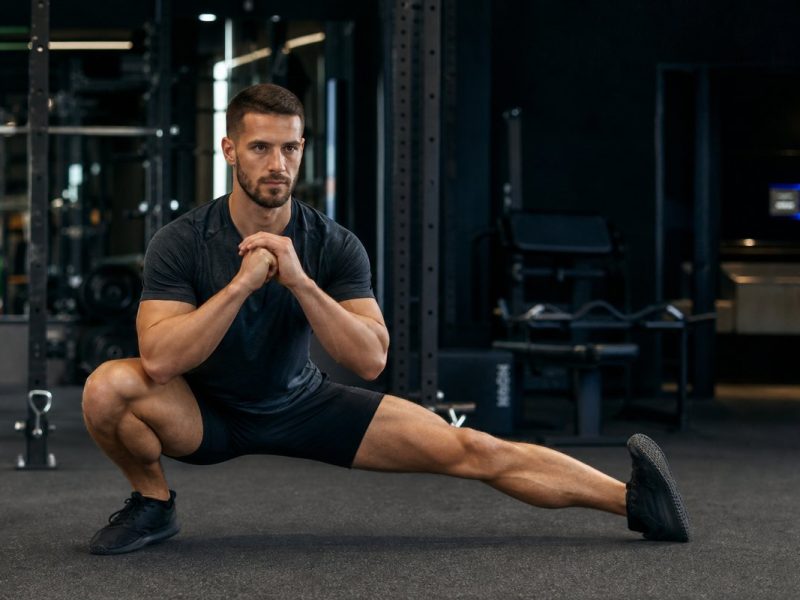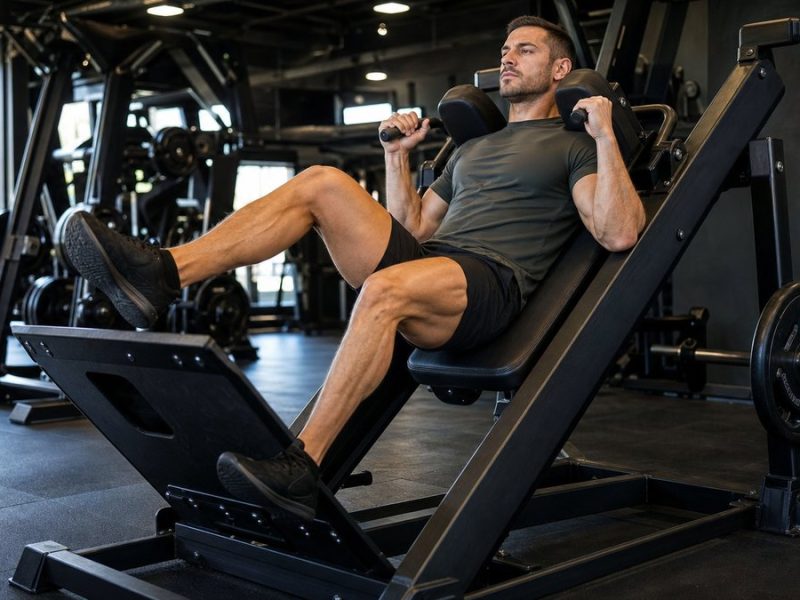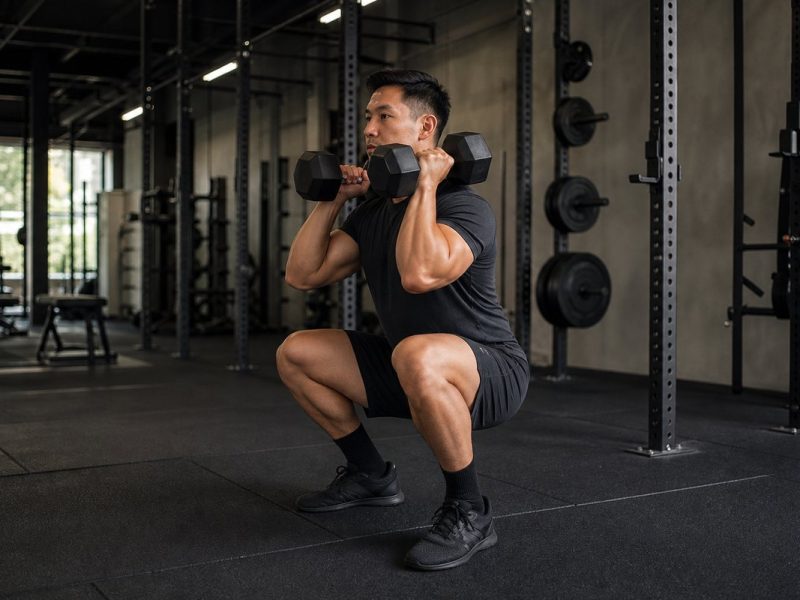

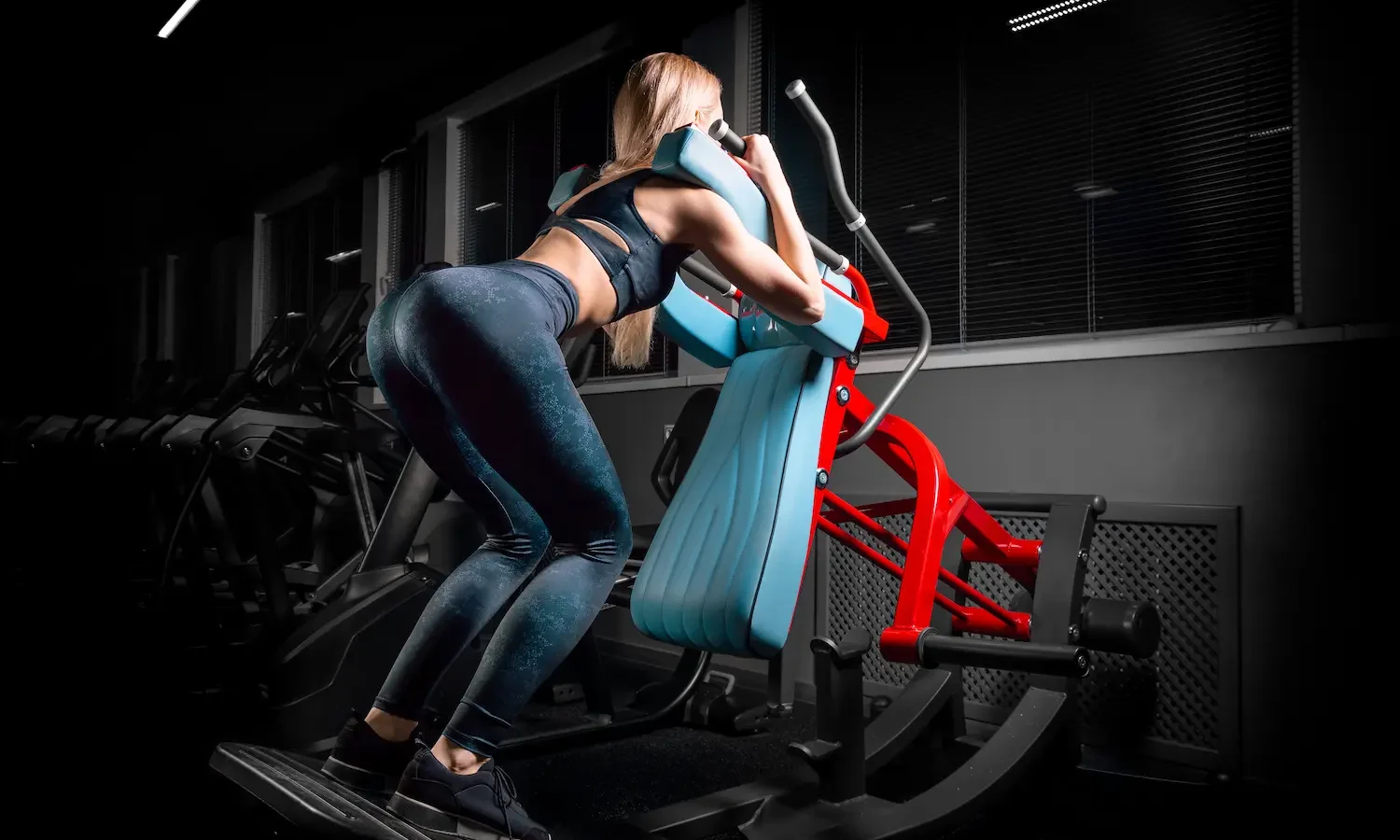
The hack squat is the squat machine for people who want quad-dominant leg work without the spinal load of a barbell. It’s a guided sled exercise: shoulders against pads, feet on a platform, descend by bending the knees, drive back up. The fixed bar path eliminates balance and lets you go heavy without fear of falling.
The hack squat is named after Russian wrestler Georg Hackenschmidt, who popularised a barbell version in the early 1900s. The modern machine version is what most people mean today — and it’s a quad-builder of the highest order.
What is the hack squat?
The hack squat is a knee-extension and hip-extension exercise performed on a hack squat machine, in which you stand on a platform with your back against angled shoulder pads, then descend into a squat by bending the knees and hips before pushing back up. The angle of the machine (typically 45°) keeps the back supported throughout.
Compared to the barbell back squat, the hack squat shifts work toward the quads (because the back support eliminates the need for postural muscles) and reduces lower-back strain. Compared to the leg press, the hack squat allows greater hip extension at the top and a more natural squat pattern.
Muscles worked
| Muscle group | Role | Contribution |
|---|---|---|
| Quadriceps | Primary mover, knee extension | ~55 % |
| Glutes | Hip extension | ~25 % |
| Hamstrings | Hip extension support | ~15 % |
| Calves · Adductors · Core | Stabilisation | ~5 % |
The hack squat is more quad-dominant than the back squat. Foot position changes the muscle distribution: feet high on the platform = more glutes/hamstrings; feet low = more quads; feet wide = more inner thighs.
How to hack squat: 5 steps
-
Set up on the machine
Stand on the platform with shoulders firmly under the pads. Feet shoulder-width, toes turned out 15-30°. Foot position varies by goal: middle for balance, low for quads, high for glutes.
-
Release the safety locks
Push up slightly to release the safety handles. Take a deep breath, brace the core. Engage the upper back into the pads.
-
Lower with control
Bend the knees and hips in a 2-second controlled descent. **Knees track over the toes** (don't cave inward). Lower back stays in contact with the back pad throughout.
-
Stop at depth
Stop when knees reach 90° or slightly past. **Lower back must remain on the back pad** — if it lifts, you've gone too deep. Brief turnaround at the bottom.
-
Drive back up
Push the platform up by extending knees and hips. Lock out at soft extension at the top. Reset breath, repeat.
Common mistakes to avoid
Variations
- Reverse hack squat. Facing the machine instead of away. More glute and hamstring focus.
- Single-leg hack squat. One foot on the platform, other off. Doubles the load, exposes asymmetries.
- High-foot hack squat. Feet high on the platform. More glute/hamstring.
- Low-foot hack squat. Feet low. Pure quad emphasis. Demanding on knees.
- Barbell hack squat. Original version: barbell behind the legs, lift to standing. Old-school but effective.
- Back squat. Free-weight bilateral compound.
Sample workout: 4-week quad block
Hack squats once or twice per week, after main squat / lunge work. Or as the primary leg exercise if back issues prevent heavy back squats.
| Week | Sets × reps | RPE |
|---|---|---|
| 1 | 3 × 10 | 7 |
| 2 | 4 × 8 | 7-8 |
| 3 | 5 × 6 | 8 |
| 4 (deload) | 3 × 8 | 6 |
Frequently asked questions
Hack squat or barbell squat?
Different tools. Barbell squat is the foundational compound — total-body strength, balance, core. Hack squat lets you load quads heavier without spinal stress. Most balanced programs include both.
Hack squat or leg press?
Hack squat allows greater hip extension at the top and a more natural squat pattern. Leg press lets you go heavier with less stabilisation demand. Hack is closer to a real squat; leg press is more isolated.
How heavy should I hack squat?
Most lifters can hack squat about 1.2-1.5 × their back squat for the same reps because of the back support. Don’t compare to other gyms — hack squat machines vary widely in lever ratios.
How deep should I go?
Until your knees reach 90° or slightly past, with the lower back maintaining contact with the back pad. Going too deep without back support causes the lumbar spine to round — same risk as the leg press.
Why does my front knee hurt during hack squats?</h3
Either feet are too low on the platform (knees travel too far forward) or the load is too heavy. Try moving feet higher on the platform and lighten the load.
Related exercises
- Back Squat: foundational free-weight squat
- Leg Press: machine quad alternative
- Front Squat: front-loaded barbell squat
- Leg Extension: pure quad isolation
- Bulgarian Split Squat: unilateral leg work
Published by: Jay — Writer covering quad exercises
Reviewed, corrected and approved by: Martin Wood — Editor-in-chief
Updated on September 29, 2026