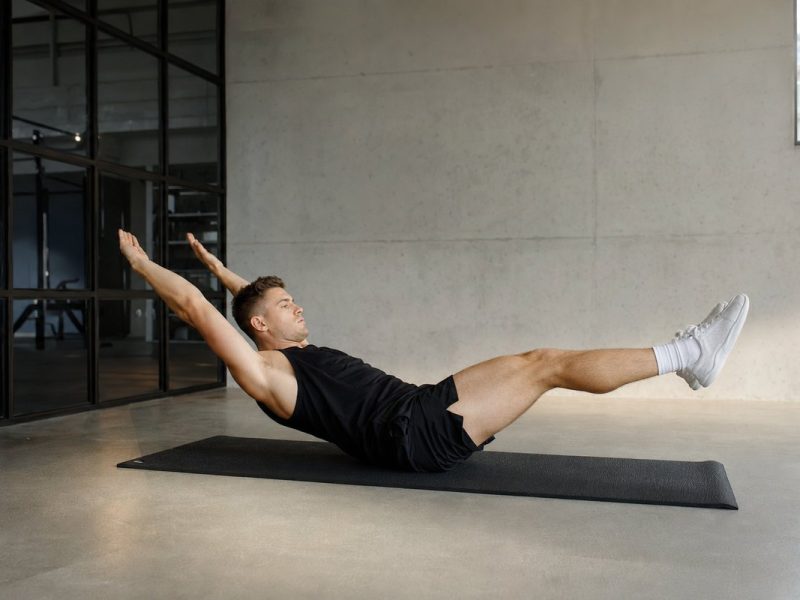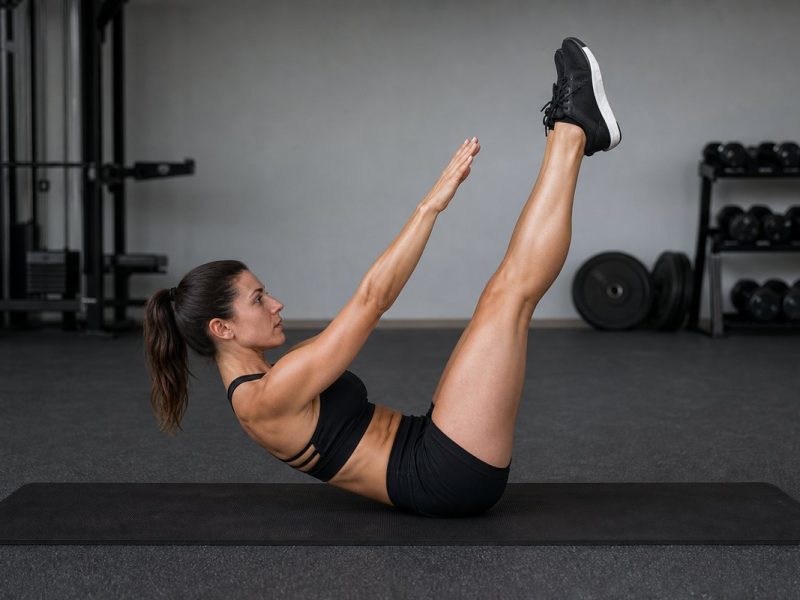


The flutter kick is a supine core exercise where the lifter alternates small vertical kicks of the legs while keeping the lower back pressed to the floor. It’s a favourite for endurance-focused ab training and swimmers’ dryland conditioning.
What it is
The flutter kick is a bodyweight core exercise. Lying supine with legs raised slightly off the floor, the lifter alternately kicks one leg up while the other lowers slightly, then reverses. The rhythmic scissor motion trains the lower abs, hip flexors and endurance while pressing the lower back into the ground.
Muscles worked
| Muscle | Contribution |
|---|---|
| Rectus abdominis (lower) | ~40 % |
| Hip flexors | ~35 % |
| Quadriceps | ~15 % |
| Transverse abdominis | ~10 % |
How to flutter kick: 5 steps
-
Lie supine
**Lie on back, hands under hips or at sides, legs straight.**
-
Raise legs slightly
**Lift both legs 15-30 cm off floor.**
-
Press back down
**Actively press lower back into floor.**
-
Alternate kicks
**Rhythmically kick legs up and down alternately** in small movements.
-
Continue
Maintain for target duration; steady breathing.
How it differs from reverse crunch
- Continuous rhythmic motion. Reverse crunch is discrete reps.
- Endurance focus. Longer time under tension per set.
- Both legs moving. Alternating rather than both up-down together.
- Higher hip flexor demand. Constant hip work.
Common mistakes
When to use this variation
Use flutter kicks for ab endurance and hip flexor conditioning. Program 3 sets of 20-45 seconds. Common in military fitness circuits and swimmers’ dryland training.
FAQ
How high the kicks?
Small — 15-30 cm of vertical travel. Big kicks turn it into leg raises.
Lower back keeps arching — what to do?
Raise legs higher above the floor (less leverage) or bend the knees.
Flutter kicks or plank?
Different training. Plank = static anti-extension. Flutter kick = dynamic endurance. Use both.
Related exercises
- Reverse Crunch: full-range lower ab
- Hollow Hold: static supine
- Dead Bug: contralateral supine
- Mountain Climber: prone dynamic equivalent