
The dead bug is a supine core exercise that alternates opposite arm and leg extensions while maintaining a pressed-down lower back. Deceptively hard, it trains anti-extension and contralateral coordination — the exact patterns needed for running, throwing, and lifting.
What it is
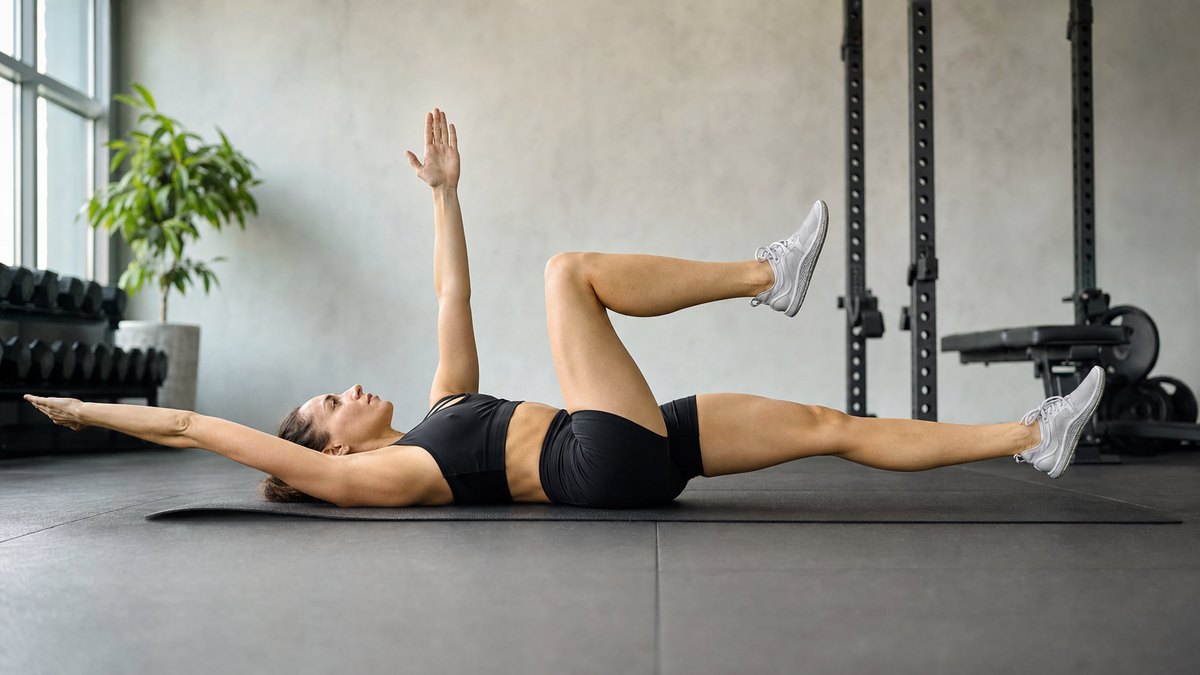
The dead bug is a core exercise performed supine (face-up). Starting with arms straight up and knees bent to 90°, the lifter alternately extends one arm and the opposite leg toward the floor while maintaining a flat lower back. The core resists lumbar extension throughout each rep.
Muscles worked
| Muscle | Contribution |
|---|---|
| Rectus abdominis | ~40 % |
| Transverse abdominis | ~30 % |
| Obliques | ~20 % |
| Hip flexors, shoulders | ~10 % |
How to dead bug: 5 steps
-
Lie supine
**Lie on back, arms straight up, knees bent to 90°** with shins parallel to floor.
-
Press lower back down
**Actively press lumbar into floor.**
-
Extend opposites
**Slowly lower right arm overhead and left leg toward floor** simultaneously.
-
Return to start
Return both limbs to starting position.
-
Alternate
Repeat with left arm and right leg. Continue alternating.
How it differs from plank
- Supine dynamic. Plank is prone static.
- Contralateral pattern. Opposite arm and leg move together.
- Anti-extension focus. Emphasises lumbar stability under moving limbs.
- Beginner-friendly. Scalable to any level via range control.
Common mistakes
When to use this variation
Use dead bugs as a foundational core exercise, warm-up drill, or as accessible rehab core work. Program 3 sets of 8-12 reps per side (or 30-45 sec time). Excellent daily for lifters with any lower-back sensitivity.
The dead bug is also part of our core exercises for back support pathway.
FAQ
Alternating or same-side?
Alternating opposite arm and leg is standard — matches natural gait patterns.
How low to reach?
As low as you can while keeping the lower back pressed to the floor. Never let the back arch up.
Dead bug or plank?
Dead bug teaches anti-extension under movement — excellent for rehab. Plank is static. Use both.
Related exercises
- Plank: prone static
- Bird Dog: kneeling contralateral variant
- Hollow Hold: static supine
- Pallof Press: anti-rotation core
Published by: Martin Wood — Writer covering ab exercises
Reviewed, corrected and approved by: Martin Wood — Editor-in-chief
Updated on July 27, 2026