
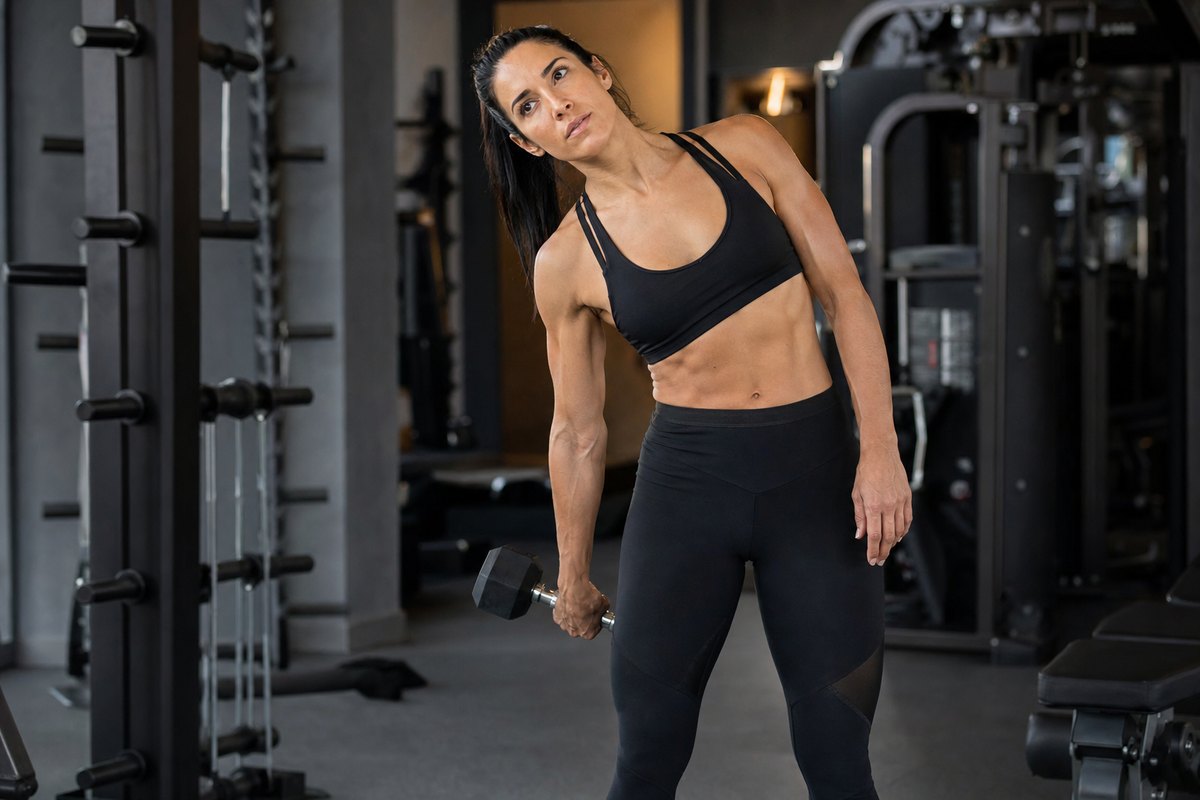
The dumbbell side bend is a simple weighted lateral flexion of the trunk. Standing with a dumbbell in one hand, bend sideways and return. Direct oblique work that loads heavier than bodyweight side planks — controversial for some, effective for others.
What it is
The dumbbell side bend is an oblique-focused exercise where the lifter holds a dumbbell at the side, then bends laterally to lower the dumbbell along the outer thigh, and returns upright. Each rep loads the opposite obliques (the muscles on the side opposite the dumbbell).
Muscles worked
| Muscle | Contribution |
|---|---|
| Obliques (opposite side) | ~65 % |
| Quadratus lumborum | ~20 % |
| Erector spinae | ~10 % |
| Forearms (grip) | ~5 % |
How to dumbbell side bend: 5 steps
-
Stand tall
Feet hip-width, **dumbbell in one hand at side, other hand on head or hip.**
-
Brace
**Core tight, torso vertical.**
-
Bend laterally
**Bend toward the dumbbell side,** lowering it along outer thigh.
-
Return upright
**Contract opposite obliques to pull back to upright.**
-
Complete reps, switch
Finish one side, then the other.
How it differs from side plank
- Dynamic lateral flexion. Side plank is isometric.
- Weighted. Loads directly with a dumbbell.
- Concentric-eccentric focus. Both phases of oblique contraction.
- Standing position. Vertical stability challenge.
Common mistakes
When to use this variation
Use dumbbell side bends for direct oblique loading. Program 3 sets of 12-15 reps per side. Not universally recommended — some coaches feel it can thicken the waist. Rotate with anti-rotation work like pallof presses.
FAQ
Does it thicken the waist?
Debatable. Heavy side bends can add oblique hypertrophy that thickens the trunk. For aesthetic-focused physiques, use moderate loads.
Both hands or one hand?
One hand at a time. Dumbbell hangs on the side you bend TOWARD; opposite obliques contract to pull back to upright.
How heavy?
Moderate — 10-20 kg for most intermediate lifters. Chasing heavy loads risks the lumbar spine.
Related exercises
- Side Plank: isometric lateral
- Suitcase Carry: dynamic anti-lateral-flexion
- Russian Twist: rotational oblique
- Pallof Press: anti-rotation core
Published by: Martin Wood — Writer covering ab exercises
Reviewed, corrected and approved by: Martin Wood — Editor-in-chief
Updated on July 21, 2026