
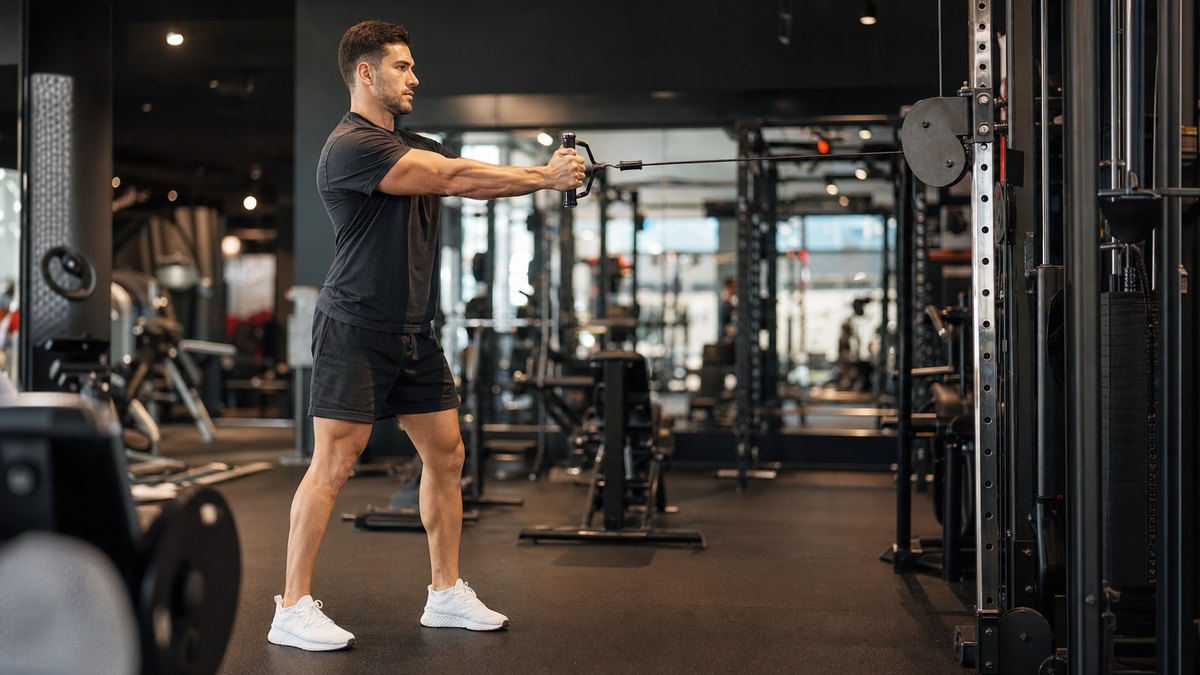
The Pallof press is the gold standard of anti-rotation core work. Standing sideways to a cable, holding the handle at chest, then pressing straight out and resisting the cable’s pull-toward-the-machine tension. The obliques and deep core stabilise against rotation the entire time.
What it is
The Pallof press is an anti-rotation core exercise. The lifter stands perpendicular to a cable at chest height, holds the handle at the sternum with both hands, then presses it straight out in front of the body. The cable pulls sideways; the core resists rotation. Brief hold at extended position, then return.
Muscles worked
| Muscle | Contribution |
|---|---|
| Obliques | ~45 % |
| Transverse abdominis | ~30 % |
| Rectus abdominis | ~15 % |
| Glutes, shoulders | ~10 % |
How to Pallof press: 5 steps
-
Set up cable
Cable at chest height, **stand perpendicular to machine, grip handle with both hands at sternum.**
-
Step away
**Step 1-2 steps away** so cable pulls sideways.
-
Brace
**Core tight, hips square, torso vertical.**
-
Press out
**Press handle straight out in front of body,** arms extend fully.
-
Return and switch
Return to chest under control. Complete reps, switch sides.
How it differs from plank
- Anti-rotation focus. Plank anti-extension; Pallof anti-rotation.
- Cable load. Bodyweight core exercises don’t load directly.
- Standing. Vertical position, functional carryover.
- Sport-specific. Anti-rotation training for throwing/hitting sports.
Common mistakes
When to use this variation
Use Pallof presses for anti-rotation core work and functional stability. Program 3 sets of 10-12 reps per side (or 30-45 sec holds). Excellent for athletes, lifters with lower-back sensitivity, and anyone wanting well-rounded core training.
For more trunk-control options, see the core exercises for back support hub.
FAQ
Cable or band?
Cable is preferred for consistent tension. Resistance band works if no cable available.
How much weight?
Enough that maintaining position feels challenging by end of set. Progress gradually.
Standing, kneeling or half-kneeling?
Standing is standard. Kneeling removes leg stabilisation. Half-kneeling adds hip stability challenge.
Related exercises
- Plank: anti-extension static
- Cable Wood Chop: rotational cable
- Suitcase Carry: anti-lateral-flexion
- Bird Dog: quadruped anti-rotation
Published by: Martin Wood — Writer covering ab exercises
Reviewed, corrected and approved by: Martin Wood — Editor-in-chief
Updated on July 27, 2026