

The dumbbell row is the strict version of the row that exposes asymmetries the barbell row hides. Each side works independently, lower-back fatigue is removed (because one knee and one hand support you on the bench), and the range of motion is greater. If your barbell row plateaus or your back feels lopsided, the dumbbell row is the fix.
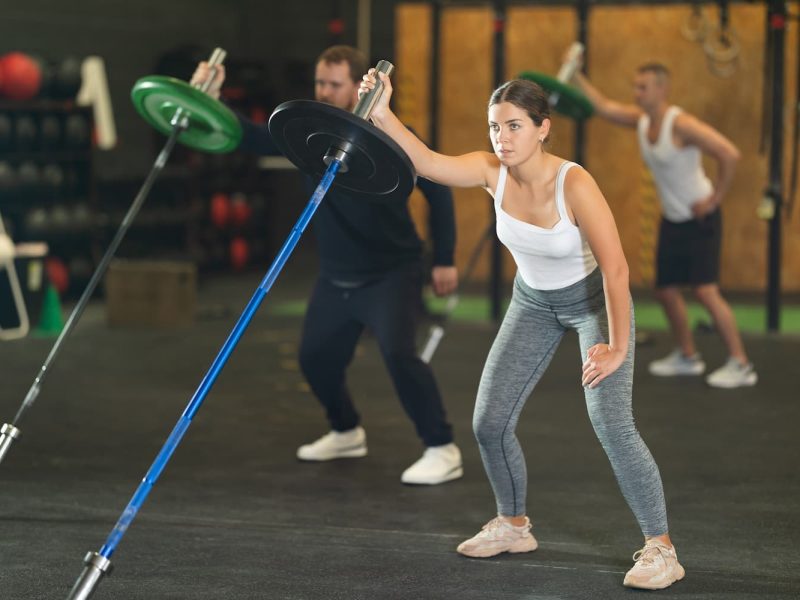
This guide covers the standard single-arm dumbbell row, performed with one knee and one hand on a bench. Variations include the chest-supported row (lying chest-down on an incline) and the meadows row (standing, single-arm at a landmine). The single-arm bench row is the foundational version and the one most lifters should master first.
What is the dumbbell row?
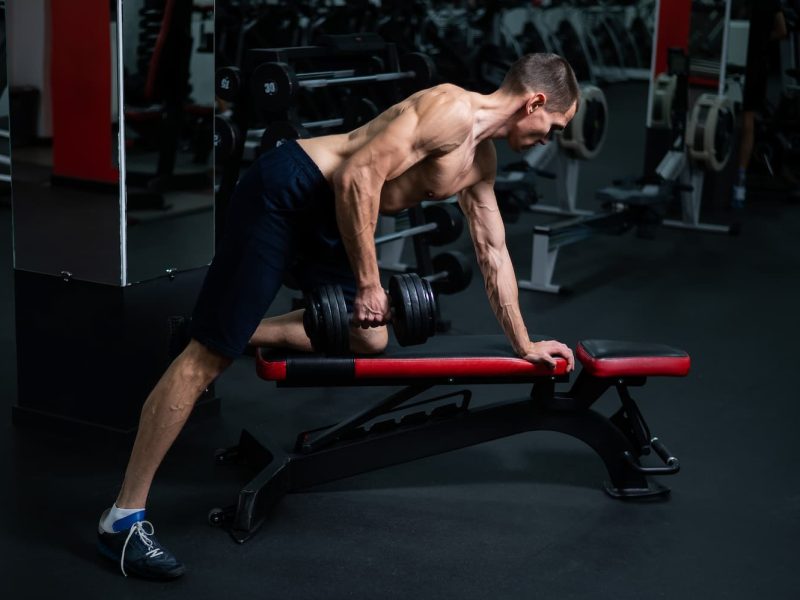
The dumbbell row is a horizontal pulling movement performed with one arm at a time. You support your weight on a bench with one knee and the same-side hand, while the other hand holds a dumbbell at arm’s length toward the floor. You pull the dumbbell up to the lower ribcage by driving the elbow up and back, then lower with control.
It’s functionally a single-arm version of the bent-over barbell row, but the bench support changes everything: the lower back is rested, the torso is fixed, and you can focus entirely on the back muscles doing the work. The trade-off is that you can’t go as heavy as on a barbell — most lifters max out around 40-50 kg per dumbbell.
Muscles worked
| Muscle group | Role | Contribution |
|---|---|---|
| Latissimus dorsi (lats) | Primary mover, shoulder extension | ~50 % |
| Mid-back (rhomboids, lower traps) | Scapular retraction | ~25 % |
| Biceps brachii | Elbow flexion | ~15 % |
| Rear deltoids · Forearms · Core | Stabilisation | ~10 % |
The bench-supported single-arm row is one of the best back exercises for pure lat development — the support eliminates the lower-back fatigue that limits barbell rows, and the longer range of motion (compared to the barbell version) loads the lat through more of its length.
How to dumbbell row: 5 steps
-
Set up on the bench
Place one knee on a flat bench, with the same-side hand on the bench supporting you. The opposite foot stays on the floor for balance. Body roughly parallel to the floor, neutral spine.
-
Pick up the dumbbell
Reach down and grip the dumbbell with the free hand. Arm fully extended, slight stretch in the lat. Shoulder pulled down (don't let it hang loosely).
-
Brace the core and lats
Take a breath into the belly, brace the core. Pull the working-side shoulder blade down and slightly back. Lats engaged before the arm moves.
-
Pull the elbow up and back
**Drive the elbow up and back** toward the ceiling — the dumbbell follows. Don't curl with the biceps. The elbow finishes high, near the ribcage. Squeeze the back at the top.
-
Lower with control
Lower in 2-3 seconds until the arm is fully extended with a stretch in the lat. **Don't rotate the torso** — the working side stays still throughout. Reset, repeat. Switch sides.
Common mistakes to avoid
Dumbbell row variations
- Chest-supported dumbbell row. Lying chest-down on an incline bench. Removes any body English. Pure back work.
- Meadows row. Standing single-arm, with a barbell anchored in a landmine. Greater stretch in the lat at the bottom.
- Two-dumbbell bent-over row. Both dumbbells, hinged-over position. Closer to barbell row but with neutral grip option.
- Seal row. Lying chest-down on a high bench, dumbbell or barbell. Lower-back-free pure rowing.
- Single-arm cable row. Cable handle, one arm. Constant tension throughout.
- Barbell row. The bilateral variant — heavier loads, more lower-back demand.
Sample workout: 4-week back block
Dumbbell rows once or twice per week. Pair with pull-ups on alternate days. Reps are per side.
| Week | Sets × reps/side | Tempo | RPE |
|---|---|---|---|
| 1 | 3 × 10 | 2 sec eccentric | 7 |
| 2 | 4 × 8 | 2 sec eccentric | 7-8 |
| 3 | 4 × 6 | 3 sec eccentric + 1 sec pause at top | 8 |
| 4 (deload) | 3 × 8 | Smooth | 6 |
Frequently asked questions
Dumbbell row or barbell row?
Both. Barbell allows heavier loads and trains the lower back; dumbbell allows asymmetry-fixing and is kinder on the back. Most balanced programs include both, often on different days.
Why is my left side weaker than my right during dumbbell rows?
Welcome to unilateral training — that’s exactly what dumbbell rows expose. To balance: train the weaker side first each session, match the rep count to what the weaker side can do, and add an extra set on the weaker side once a month.
How heavy should I dumbbell row?
For a healthy male intermediate: 25-35 kg dumbbell for 8-10 strict reps per side. For females: 10-18 kg. The right load lets you do strict reps with full range and no torso bobbing.
Should I pull to my hip or my chest?
Lower ribcage / waist area. Pulling to the hip biases the lats more; pulling to the chest biases the upper back and rear delts. Most lifters benefit from cycling between both styles across blocks.
Why does my lower back hurt during dumbbell rows?
The bench should remove most of the lower-back load. If yours hurts, you’re probably twisting the spine to row higher (rotating the torso each rep). Lock the torso in place — only the arm moves. If the bench-supported variant still hurts, switch to chest-supported (lying chest-down on an incline).
Related exercises
- : bilateral, heavier loads
- Chest-Supported Row: pure back, no lower-back load
- Seated Cable Row: machine seated variant
- Pull-Up: vertical pulling counterpart
- Lat Pulldown: machine vertical pull