

The seated cable row is the back exercise everyone should do but most people do badly. It loads the mid-back, lats, and biceps with constant tension throughout the range — a quality the barbell row can’t match. It’s also kinder on the lower back than free-weight rows, making it ideal for high-volume work or for lifters who can’t hinge under heavy load.
This guide covers the standard seated cable row with a V-bar (close-grip) attachment. Wide-grip and rope variations exist and are covered briefly at the end.
What is the seated cable row?
The seated cable row is a horizontal pulling exercise performed seated at a low cable, in which you grip a handle with both hands and pull it toward your lower ribcage by driving the elbows back. The torso stays roughly upright throughout — minimal swinging.
Compared to the barbell row, the seated cable row has three advantages: the seated position removes lower-back fatigue as a limiting factor; the cable provides constant tension at every angle; and the path is fixed so you can focus on the muscles working. The trade-off: load is limited by the cable stack (typically 80-100 kg max), and the lift is slightly less athletic.
Muscles worked
| Muscle group | Role | Contribution |
|---|---|---|
| Mid-back (rhomboids, lower traps) | Primary movers, scapular retraction | ~40 % |
| Lats | Shoulder extension | ~30 % |
| Biceps brachii | Elbow flexion | ~20 % |
| Rear delts, forearms, core | Stabilisation | ~10 % |
The exact muscle distribution depends on grip and pull angle. Pulling a wide bar to the upper chest biases the mid-back and rear delts. Pulling a V-bar to the lower abdomen biases the lats. Both are valid — most balanced back programs include both pulls.
How to seated cable row: 5 steps
-
Set up on the machine
Sit on the seated cable row machine. Place feet on the platform, knees slightly bent. Grip the V-bar (or chosen handle) with both hands. Slide back so your torso is upright and the cable is taut at the start.
-
Set the body position
Sit upright, chest proud. Pull shoulder blades down and back. Brace the core. Knees stay slightly bent throughout — don't lock them out.
-
Pull the elbows back
Drive the **elbows back and down** along the sides of the body. The handle travels in a straight line toward your lower abdomen / belly button. Don't curl with the biceps.
-
Squeeze at the top
When the handle reaches your abdomen, squeeze the shoulder blades together hard. **Mid-back contraction** is the goal. Pause for half a second.
-
Lower with control
Reverse the motion in 2-3 seconds. Let the cable pull your arms forward until you feel a stretch in the lats. Don't fully relax — maintain tension.
Common mistakes to avoid
Variations
- Wide-grip cable row. Long bar with a wide grip. More mid-back and rear delts. Pull to the upper chest.
- Rope cable row. Rope handle, palms facing each other. Allows greater scapular squeeze at the top.
- Single-arm cable row. One arm at a time with a D-handle. Excellent for asymmetry-fixing.
- Reverse-grip cable row. Underhand grip on a straight bar. More biceps involvement, lower lat focus.
- Chest-supported cable row. Lying chest-down on a bench. Pure back work, no torso bobbing.
- Barbell row. Free-weight horizontal row, heavier loads.
Sample workout: 4-week back block
Cable rows 2 times per week. Pair with vertical pulls (pull-ups, lat pulldowns) on the same day or alternate days for full back coverage.
| Week | Sets × reps | Tempo | RPE |
|---|---|---|---|
| 1 | 3 × 12 | 2 sec eccentric | 7 |
| 2 | 4 × 10 | 2 sec eccentric + 1 sec pause at top | 7-8 |
| 3 | 4 × 10 + 1 set wide-grip | 3 sec eccentric | 8 |
| 4 (deload) | 3 × 10 | Smooth | 6 |
Frequently asked questions
Cable row or barbell row?
Both. Cable row provides constant tension and is easier on the lower back, perfect for hypertrophy. Barbell row allows heavier loads and trains the lower back as a stabiliser. Most balanced programs include both.
Should I lean back during the rep?
A small lean back (10-15°) is fine and natural at peak contraction. A big lean (30-45°) means the load is too heavy and you’re using body English. Stay close to vertical.
How heavy should I cable row?
For a healthy male intermediate: 50-70 kg on the cable for 10 strict reps. For females: 25-40 kg. The right weight is what lets you do strict reps with no torso bobbing or lean-back.
Why don’t I feel my mid-back during cable rows?
You’re probably pulling with the biceps. At the top of each rep, focus on **squeezing the shoulder blades together** — that engages the mid-back. The arms are just hooks; the back drives.
Should I touch my chest with the handle?
For wide-grip variations pulled to the upper chest: yes, light touch. For V-bar pulled to the lower abdomen: yes, light touch. Either way, full ROM matters.
Related exercises
- Barbell Row: free-weight horizontal pull
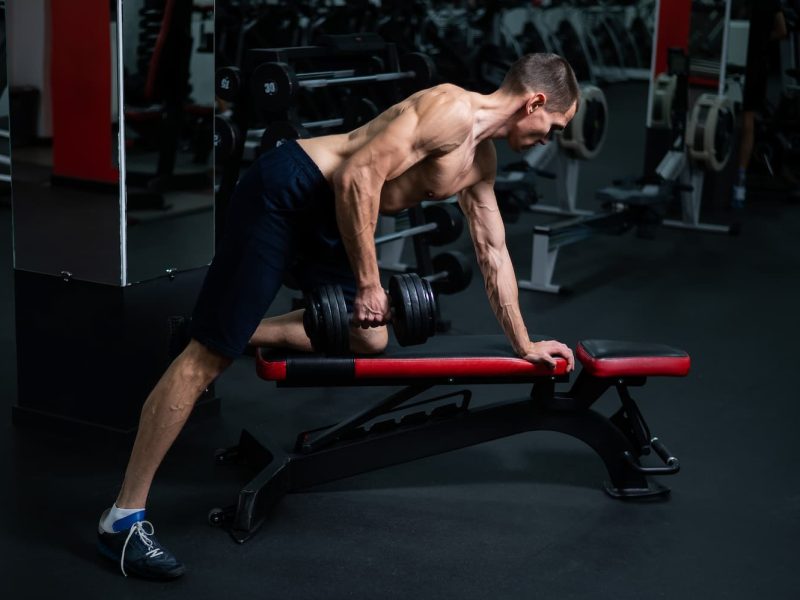
- Dumbbell Row: single-arm horizontal pull
- Lat Pulldown: vertical pull complement
- Pull-Up: bodyweight vertical pull
- Face Pull: rear delt + posture finisher
Published by: Jay — Writer covering back exercises
Reviewed, corrected and approved by: Martin Wood — Editor-in-chief
Updated on May 8, 2026