
The chest-supported row removes the lower back from the rowing equation. With your torso supported on an incline bench, you can pull heavy and chase pure back stimulus without worrying about lumbar fatigue or technique breakdown. It is one of the cleanest upper-back hypertrophy tools in the gym.
What it is
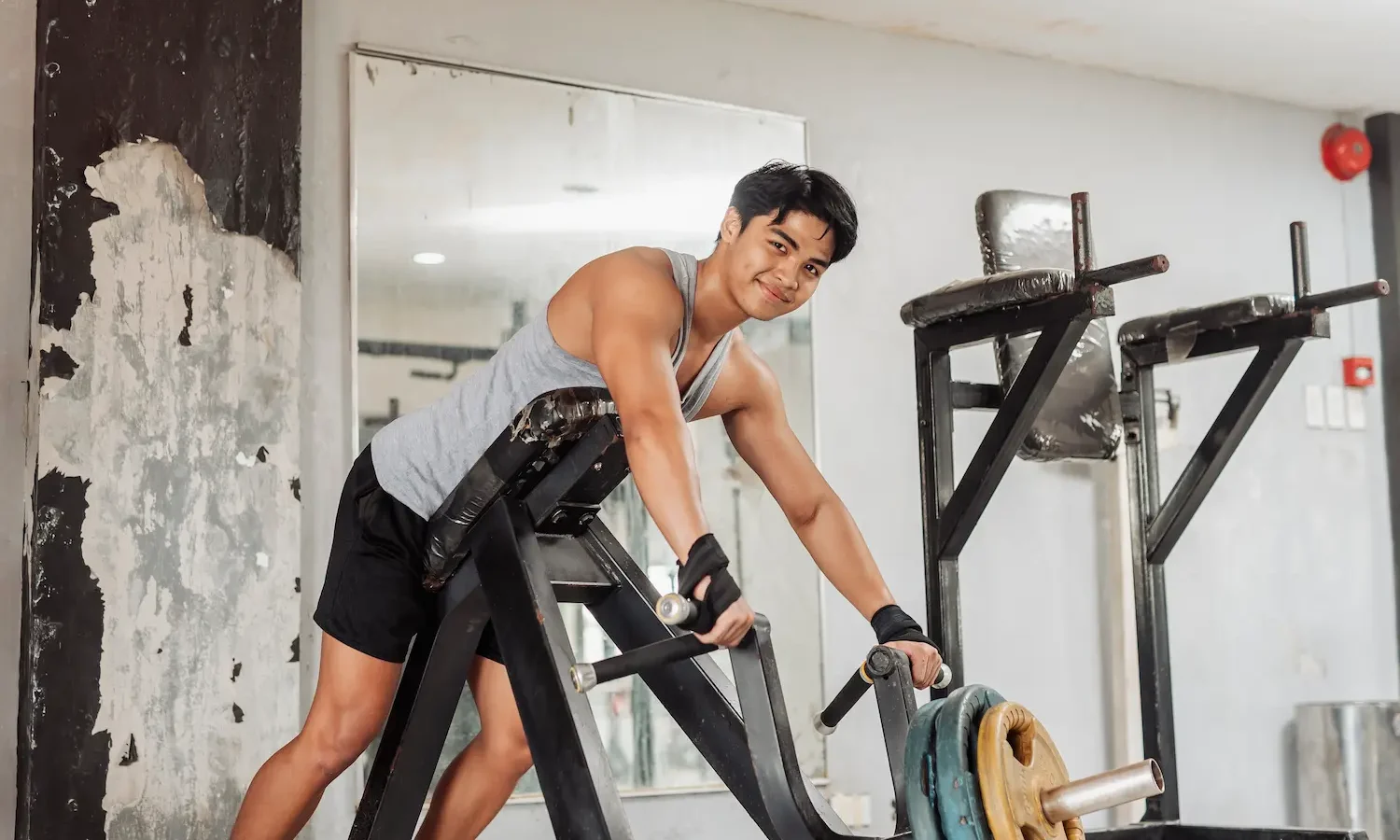
The chest-supported row is a rowing exercise performed face-down on an incline bench set at 30-45°. The bench supports the torso so the lower back does no isometric work. The lifter rows two dumbbells (or a barbell, T-bar handle, or even a Smith machine bar) up toward the hips while keeping the chest pressed into the bench.
Muscles worked
| Muscle | Contribution |
|---|---|
| Lats | ~40 % |
| Rhomboids, mid-traps | ~30 % |
| Rear delts, biceps | ~25 % |
| Forearms | ~5 % |
How to chest-supported row: 5 steps
-
Set the bench
Set an incline bench at **30-45°**. Place two dumbbells on the floor at each side.
-
Lie face-down
**Lie chest-down on the bench, feet on the floor or footrest.** Grab the dumbbells, arms extended.
-
Brace the scapulae
**Engage the upper back, retract the shoulder blades slightly before pulling.**
-
Row to the hips
**Pull the dumbbells up toward the hips, elbows tight to the body.** Squeeze the back at the top.
-
Controlled descent
**Lower over 2 seconds** to full arm extension. Chest stays pressed into the bench throughout.
How it differs from barbell row
- Torso supported. The lower back does no isometric work — pure focus on the upper back.
- Strict by design. Impossible to cheat with body english when the chest is locked to the bench.
- Higher-volume tool. Less systemic fatigue means more sets possible per session.
- Lower-back recovery. Ideal when squats and deadlifts have your lower back taxed.
Common mistakes
When to use this variation
Use chest-supported rows for high-volume upper-back work, lower-back recovery weeks, or as a strict-form complement to heavier free-standing rows. Program 3-4 sets of 8-15 reps. Pair after compound pulling like deadlifts or pull-ups for a focused back-thickness stimulus.
FAQ
What bench angle?
30-45° works best. Lower angles (30°) keep more focus on the lats; steeper angles (45°) shift work to the mid-traps and rhomboids.
Dumbbells, barbell or T-bar?
All work. Dumbbells give independent loading; barbell is the heaviest loading option; T-bar handle (placed under the bench) gives a neutral grip. Rotate between them.
Chest-supported row or seal row?
The seal row uses a flat bench raised so a barbell can swing freely underneath. It is even stricter and requires specific setup. The chest-supported row is more versatile and easier to set up in any gym.
Related exercises
- Barbell Row: free-standing bilateral row
- Seal Row: the strictest chest-supported variant
- Dumbbell Row: single-arm free-standing row
- T-Bar Row: free-standing T-bar version
Published by: Jay — Writer covering back exercises
Reviewed, corrected and approved by: Martin Wood — Editor-in-chief
Updated on September 29, 2026