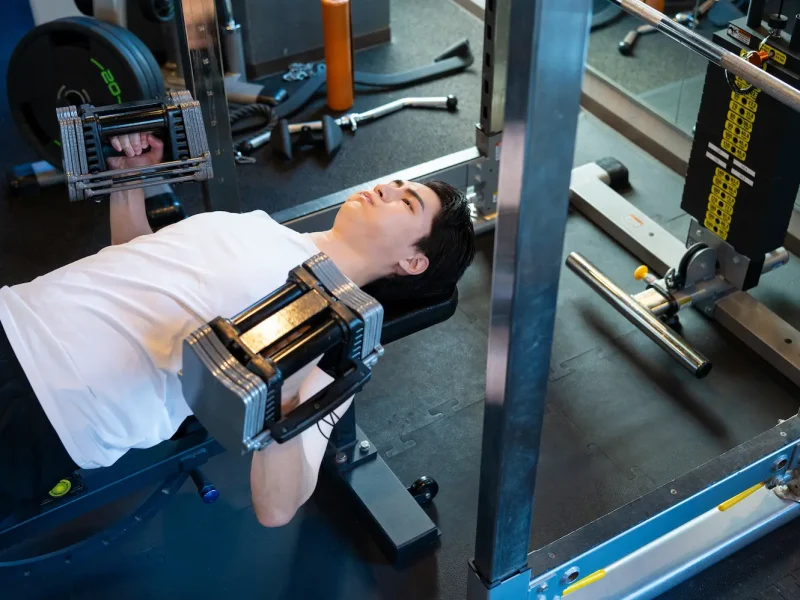


The tempo bench press is the bench press with a deliberately slow eccentric phase — typically 3-5 seconds to lower the bar to the chest, instead of the 1-2 seconds most lifters use. The extended eccentric increases time under tension, improves bar control, and exposes weaknesses in shoulder positioning and tightness that fast eccentrics let you cheat through.
What it is
The tempo bench press is a bench press where the descent (eccentric) phase is intentionally extended to 3-5 seconds. The lifter counts the descent — “one, two, three” silently or with a coach calling tempo — while maintaining full body tension, scapular retraction, and bar control. The pause at the chest is usually 1 second, and the concentric (press up) is normal speed.
Muscles worked
| Muscle | Contribution |
|---|---|
| Pectoralis major | ~45 % |
| Triceps brachii | ~20 % |
| Anterior deltoid | ~15 % |
| Lats, traps, core, scapular stabilisers | ~20 % |
How to tempo bench press: 5 steps
-
Set up tight on the bench
Lie on the bench, retract scapulae, slight arch, feet planted. Grip slightly wider than shoulder-width. Brace core.
-
Unrack and set position
Unrack the bar with help if heavy. Bar held over the chest with arms extended. **Mentally commit to the slow eccentric.**
-
Lower slowly with control
**Lower the bar in 3-5 seconds** (count silently or have a coach call tempo). Maintain shoulder retraction, body tension, bar path throughout. **Elbows tuck at 45-60°.**
-
Brief pause at the chest
1-second pause at the chest. **No bounce.** Maintain tightness — this is where form often breaks during fast eccentrics.
-
Press up at normal speed
**Press the bar back up normally** — 1-2 seconds. The concentric is standard speed; only the eccentric is slowed. Reset, repeat.
How it differs from standard bench press
- Slow eccentric forces tension. The standard bench can be lowered fast — sometimes hiding shoulder or back tension issues. The tempo version exposes them; you can’t fake form for 3-5 seconds of controlled descent.
- More time under tension. Standard bench rep = ~3 sec total. Tempo bench rep = ~7-10 sec total. Significantly more chest stimulus per rep.
- Lower loads. Most lifters tempo-bench 70-80 % of their standard bench 1RM. The extended eccentric is harder than it sounds.
- Builds bar-path consistency. Slow descents teach the lifter exactly where the bar should travel, reinforcing the optimal path.
Common mistakes
When to use this variation
Use tempo bench during off-season hypertrophy blocks (more time under tension = more chest growth), during technique-rebuild blocks after time off, or as accessory work to fix form issues. 4-6 week blocks at 70 % of bench 1RM, 3-4 sets of 5-8 reps, with 3-5 sec eccentric.
FAQ
How long should the eccentric be?
3-5 seconds is the standard tempo range. 3 sec for moderate loads (75-80 % of bench 1RM). 5 sec for lighter loads (70 % of bench 1RM). Longer tempos (8+ sec) become specialty work — not recommended as default tempo.
Tempo bench or pause bench?
Different focuses. Pause bench emphasises bottom-position strength. Tempo bench emphasises eccentric control and time under tension. Combine them: use tempo bench in hypertrophy blocks, pause bench in strength blocks.
Why is the eccentric so taxing?
Eccentric muscle contractions (lengthening under load) cause the most muscle damage — and thus the most growth — per rep. A 5-second eccentric extends this damage-causing phase, leading to more hypertrophy stimulus per rep than fast eccentrics.
Related exercises
- Pause Bench Press: chest-pause variant
- Bench Press: standard speed
- Dumbbell Bench Press: stretch-emphasis variant
- Spoto Press: mid-air pause
Published by: Jay — Writer covering chest exercises
Reviewed, corrected and approved by: Martin Wood — Editor-in-chief
Updated on September 29, 2026