
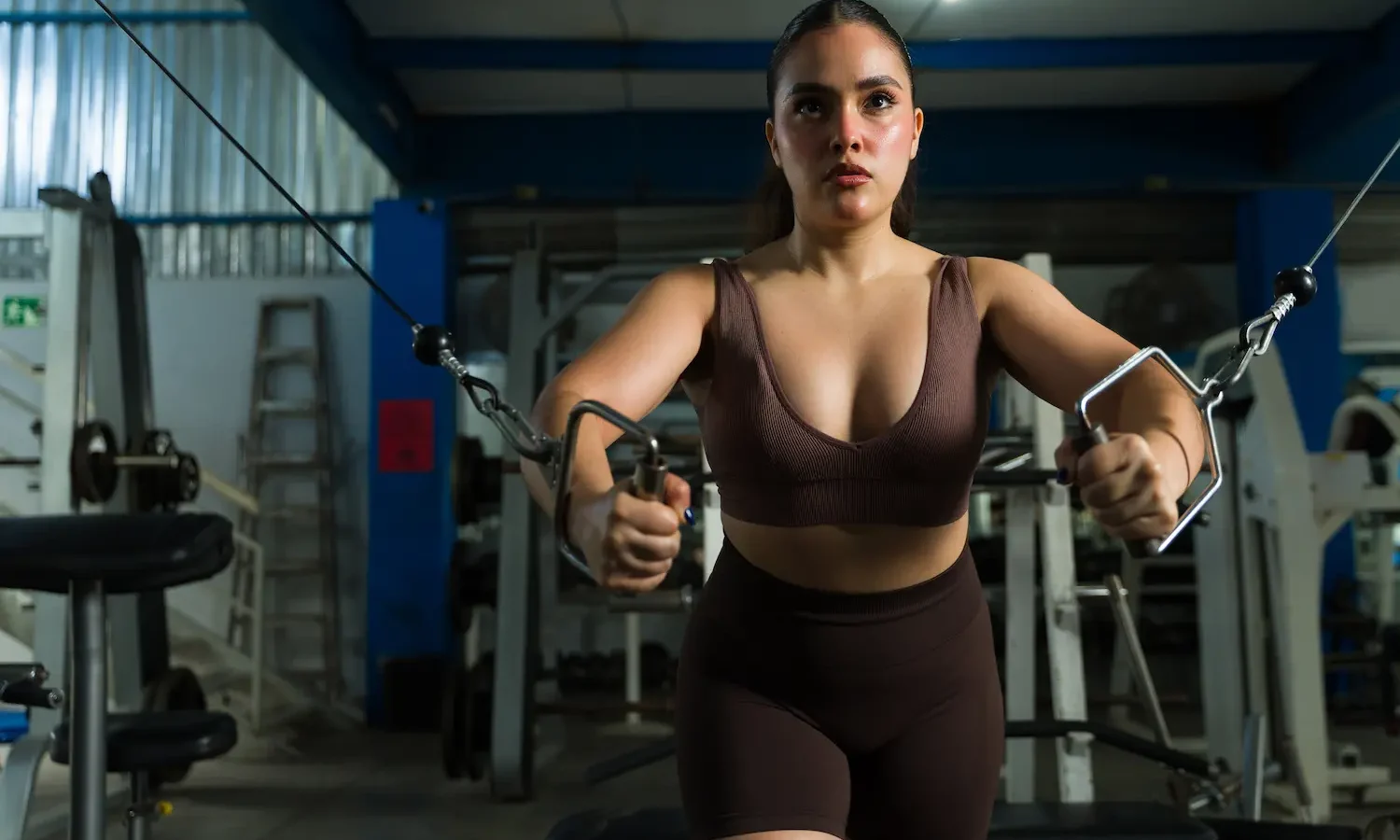
The cable crossover is the gold-standard cable chest fly. Standing in the centre of a dual-cable station with handles set at shoulder height (or high), you pull both cables down and across the body, crossing the hands at the midline. The crossing motion gives the inner pec a peak contraction no other chest exercise can match.
It’s the finisher exercise that every chest day deserves. Pair it with compound pressing (bench, dips) for complete chest development.
What is the cable crossover?
The cable crossover is a cable chest isolation performed at a dual cable station. With handles at high or shoulder-height settings, you stand in the middle, grip both handles with arms slightly bent, then bring the hands together in front of the body — crossing them slightly past midline for the peak squeeze. The shoulders adduct horizontally; the elbows stay fixed at a slight bend.
The constant cable tension keeps the chest loaded throughout the entire range — including the cross-over at the centre where free-weight flyes have already lost all resistance. For chest hypertrophy in the inner-pec region, nothing beats it.
Muscles worked
| Muscle group | Role | Contribution |
|---|---|---|
| Pectoralis major (sternal head) | Primary mover, horizontal adduction | ~70 % |
| Anterior deltoid | Shoulder flexion assist | ~15 % |
| Serratus anterior | Scapular protraction | ~10 % |
| Biceps (short head) | Elbow stabilisation | ~5 % |
The cable crossover isolates the pectoralis major cleanly. Cable angle determines the emphasis: high-to-low crossover hits the lower/inner chest; mid-height hits the middle/sternal region; low-to-high hits the upper chest.
How to cable crossover: 5 steps
-
Set up the dual cable station
Set both cables to the **high pulley** (for high-to-low crossover) or shoulder height. Attach single handles. Stand in the centre, one foot slightly forward in a staggered stance. Grip the handles with arms extended out and slightly bent.
-
Set the body position
Lean **slightly forward at the hips** (15-20°). Brace the core. Elbows at a **fixed slight bend (~15-20°)** — this bend stays the same throughout. Cable tension pulls arms back and slightly up.
-
Pull the hands together in an arc
**Bring the hands together in a wide arcing path** down and across the body in front of you. **Drive with the chest** — feel the pec working. 2 seconds. Hands meet at midline at chest or stomach height (depending on cable height).
-
Cross at the centre and squeeze
**Cross the hands 5-15 cm past midline** at the centre. 1-2 second pause — **squeeze the chest hard** at peak contraction. Don't let the elbows extend.
-
Return with control
Reverse in 3 seconds back to the wide-arm starting position. **Maintain cable tension** throughout — stop just before the cables slack. Reset, repeat.
Common mistakes to avoid
Variations
- High-to-low cable crossover. Cables from high pulleys, hands meet low in front. Lower-chest emphasis.
- Low-to-high cable crossover. Cables from low pulleys, hands meet high. Upper-chest emphasis.
- Mid-height cable crossover. Cables at shoulder height. Middle-chest emphasis. The standard.
- Single-arm cable crossover. One arm at a time. Identifies asymmetries, allows greater ROM.
- Kneeling cable crossover. Kneeling stance for max strictness, no body sway.
- Dumbbell fly. Free-weight version, loses tension at the top.
- Pec deck. Machine-based fly, easier to learn.
Sample workout: 4-week chest finisher block
Cable crossovers as the last chest exercise on push days, 2 times per week. Pair with main compound pressing earlier in the session.
| Week | Sets × reps | Tempo |
|---|---|---|
| 1 | 3 × 12 | 2 sec in + 1 sec squeeze + 2 sec out |
| 2 | 4 × 12 | 2 sec in + 2 sec squeeze + 2 sec out |
| 3 | 3 × 15 + drop set | 1 sec in + 1 sec squeeze + 3 sec out |
| 4 (deload) | 3 × 12 | Smooth |
Frequently asked questions
Cable crossover or dumbbell fly?
Cable wins for constant tension and peak-contraction loading at the centre. Dumbbell flyes lose tension precisely where they should be working hardest (at the top of the rep). For the inner-chest contraction specifically, cable crossover is markedly superior.
Should the hands actually cross at the centre?</h3
Yes — slightly. Bringing the hands to “just touching” gets you to about 90 % of the chest contraction. Letting them cross by 5-15 cm past midline gets the last 10 % and is what makes the exercise unique. Don’t over-cross by 30 cm — the cable tension becomes awkward.
What cable height should I use?</h3
Depends on the chest region you want to emphasise. **High cables, low cross** = lower chest. **Low cables, high cross** = upper chest. **Shoulder-height cables, mid cross** = middle chest. Most lifters rotate between heights.
How heavy should the cable crossover be?</h3
Light to moderate. Cable crossover is isolation — the goal is feeling the chest, not lifting maximum load. Most lifters work in the 15-30 kg per side range for 10-15 reps. Heavier loads almost always force form breakdown (body sway, elbows extending).
Why do I feel it more in my shoulders than chest?</h3
Two common causes. (1) Elbows are too straight — the front delts take over. Keep the elbows at ~15-20° bend. (2) You’re leaning forward too much from the hips, which shifts the load to the shoulders. Stay more upright with a slight hinge.
Related exercises
- Pec Deck: machine fly
- Bench Press: compound chest builder
- Incline Dumbbell Press: upper-chest compound
- Dips: bodyweight chest + triceps
- Push-Up: bodyweight chest foundational
Published by: Jay — Writer covering chest exercises
Reviewed, corrected and approved by: Martin Wood — Editor-in-chief
Updated on May 17, 2026