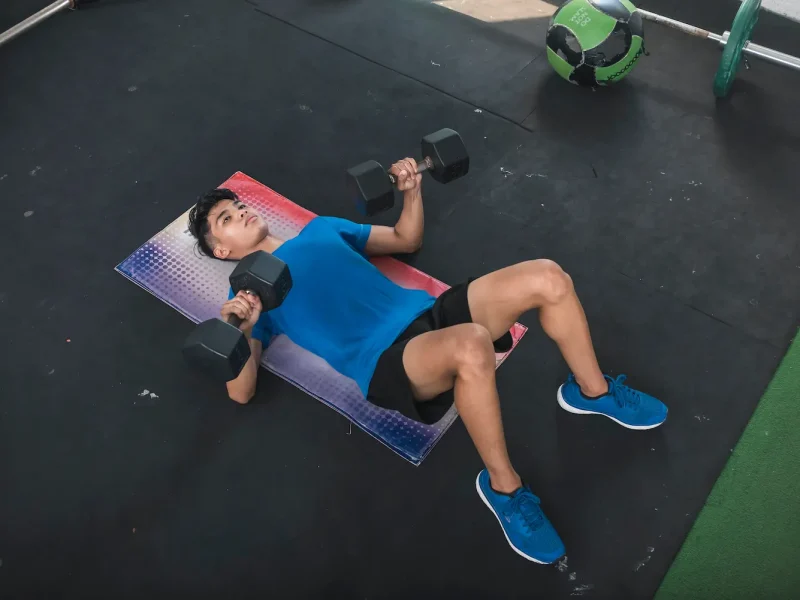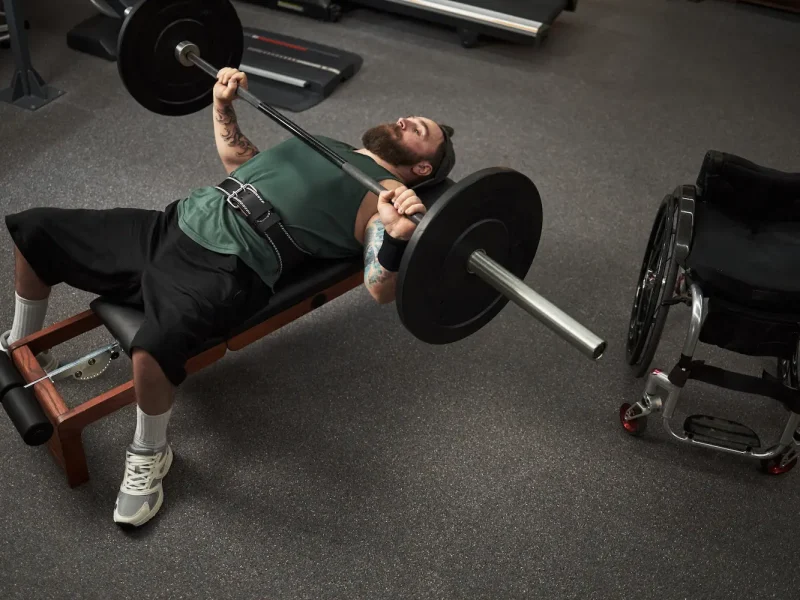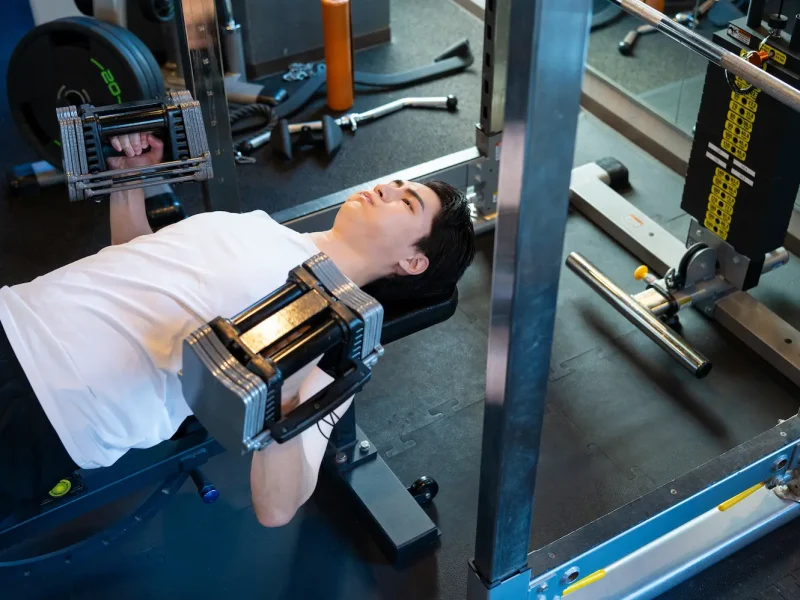


The incline dumbbell press is the upper-chest builder for lifters who don’t want to bench heavy. While the incline barbell bench wins on absolute load, the dumbbell version wins on range of motion, asymmetry-fixing, and shoulder-friendliness. For most physique-focused lifters, it’s the better choice.
This guide covers the standard incline dumbbell press at 30-45° — the angle that hits the upper chest hardest without turning the lift into a shoulder press.
What is the incline dumbbell press?
The incline dumbbell press is a horizontal pushing exercise performed on a bench inclined at 30-45° from horizontal, in which you press two dumbbells from chest level to arm’s length. Compared to the barbell incline, the dumbbells allow each arm to work independently, expose left-right asymmetries, and provide greater range of motion at the bottom (the dumbbells can travel below chest level).
Compared to the flat bench press, the incline version shifts work from the lower chest to the upper chest (clavicular pec fibres) and recruits more anterior delt. At 30°, the bias is mostly upper chest. At 45°, it’s roughly half upper chest, half front delt.
Muscles worked
| Muscle group | Role | Contribution |
|---|---|---|
| Pectoralis major (clavicular head / upper chest) | Primary mover | ~50 % |
| Anterior deltoid | Press initiation | ~25 % |
| Triceps brachii | Lockout | ~20 % |
| Stabilisers (rotator cuff, serratus) | Balance, dumbbell control | ~5 % |
The unique advantage of dumbbells over the barbell is that they let each arm find its own optimal path. They also load the stabilisers harder — the rotator cuff has to work to control independent dumbbells, building shoulder health.
How to incline dumbbell press: 5 steps
-
Set the bench and grab the dumbbells
Adjust bench to 30° (or up to 45° for more shoulder bias). Sit on the bench with dumbbells on your thighs. Lean back, kick the knees up to bring the dumbbells with you. Position dumbbells at chest level, palms facing forward.
-
Set the upper back
Pull shoulder blades together and down. Slight upper-back arch, glutes glued to the bench. Brace the core. Feet planted firmly.
-
Lower with control
Lower the dumbbells in a 2-second controlled descent. **Elbows tucked at 45-60° from the torso** — not flared out. Lower until the dumbbells are at upper-chest level (or slightly below for ROM).
-
Press up and slightly inward
Drive the dumbbells up and slightly together. The dumbbells finish nearly touching at the top, over the upper chest. **Soft lockout** — don't hyperextend.
-
Pause and reset
Half-second hold at the top. Reset breath and brace. Don't let the dumbbells crash back down — control the eccentric.
Common mistakes to avoid
Variations
- Incline barbell bench. Heavier loads possible. Less range of motion. The strength-focused alternative.
- Low-incline dumbbell press (15-25°). Closer to flat. Still hits upper chest but with more lower-chest involvement.
- High-incline dumbbell press (50-60°). Shifts work toward shoulders. Bridge to overhead pressing.
- Incline dumbbell fly. Same incline, but arc the dumbbells out to the sides instead of pressing. Pure chest stretch isolation.
- Single-arm incline dumbbell press. One dumbbell at a time. Even better asymmetry exposure.
- Decline bench press. The opposite-angle complement for full chest development.
Sample workout: 4-week upper chest block
| Week | Sets × reps | RPE |
|---|---|---|
| 1 | 3 × 10 | 7 |
| 2 | 4 × 8 | 7-8 |
| 3 | 4 × 6 | 8 |
| 4 (deload) | 3 × 8 | 6 |
Frequently asked questions
Incline dumbbell or incline barbell?
Both. Barbell allows heavier loads and is the strength lift. Dumbbells allow greater ROM and asymmetry-fixing. Most balanced programs include both, often alternating across blocks.
What angle should the bench be?
30° for most lifters. 45° if you want more shoulder. Above 60° you’re basically doing a shoulder press.
How heavy should I incline dumbbell press?
Most lifters can incline dumbbell press about 35-40 % of their flat bench per dumbbell. So 100 kg flat bench = ~35-40 kg per dumbbell for 8 reps.
How do I get the dumbbells into position safely?
Sit on the bench with the dumbbells on your thighs. Lie back while kicking your knees up to lift the dumbbells with you. Once flat, position the dumbbells at chest level and start the set.
Why does my front shoulder hurt during incline press?
Either the angle is too steep (50°+ stresses the front delt heavily) or your elbows are flaring out at 90°. Try a 30° angle and tuck the elbows to 45-60° from the torso.
Related exercises
- Incline Bench Press: barbell variant, heavier loads
- Bench Press: flat barbell foundational
- Dumbbell Bench Press: flat dumbbell variant
- Incline Dumbbell Fly: chest stretch isolation
- Dips: bodyweight chest complement
Published by: Jay — Writer covering chest exercises
Reviewed, corrected and approved by: Martin Wood — Editor-in-chief
Updated on May 8, 2026