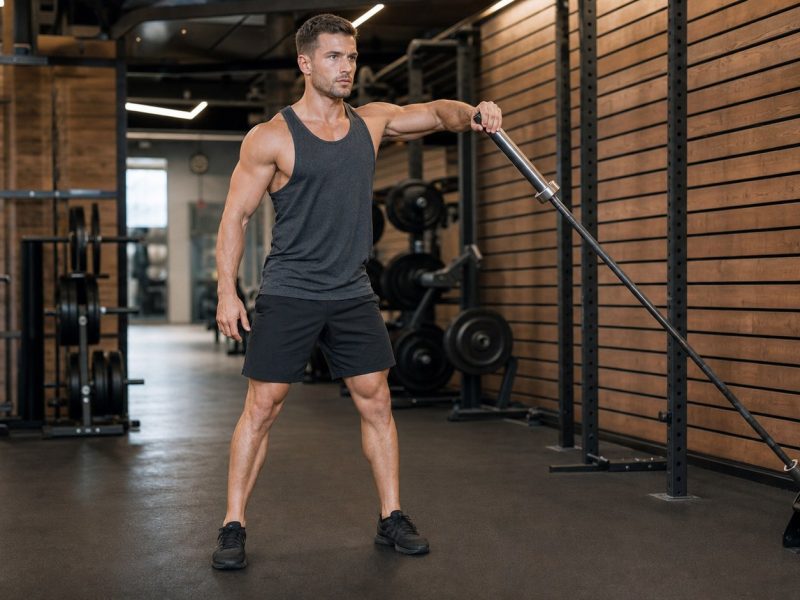

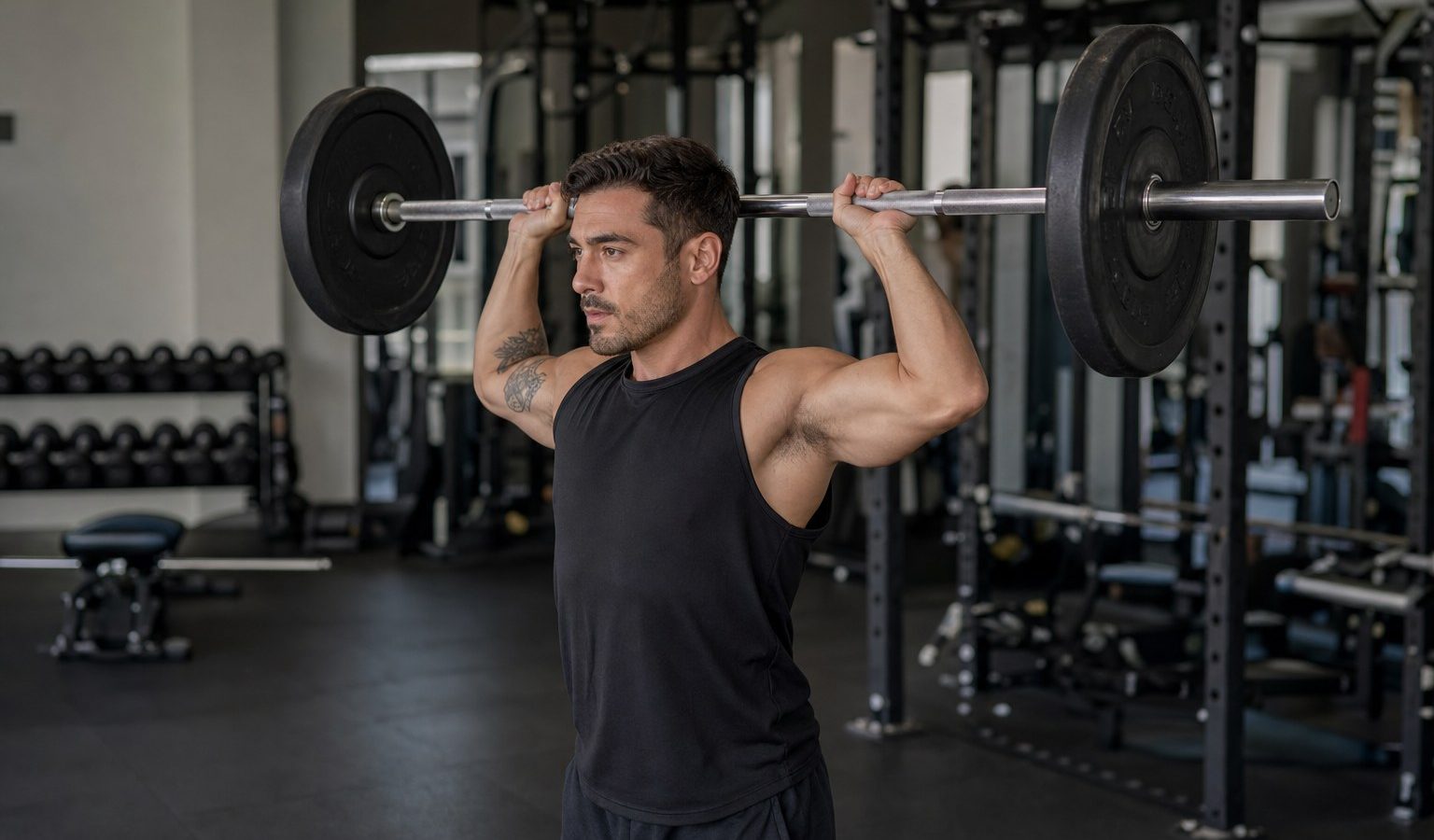
The Bradford press alternates between a front press and a behind-the-neck press in continuous motion. Named after Olympic lifter Jim Bradford, it never lets the bar fully lock out — creating constant time under tension on the shoulders. It’s an old-school delt builder that still works.
What it is
The Bradford press is a barbell shoulder press that rocks the bar from front to back over the head continuously. Starting at the chest, the bar is pressed up and back over the head (behind-neck position), then forward and up (front position), never fully locking out. Each cycle counts as one rep.
Muscles worked
| Muscle | Contribution |
|---|---|
| Anterior deltoid | ~40 % |
| Lateral deltoid | ~25 % |
| Posterior deltoid | ~15 % |
| Triceps, traps, core | ~20 % |
How to Bradford press: 5 steps
-
Set up seated
Seated with back support, **barbell at collar bone.**
-
Brace
**Core tight, chest up, elbows below bar.**
-
Press over head
**Press bar just over the head, arms not fully extended.** Bar clears skull.
-
Lower behind neck
**Bring bar down behind neck to upper trap level.**
-
Reverse to front
**Press up and forward back to collarbone position.** That's one rep.
How it differs from standard OHP
- Continuous rocking motion. No lockout — bar oscillates between front and behind.
- All three delt heads worked. Front and back positions cover all fibres.
- Constant tension. No rest position; shoulders work continuously.
- Requires shoulder mobility. The behind-neck position demands good thoracic and shoulder mobility.
Common mistakes
When to use this variation
Use Bradford presses as a shoulder finisher for time under tension. Program 3 sets of 8-12 reps. Skip if you have shoulder mobility issues or a history of impingement.
FAQ
Is it safe for the shoulders?
For healthy, mobile shoulders — yes. Anyone with impingement or rotator cuff issues should skip; the behind-neck component is risky.
Seated or standing?
Seated (with back support) is stricter and safer. Standing allows more mobility but higher fall risk.
How high behind the neck?
Just past the ears or upper neck. Deeper adds shoulder stress without extra benefit.
Related exercises
- Overhead Press: strict front version
- Behind-the-Neck Press: back-only variant
- Arnold Press: rotational alternative
- Push Press: leg-drive OHP
Published by: Martin Wood — Writer covering shoulder exercises
Reviewed, corrected and approved by: Martin Wood — Editor-in-chief
Updated on July 20, 2026