
The band-assisted pull-up uses a resistance band looped over the bar and around the foot or knee to reduce the bodyweight load on the pull. It is the cleanest path from zero pull-ups to your first strict rep, and a versatile tool for higher-volume training even for advanced lifters.
What it is
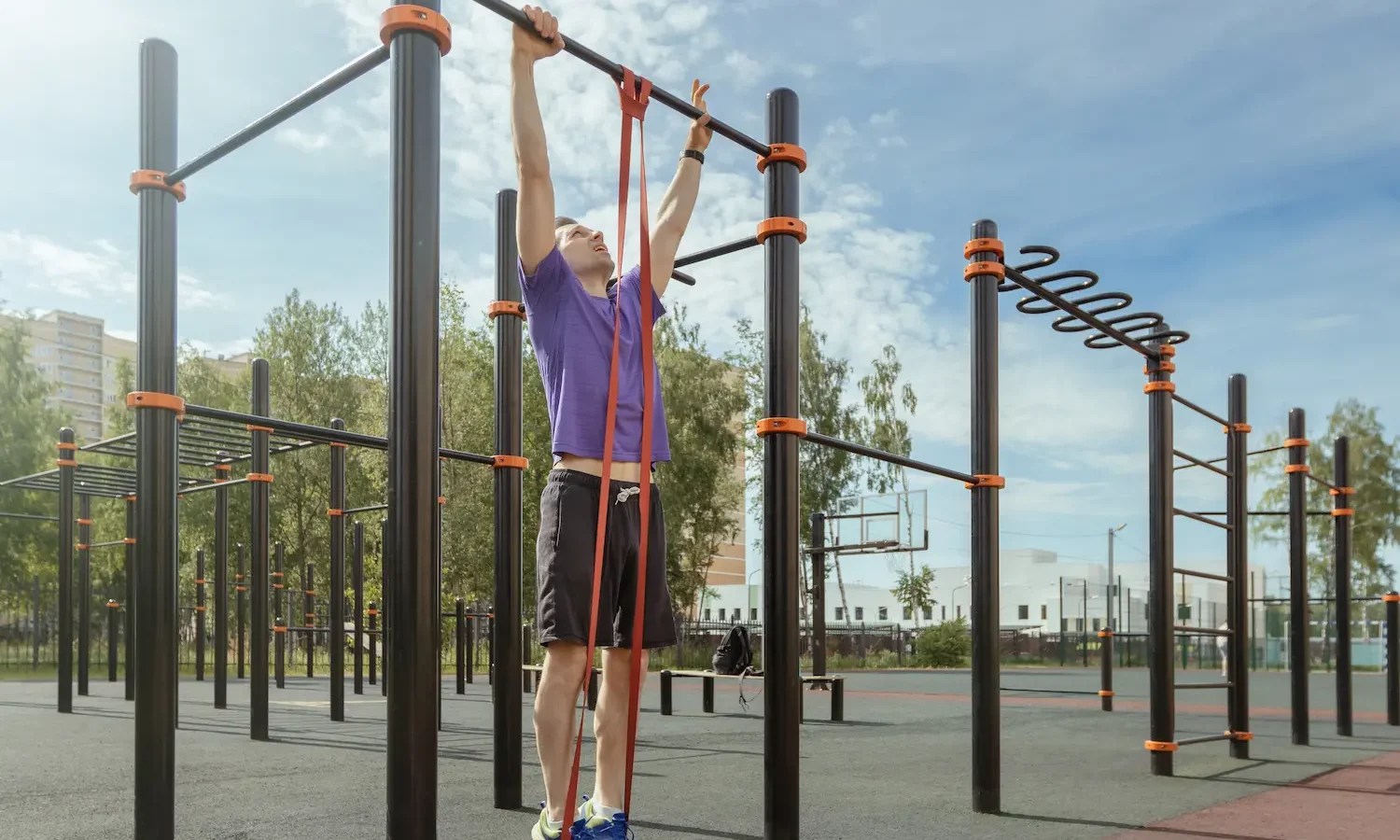
The band-assisted pull-up is a standard pull-up performed with one end of a resistance band looped over the bar and the other under one knee or foot. The band stretches at the bottom of the pull and assists most at full hang — exactly where the lift is hardest for beginners. Different band thicknesses provide 5-30 kg of assistance.
Muscles worked
| Muscle | Contribution |
|---|---|
| Lats | ~45 % |
| Biceps, brachialis | ~25 % |
| Traps, rhomboids | ~20 % |
| Forearms, core | ~10 % |
How to band-assisted pull-up: 5 steps
-
Loop the band
Loop the band over the pull-up bar with a girth hitch. **The other end hangs down.**
-
Step into the band
**Place one knee in the band loop** (or foot for more assist). Hands on the bar, shoulder-width pronated grip.
-
Active hang
**Engage the scapulae,** brace the core. The band supports part of your weight.
-
Pull strict
**Drive the elbows down to the hips. Chin clears the bar.**
-
Controlled descent
**Lower over 2-3 seconds** to a full dead hang. The band assists most here.
How it differs from standard pull-up
- Reduced bodyweight load. The band reduces the effective weight by 5-30 kg depending on band thickness.
- Most help at the bottom. Band assistance is greatest at full hang and decreases at the top — opposite of a real pull-up’s strength curve.
- Beginner-friendly. Lets you train pull-up patterning before you can do unassisted reps.
- Easier on grip. The assist reduces the work the hands need to do.
Common mistakes
When to use this variation
Use band-assisted pull-ups to build toward your first unassisted rep, or to add high-volume back work without burning out grip and biceps. Program 3-4 sets of 6-12 reps. Progress by using thinner bands as you get stronger. Once you can do 12 reps with a medium-thickness band, drop to a thinner band — or attempt your first unassisted pull-up.
FAQ
Which band size to start with?
For an absolute beginner (no unassisted pull-ups): start with a thick band giving 20-30 kg of assistance. For an intermediate working on volume: a thin band giving 5-10 kg.
Foot or knee in the band?
The knee is easier and more stable. Foot gives slightly more assistance but is less stable. Start with the knee.
Band-assisted or negative pull-ups?
Combine both. Band-assisted teaches the full pulling pattern; negatives (jump to top, lower slowly) build the eccentric strength. Most successful first-pull-up programs use both.
Related exercises
- Pull-Up: the target
- Inverted Row: another progression option
- Lat Pulldown: machine alternative
- Chin-Up: often the first unassisted milestone
Published by: Jay — Writer covering back exercises
Reviewed, corrected and approved by: Martin Wood — Editor-in-chief
Updated on June 1, 2026