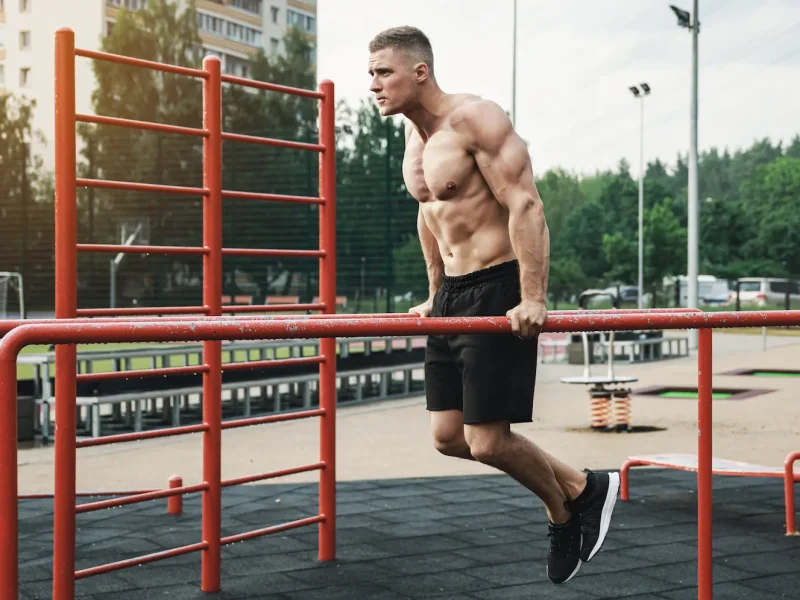

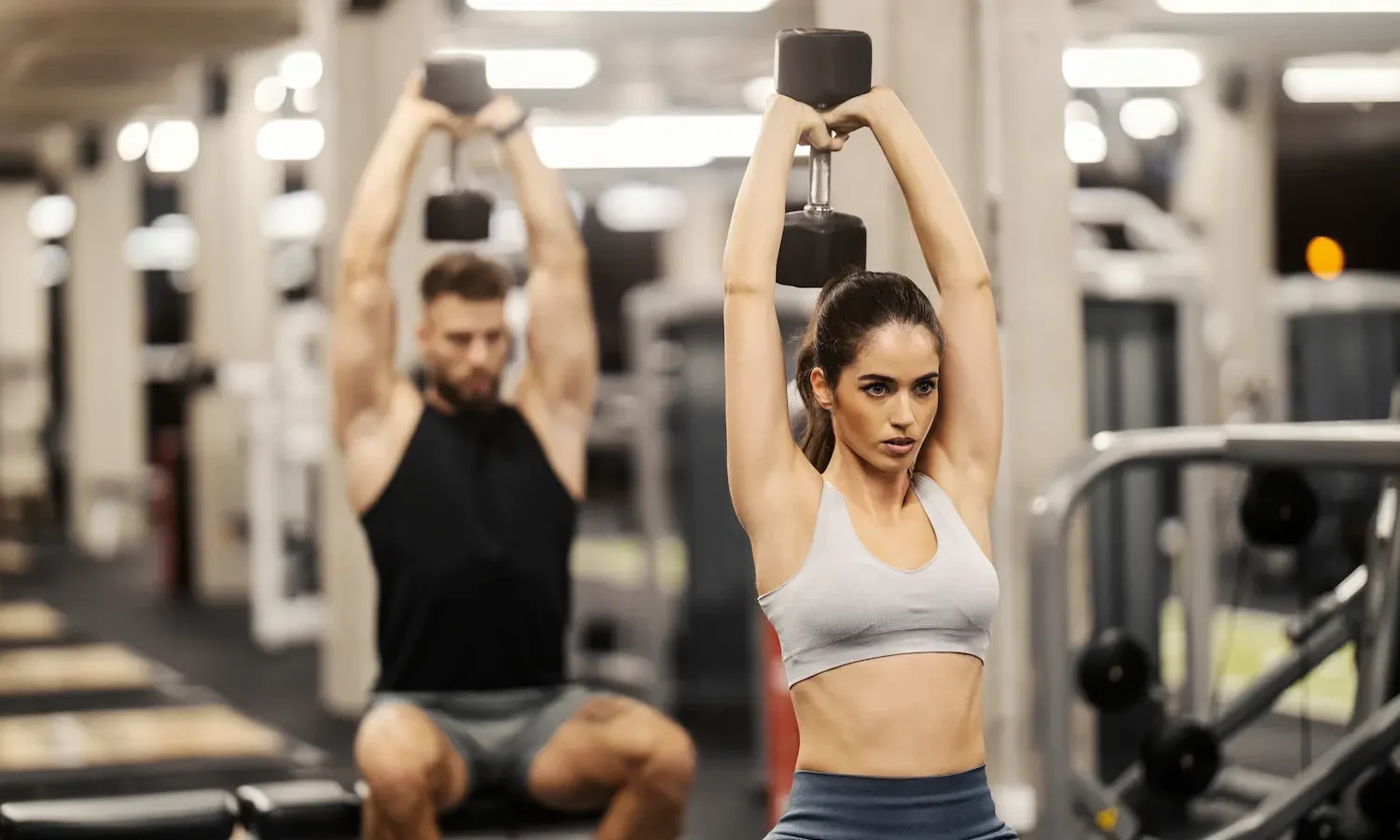
The triceps extension is the most efficient way to build the long head of the triceps — the muscle that gives the upper arm its thick, horseshoe shape. While the bench press and dips hit the triceps as a secondary, only an exercise that fully extends the elbow with the arm overhead loads the long head through its complete range.
This guide covers the overhead triceps extension (also called French press) — the foundational triceps isolation. Several variations exist (skull crusher, kickback, pushdown), each with their own merits, but the overhead version is where most lifters should start.
What is the triceps extension?
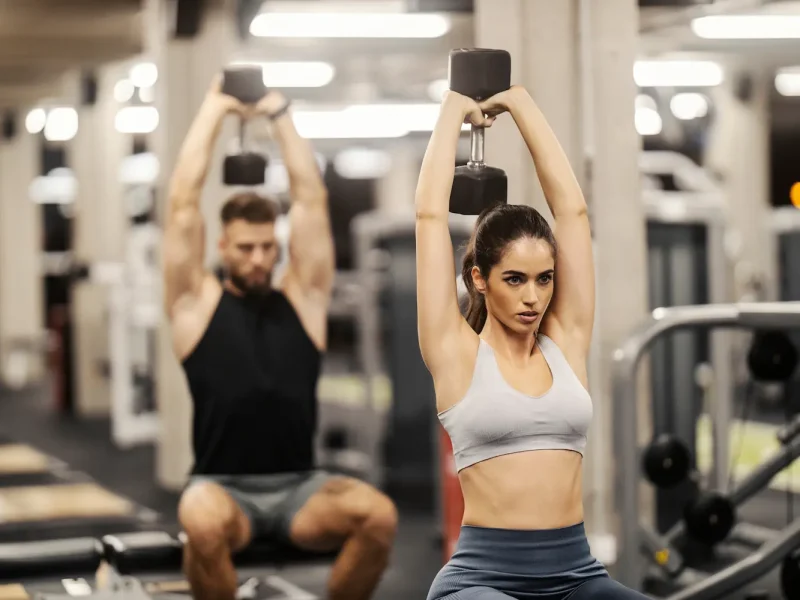
The triceps extension is an isolation exercise in which you hold a dumbbell overhead with one or both hands, lower it behind your head by bending the elbows, then extend the arms back to vertical. The shoulders stay still — only the elbows move.
Several variations all train the triceps but emphasise different heads. The overhead extension emphasises the long head (because the arm is in shoulder flexion). The skull crusher (lying triceps extension) emphasises all three heads more evenly. The pushdown emphasises the lateral head. Mix them for full triceps development.
Muscles worked
| Muscle group | Role | Contribution |
|---|---|---|
| Triceps brachii (long head) | Primary mover | ~60 % |
| Triceps brachii (lateral head) | Elbow extension | ~25 % |
| Triceps brachii (medial head) | Elbow extension | ~15 % |
The long head is the largest of the three triceps heads and the only one that crosses the shoulder joint. Overhead positions stretch it under load, which is the position it grows best in.
How to triceps extension: 5 steps
-
Set the start position
Stand tall (or sit on a bench with back support). Hold a single dumbbell with both hands, gripping the inside of the top plate. Press it overhead with arms fully extended. Elbows pointing forward, biceps near the ears.
-
Lock the elbows in position
**Elbows pinned in place** — they do not move during the rep. Only the forearms rotate. Brace the core, don't arch the lower back.
-
Lower behind the head
Bend the elbows in a controlled 2-3 second descent. The dumbbell lowers behind your head until you feel a stretch in the triceps and back of the upper arm. **Elbows do not flare outward.**
-
Pause at the stretch
Half-second pause at the bottom, triceps fully stretched. No bouncing.
-
Extend back to the top
Drive the dumbbell back up by extending the elbows. **Soft lockout** — nearly straight but not hyperextended. Squeeze the triceps. Reset, repeat.
Common mistakes to avoid
Triceps extension variations
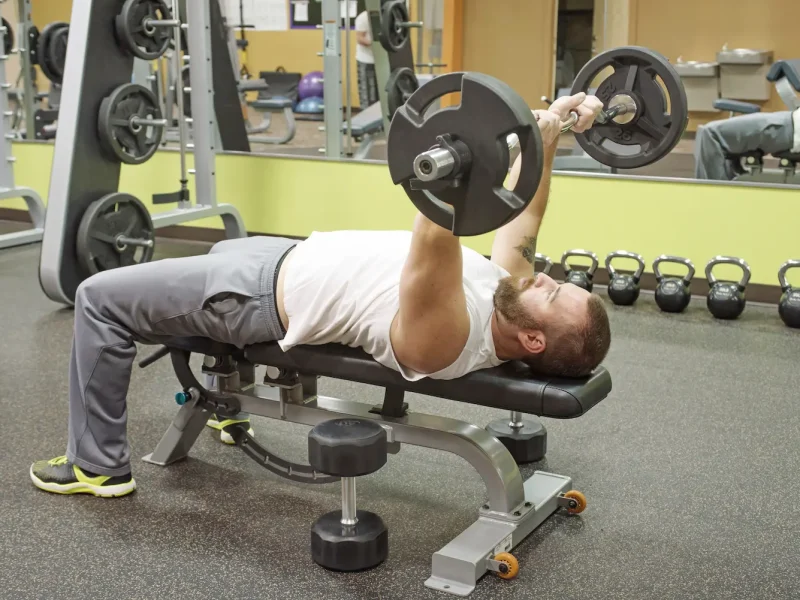
- Skull crusher (lying triceps extension). On a bench, EZ bar lowered to forehead. Heaviest version, all-three-heads emphasis.
- Triceps pushdown (cable). Standing at a high cable. Lateral head emphasis. Can be done with rope or bar.
- Triceps kickback. Bent over, elbow up, extend at the elbow. Lateral head + elbow lockout focus.
- Two-handed overhead extension. One dumbbell held with both hands. Heaviest overhead variant.
- Cable overhead extension. Standing or kneeling, rope from a low pulley. Constant tension throughout.
- Single-arm overhead extension. One dumbbell at a time. Better mind-muscle connection, asymmetry-fixing.
Sample workout: 4-week triceps block
Triceps extensions 2 times per week, after your main pressing work.
| Week | Sets × reps | Tempo |
|---|---|---|
| 1 | 3 × 12 | 2 sec eccentric |
| 2 | 4 × 10 | 3 sec eccentric |
| 3 | 4 × 8 | 3 sec eccentric + 1 sec stretch pause |
| 4 (deload) | 3 × 10 | Smooth |
Frequently asked questions
Triceps extension or skull crusher — which is better?
Both. Overhead extension biases the long head; skull crusher biases all three heads more evenly. Cycle through both across blocks for complete triceps development.
Why do my elbows hurt during triceps work?
Either you’re going too heavy, locking out hard at the top, or hyperextending the elbow joint. Reduce the load, stop the lockout slightly short, and use an EZ bar instead of a straight bar (the angle reduces wrist + elbow strain).
How heavy should I extend?
For a healthy male intermediate: 12-18 kg single dumbbell overhead for 10 reps; for females: 5-10 kg. The right weight is one you can extend strict for 8-12 reps without elbow flare.
Should I lock out the elbows at the top?
Soft lockout — elbows nearly straight but not hyperextended. Hard lockout puts undue stress on the elbow joint. Stop just short of full extension and squeeze.
Are triceps extensions enough for arms or do I need pushdowns too?
Most balanced programs include both: overhead extensions for the long head, pushdowns or skull crushers for the lateral and medial heads. Combined with heavy bench press and dips, that’s complete triceps coverage.
Related exercises
- Skull Crusher: lying variant, heaviest loads
- Triceps Pushdown: cable lateral head focus
- Dips: bodyweight compound triceps
- Close-Grip Bench Press: triceps-biased pressing
- Diamond Push-Up: bodyweight triceps
Published by: Jay — Writer covering triceps exercises
Reviewed, corrected and approved by: Martin Wood — Editor-in-chief
Updated on May 8, 2026