
The trap bar deadlift is the deadlift for athletes who don’t want to be powerlifters. Same primary muscles as the conventional deadlift, but with a hexagonal “trap bar” that lets you stand inside it. The result: a more upright torso, less spinal load, and a lift that feels closer to a heavy squat than a heavy hinge.
For sports performance, lower-back-injury rehab, or simply lifters who want heavy posterior chain training without conventional deadlift demands, the trap bar deadlift is one of the most useful tools in the gym. It’s also one of the easiest big lifts to learn well.
What is the trap bar deadlift?
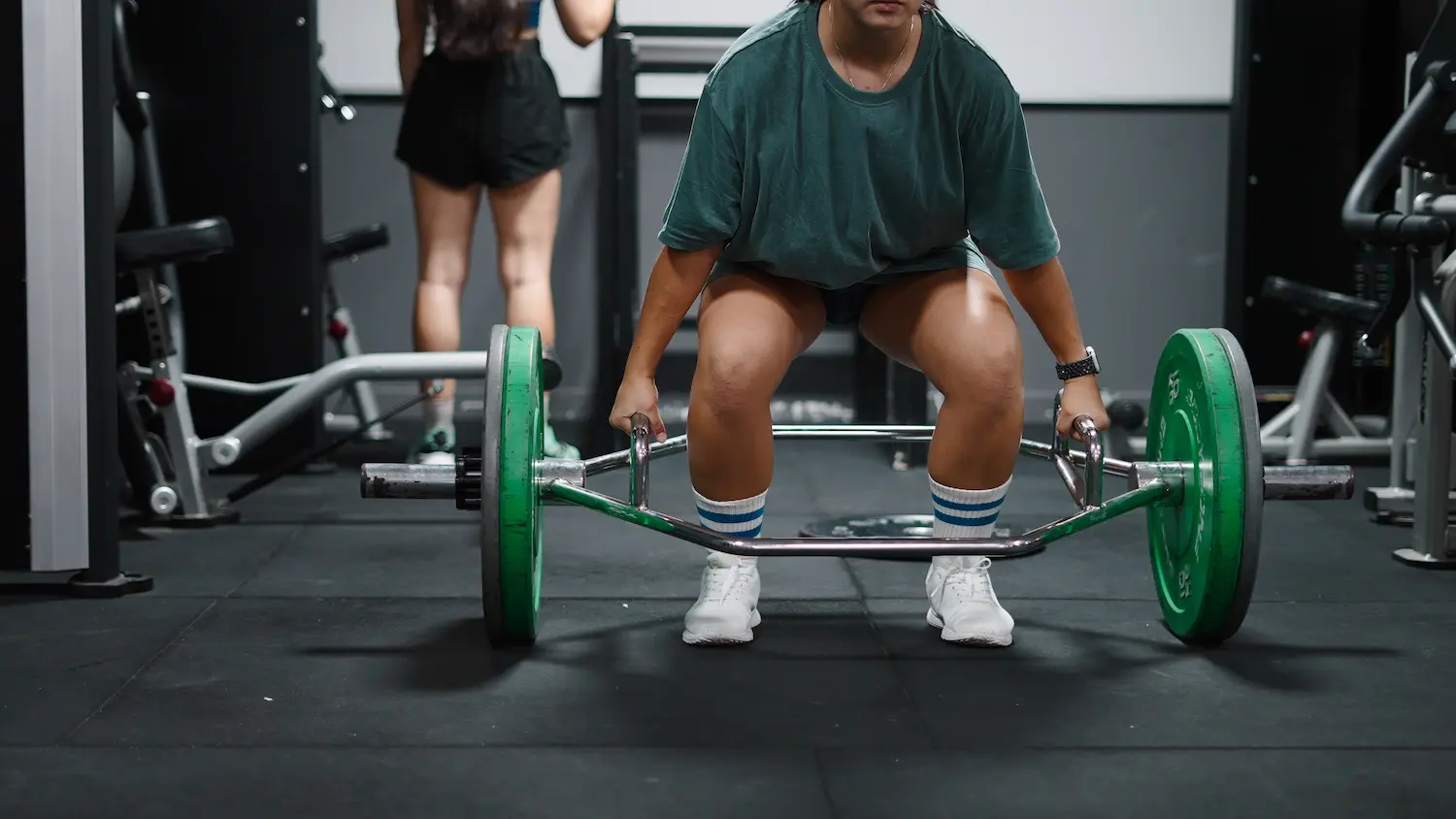
The trap bar deadlift is a hip-hinge and knee-extension exercise performed inside a hexagonal-shaped barbell (“trap bar” or “hex bar”), in which the lifter grips two parallel handles at their sides and stands the bar to lockout. The neutral grip and centered load shift work toward the quads compared to the conventional deadlift.
Two grip heights exist on most trap bars: a “high handle” (raised) and a “low handle” (level with the plates). Beginners and recreational lifters use the high handle. Competitive lifters and athletes use the low handle for greater range of motion.
Muscles worked
| Muscle group | Role | Contribution |
|---|---|---|
| Quadriceps | Knee extension (more than conventional) | ~30 % |
| Glutes | Hip extension | ~25 % |
| Hamstrings | Hip extension support | ~20 % |
| Erector spinae (lower back) | Posture | ~15 % |
| Traps, lats, forearms | Bar control | ~10 % |
Compared to the conventional deadlift, the trap bar shifts about 10-15 % of the work from the lower back to the quads. The neutral grip is also kinder on the shoulders and biceps. Most lifters can pull 5-15 % more weight on a trap bar than a conventional deadlift.
How to trap bar deadlift: 5 steps
-
Set up inside the trap bar
Step inside the trap bar with feet hip-width apart, centered between the handles. Bar should be loaded with bumper plates on both sides. Stand tall first, then hinge down to the handles.
-
Grip the handles and set the back
Hinge at hips, bend knees, grip both handles with arms vertical (neutral grip). Hips above the knees. **Back flat, chest up.** Lats engaged — pull shoulder blades down and back.
-
Pre-tension and brace
Drop the hips slightly until you feel tension on the bar. Take a deep breath into the belly, brace the core hard. **Pull the slack out** — gentle pre-pull before the lift.
-
Drive through the floor
Push the floor away with your legs while keeping the back rigid. Bar rises straight up. **Hips and shoulders rise at the same rate.** As bar passes the knees, drive hips forward.
-
Lock out and lower
Stand fully upright, hips and knees locked. Don't lean back at the top — straight, glutes squeezed. Lower the bar by reversing the motion: push hips back, then bend knees once bar passes them.
Common mistakes to avoid
Variations
- High-handle trap bar deadlift. Using the raised handles. Reduced ROM, easier on mobility-limited lifters.
- Low-handle trap bar deadlift. Using the lower handles. Greater ROM, closer to conventional deadlift in difficulty.
- Trap bar jump. Light load, jump explosively. Power development for athletes.
- Trap bar farmer walk. Hold heavy load, walk. Grip + core conditioning.
- Trap bar RDL. Hip-hinge variant from standing. Hamstring focus.
- Conventional deadlift. Free-weight bilateral pull, more posterior chain emphasis.
Sample workout: 4-week strength block
| Week | Sets × reps | Intensity |
|---|---|---|
| 1 | 3 × 5 | 70 % 1RM |
| 2 | 4 × 3 | 80 % |
| 3 | 5 × 1-2 | 90 % |
| 4 (deload) | 3 × 5 | 60 % |
Frequently asked questions
Trap bar or conventional deadlift?
For sports performance, lower-back issues, or general fitness: trap bar. For pure posterior chain hypertrophy or powerlifting: conventional. Many programs use the trap bar as the primary deadlift variant for athletes; conventional for powerlifters.
How heavy can I trap bar deadlift?
Most lifters can trap bar deadlift 5-15 % more than conventional. So if you conventional deadlift 150 kg, expect 160-175 kg on the trap bar.
High handle or low handle?
High handle for beginners and lifters with limited mobility. Low handle for advanced lifters wanting full ROM. Most strength programs use the low handle once technique is locked in.
Why does my trap bar deadlift feel like a squat?
That’s because it kind of is one. The centered load with handles at your sides allows a more upright torso, which biases the quads. Some lifters call the trap bar deadlift a “squatlift” or “deadsquat” — it’s a hybrid by design.
Can the trap bar replace squats?
Not entirely. The squat trains a deeper knee bend and core stability under the bar that the trap bar deadlift doesn’t replicate. But for general athletic strength, the trap bar covers a huge percentage of what squats provide with less spinal load.
Related exercises
- Conventional Deadlift: posterior chain emphasis
- Sumo Deadlift: wide-stance variant
- Squat: foundational quad/glute
- Romanian Deadlift: hip-hinge accessory
- Trap Bar Farmer Walk: grip + core variant