
The thruster is the CrossFit signature compound: a front squat that flows directly into a push press at the top, in one continuous motion. It hits the entire body in a single rep — quads, glutes, shoulders, triceps — making it one of the most metabolically punishing exercises in any program.
Whether you use it for conditioning (the classic “Fran” workout: 21-15-9 thrusters + pull-ups) or as a strength-and-power developer, the thruster delivers full-body output that few exercises can match.
What is the thruster?
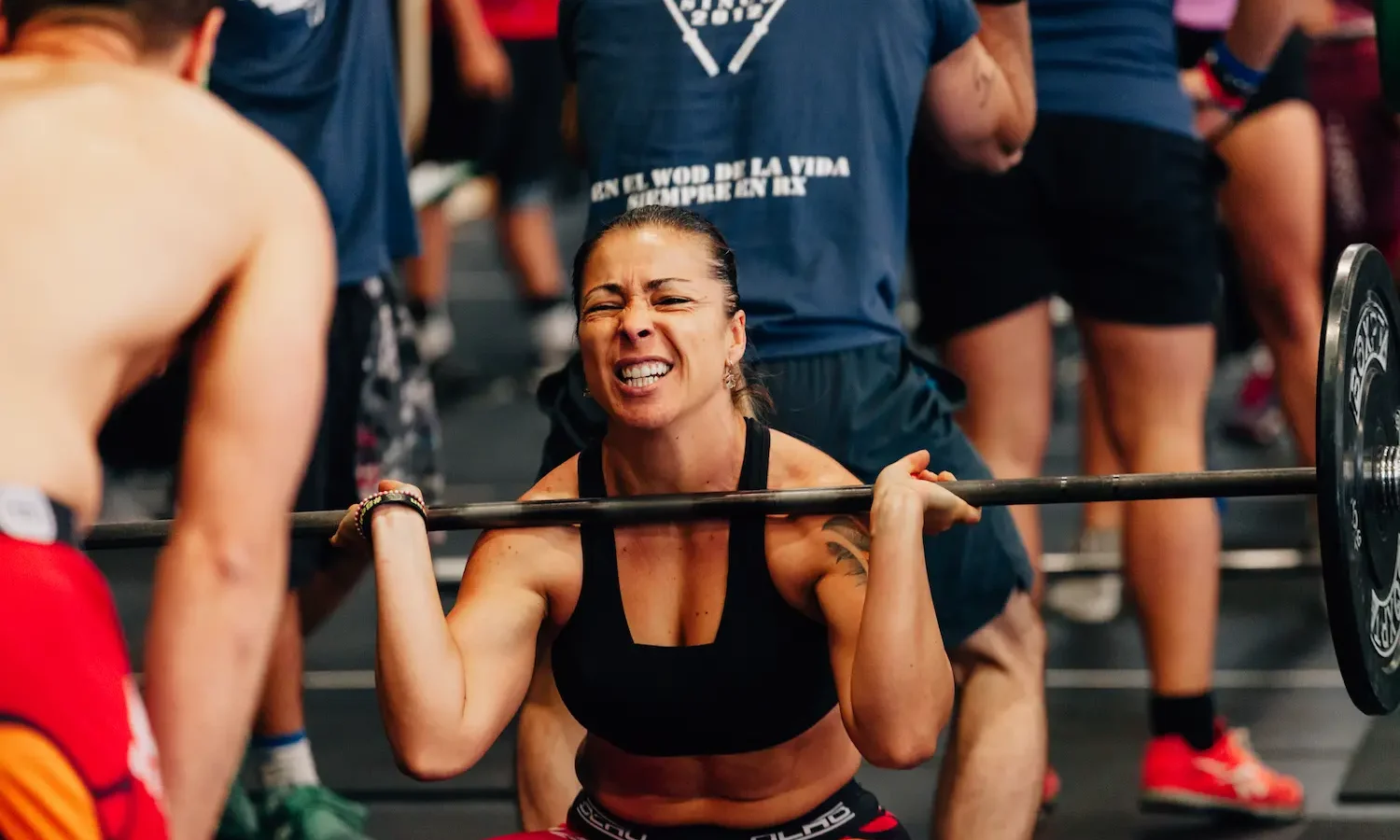
The thruster is a compound barbell exercise combining a front squat and a push press in one continuous motion. Bar in front rack, you squat to depth, then drive up explosively — using the leg drive at the top of the squat to launch the bar overhead. The lockout is achieved at the same moment the legs extend.
Done with light loads for reps, it’s a conditioning monster. Done with heavy loads for low reps, it’s a strength and power compound. CrossFit, MetCon, and athletic training programs all use it for exactly these reasons.
Muscles worked
| Muscle group | Role | Contribution |
|---|---|---|
| Quadriceps, glutes | Squat and leg drive | ~40 % |
| Anterior + middle deltoid | Overhead press | ~20 % |
| Triceps brachii | Elbow extension at lockout | ~15 % |
| Upper back, traps | Front rack stability | ~10 % |
| Core, hamstrings, calves | Stabilisation, drive | ~15 % |
The thruster is one of the most efficient total-body movements available — the quads, glutes and shoulders all work hard in a single rep. For conditioning, nothing taxes the cardiovascular system faster than 15 thrusters with a moderate load.
How to thruster: 5 steps
-
Set up in the front rack
Bar resting on the front of the shoulders, fingertip grip, elbows pointing forward and slightly up. Feet shoulder-width or slightly wider, toes slightly turned out. **Brace the core.**
-
Squat to depth
**Squat down** with control — hips back, chest up, elbows high. **Hip crease below knee** (full depth). Maintain front rack throughout — elbows must stay up.
-
Drive up explosively
**Drive through the heels** and stand up with maximum power. As the legs reach full extension, the upward momentum continues into the press phase. **No pause at the top of the squat.**
-
Press to overhead lockout
As the bar leaves the shoulders, **press the bar directly overhead**. Elbows extend, head pushes through the arm window. Bar locks out **at the moment the legs reach full extension**. Triceps lock the elbows.
-
Lower back to front rack
Bring the bar back to the front rack with control. Use a slight knee bend to absorb the bar (cushion the descent). Reset the front rack and begin the next rep.
Common mistakes to avoid
Variations
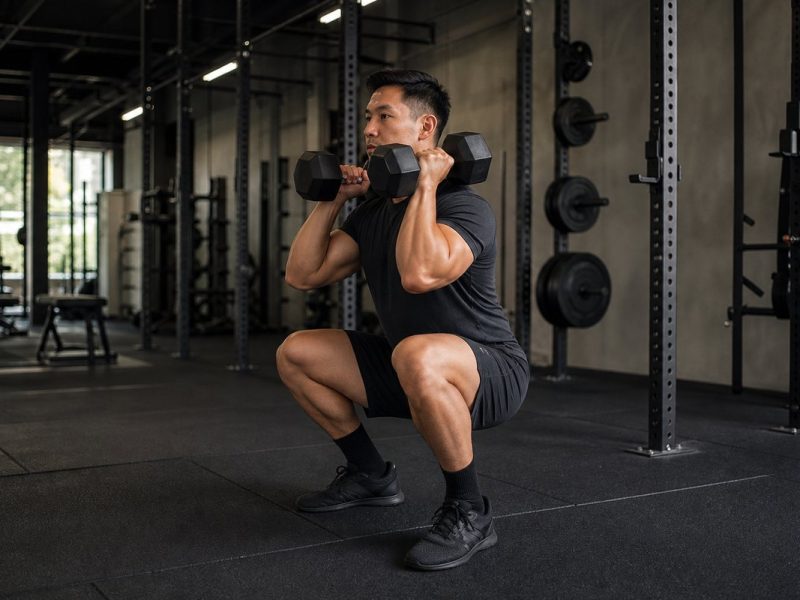
- Dumbbell thruster. Dumbbells instead of a barbell — more accessible, allows unilateral loading.
- Kettlebell thruster. Single or double kettlebells. Excellent at home or with limited equipment.
- Single-arm dumbbell thruster. Unilateral version — major core anti-rotation work.
- Wall ball. Medicine ball thruster against a wall target. Cardio finisher.
- Sandbag thruster. Strongman-style with a sandbag.
- Front squat. The lower-body component.
- Push press. The upper-body component.
Sample workouts
Strength workout
5 × 5 thrusters at 65-75 % of the bar weight you can front-squat for 5 reps. Long rest (2-3 minutes between sets).
Conditioning workout — “Fran”
The classic CrossFit benchmark: 21-15-9 reps for time, alternating thrusters (43 kg men / 30 kg women) with pull-ups. Sub-5-minute Fran = elite.
Density block
EMOM (every minute on the minute) for 10 minutes: 5 thrusters at moderate load. Get done, rest the remaining time, repeat. Brutal.
Frequently asked questions
How is the thruster different from a front squat + press?
The thruster is one continuous motion — the leg drive at the top of the squat directly drives the bar overhead. A front squat + press is two separate movements with a brief pause. The thruster is much faster, much more taxing, and uses the squat’s leg drive to assist the press.
How heavy should I thruster?
The thruster is limited by your overhead press, not your front squat. Most lifters can thruster 70-85 % of their max push press. For conditioning, light loads (60-70 % of push press 1RM) work best — heavy thrusters break form fast.
Why do I lose my front rack at the top?
The elbows drop during the drive. Cue “elbows up throughout, especially during the leg drive”. As the bar travels up, the elbows must stay high to position for the overhead lockout.
Are thrusters bad for the wrists?
Only if the front rack is wrong. Fingertip grip with high elbows = comfortable wrists. Full-hand grip with low elbows = wrist pain. Master the front rack on front squats first.
Thrusters for non-CrossFitters?
Absolutely. The combination of squat and press in one move makes it a great strength-conditioning hybrid for any athlete. 2-3 sets a week of light-to-moderate thrusters add a lot to general fitness.
Related exercises
- Front Squat: lower-body component
- Push Press: upper-body component
- Wall Ball: med-ball thruster
- Overhead Press: strict shoulder press
- Burpee: full-body conditioning
Published by: Jay — Writer covering quad exercises
Reviewed, corrected and approved by: Martin Wood — Editor-in-chief
Updated on September 29, 2026