
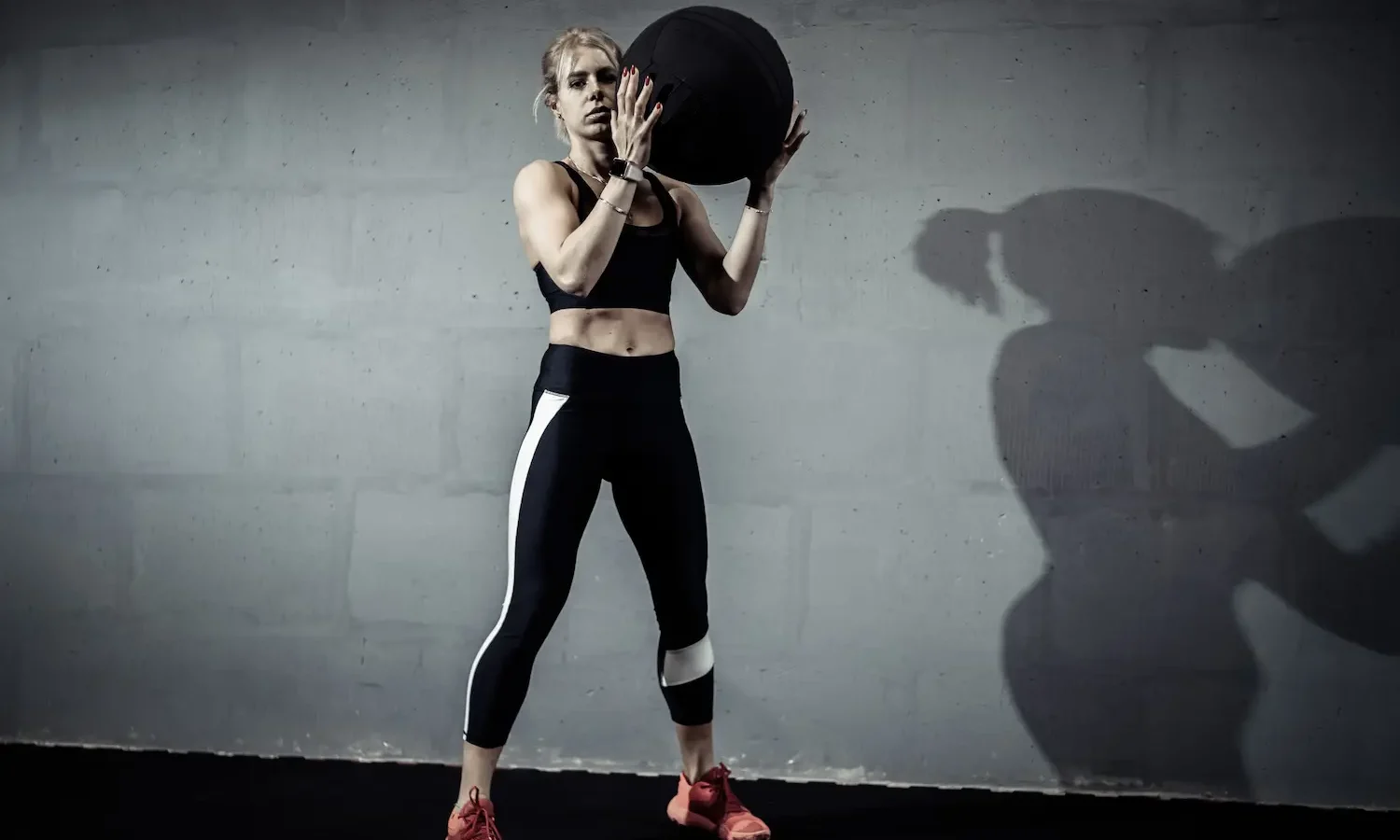
The wall ball is the medicine-ball thruster. You hold a weighted ball (typically 5-12 kg), squat to depth, then explode up and throw the ball at a target on a wall (typically 9-10 ft / 2.7-3 m high). Catch it on the way down, descend into the next squat, repeat. It’s a brutal conditioning compound that hammers the legs and shoulders simultaneously.
Wall balls are a staple of CrossFit (the Open features them in nearly every season), kettlebell sport, and any conditioning program looking for a metabolic-heavy compound. They’re unforgiving when you’re tired — and that’s exactly the point.
What is the wall ball?
The wall ball is a compound conditioning exercise combining a squat with an overhead medicine-ball throw at a wall target. Standing about 1 m from a wall with a medicine ball held at the chest, you squat to depth, then drive up explosively while throwing the ball to a marked height on the wall. You catch the ball as it falls back down, absorb the catch into the next squat, and repeat.
It hits the entire body in a sustained metabolic pattern — quads, glutes, shoulders, core, and grip all fire continuously. Standard target height is 10 ft (3 m) for men and 9 ft (2.7 m) for women in CrossFit competitions.
Muscles worked
| Muscle group | Role | Contribution |
|---|---|---|
| Quadriceps, glutes | Squat and explosive drive | ~40 % |
| Anterior deltoid, triceps | Throw and overhead extension | ~25 % |
| Core, hip flexors | Stabilisation, ball absorption | ~15 % |
| Upper back, traps | Throw setup, scapular control | ~10 % |
| Calves, hamstrings | Triple-extension drive | ~10 % |
The wall ball is one of the most efficient full-body conditioning exercises available. The throw component adds upper-body work that pure squat-jump variants lack.
How to wall ball: 5 steps
-
Set up in front of the wall
Stand about 60-80 cm from a wall with a marked target (10 ft / 3 m). Hold the medicine ball at chest height, hands cupped under it, elbows tucked. Feet shoulder-width.
-
Squat to depth
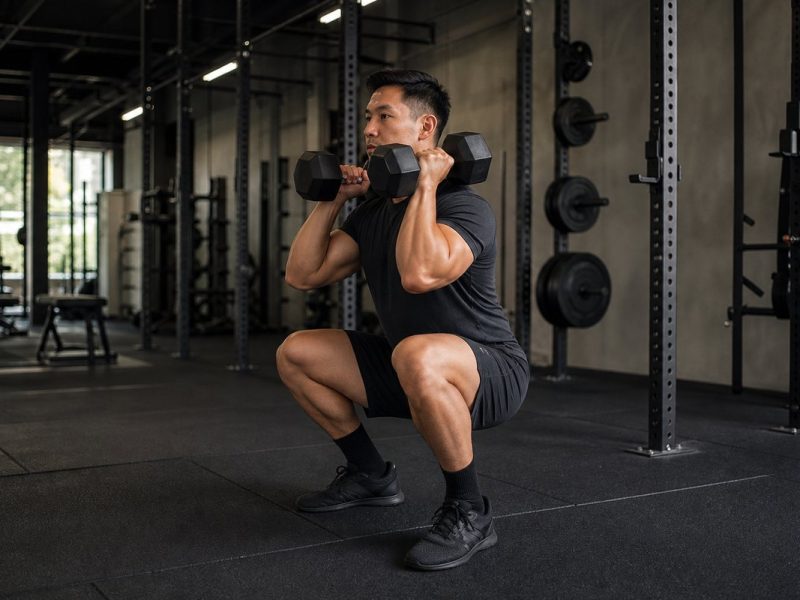
**Squat down** with the ball held at chest. Hips back, chest up. **Hip crease below knee.** The ball stays close to the chest throughout — don't let it drift forward.
-
Drive up explosively
**Drive through the heels** and stand up with maximum power. As the legs reach extension, the upward momentum continues into the throw.
-
Throw the ball at the target
**Extend the arms** and throw the ball directly UP at the wall target. Hit the marked height. The throw and the leg extension happen as one continuous motion.
-
Catch and descend
**Catch the ball at chest height** as it falls back down. **Absorb the catch by descending into the next squat** — let the falling ball pull you into depth. Reset the bottom, drive up again.
Common mistakes to avoid
Variations
- Wall ball side toss. Throw against the wall to one side, catch and rotate. Rotational power version.
- Dumbbell wall ball. Single dumbbell instead of a ball. Different rhythm — no catch-and-bounce.
- Slam ball overhead. Throw a slam ball down instead of up. Different metabolic stress, more eccentric load.
- Thruster. Barbell version — no throw, but heavier loading possible.
- Goblet squat. Strength version without the throw — same lower-body pattern.
- Burpee. Bodyweight conditioning alternative.
Sample workout
Conditioning AMRAP
AMRAP (As Many Reps As Possible) in 5 minutes — choose a sustainable pace, don’t blow up in the first minute.
For time
100 wall balls (or 150 for advanced) for time. Most lifters complete 100 in 3-7 minutes depending on conditioning and ball weight.
EMOM
EMOM 10 minutes: 15 wall balls. Get the reps done, rest until the next minute. Brutal aerobic-anaerobic crossover.
“Karen”
The classic CrossFit benchmark: 150 wall balls for time. Sub-7-minute “Karen” = advanced.
Frequently asked questions
What weight ball should I use?
Standard CrossFit: 20 lb / 9 kg for men, 14 lb / 6 kg for women. Beginners start with 4-6 kg. The ball weight should let you string 15-20 unbroken reps with full target height. If you can’t reach the target, lighten the ball.
How high should the target be?
10 ft (3 m) for men, 9 ft (2.7 m) for women in CrossFit. Beginners can use 8 ft (2.4 m) while learning. Lower targets reduce the drive demand but also reduce the work output per rep.
How is the wall ball different from a thruster?
Thrusters use a barbell — heavier loads, more strength. Wall balls use a med-ball — lighter, more cardio. Wall balls have the throw-and-catch rhythm; thrusters have a controlled overhead lockout. Both target similar muscles; wall balls are pure conditioning while thrusters span strength and conditioning.
Why does my back hurt during wall balls?
Two common causes: (1) catching the ball with arms too high (hyper-extending the back), or (2) bouncing the catch into the squat with too much spinal load. Catch the ball at chest height, absorb into the squat with bent legs, keep the back neutral.
Wall balls every day?
Not advised. The shoulders and quads take a beating. 2-3 wall ball sessions per week is plenty. More than that and shoulder soreness becomes the limiter.
Related exercises
- Thruster: barbell counterpart
- Slam Ball: med-ball slam alternative
- Goblet Squat: dumbbell squat without throw
- Burpee: bodyweight cardio compound
- Box Jump: explosive leg power
Published by: Jay — Writer covering quad exercises
Reviewed, corrected and approved by: Martin Wood — Editor-in-chief
Updated on September 29, 2026