
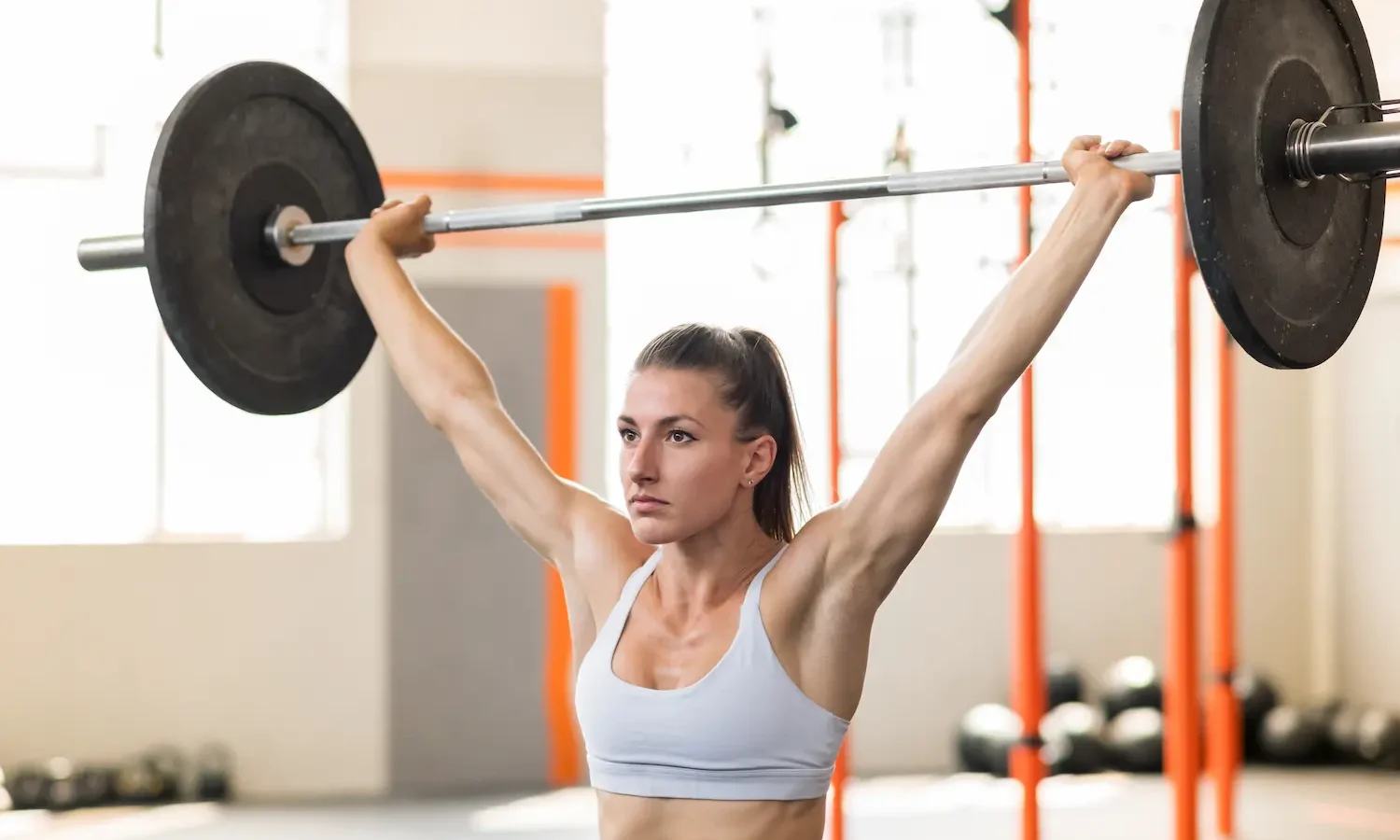
The snatch is the most technical lift in weightlifting and one of the most demanding athletic movements in any sport. You lift a barbell from the floor to a locked-out overhead position in a single, continuous motion — pulling, jumping under, and catching the bar in a deep squat with arms fully extended. It demands explosive hip power, full-body mobility, and the kind of timing that takes years to master.
This guide covers the full classic (squat) snatch. It is not a beginner exercise. Most lifters spend 6-12 months on the hang snatch, power snatch, and snatch balance progressions before attempting full snatches with load.
What is the snatch?
The snatch is a competitive Olympic lift in which a barbell is moved from the floor to overhead in one continuous motion. It has three phases: the first pull (floor to knee), the second pull (explosive triple extension at hip-height), and the third pull (pulling under the bar while it travels overhead). The lifter catches the bar at full lockout in a deep overhead squat.
It develops elite-level power, speed, mobility, and coordination. Even for non-competing athletes, learning the snatch builds athletic qualities that no other single exercise replicates.
Muscles worked
| Muscle group | Role | Contribution |
|---|---|---|
| Glutes, hamstrings, quads | Pull + catch primary movers | ~40 % |
| Erector spinae, traps | Bar control, second pull | ~20 % |
| Deltoids, triceps | Overhead catch and stabilisation | ~15 % |
| Lats, mid-back | Bar path control | ~10 % |
| Core, forearms | Full-body stabilisation | ~15 % |
The snatch is unmatched as a total-body power developer. Every major muscle group fires — and they fire fast. Compared to the deadlift or clean and jerk, the snatch demands more shoulder mobility and more precise bar path.
How to snatch: 5 steps
-
Set up at the bar
Feet hip-width. **Snatch-grip the bar — very wide, hands roughly elbow-distance from shoulders when bar is at hip crease.** Hook grip (thumbs locked under index). Hips above knees. Back tight, arms straight.
-
First pull: floor to knee
**Push the floor away with the legs**, bar travels straight up close to the body. Maintain back angle — shoulders stay slightly in front of the bar. Bar reaches knee height with chest up and back tight. Slow and controlled.
-
Second pull: explosive triple extension
As the bar passes the knees, **drive the hips forward violently** and **fully extend** at ankles, knees and hips (triple extension). Shrug aggressively. The bar accelerates upward — the "jump" phase.
-
Third pull: pull under the bar
**Pull yourself under the rising bar** by dropping into a deep squat while pulling elbows high and outward. Bar travels overhead in a tight path. You catch the bar **at full overhead lockout in a deep squat** — arms fully extended, bar over the back of the head.
-
Stand up with the bar overhead
Stabilise in the bottom of the overhead squat — **bar locked out, weight in mid-foot, chest up**. Stand up by extending hips and knees. Hold the lockout, then drop or lower the bar. Reset before the next rep.
Common mistakes to avoid
Variations & progressions
- Power snatch. Catch above parallel — no full squat under. The beginner progression.
- Hang snatch. From the hang position (above the knee). Removes the floor-to-knee pull. The standard teaching variant.
- Snatch balance. Bar on the back, then squat under into overhead catch. Builds the receiving position.
- Overhead squat. Bar locked out overhead, full squat. Builds the catch position mobility.
- Snatch pull. First and second pull only — no catch. Strength work for the pull phase.
- Muscle snatch. No leg drop under the bar — strict pull-and-press. Builds bar-path strength.
Sample workout: 12-week snatch teaching block
The snatch demands daily practice with light loads. Don’t chase 1RMs early. Train 3-4 times per week with technical priorities.
| Weeks | Focus | Sets × reps |
|---|---|---|
| 1-3 | Overhead squat + snatch balance | 5 × 5 light |
| 4-6 | Hang snatch + snatch pull | 5 × 3 moderate |
| 7-9 | Power snatch from floor | 5 × 3 building |
| 10-12 | Full snatch — light to moderate | 5 × 2-3 working up |
Frequently asked questions
Snatch or clean and jerk?
Both are competition lifts. The snatch is more technical and requires more shoulder mobility. The clean and jerk allows heavier loads (typically 25-30 % more than snatch). Most weightlifters train both — they’re complementary skills.
How long does it take to learn the snatch?</h3
6-24 months of consistent practice (3-4x/week with a coach) to land it confidently with meaningful loads. The snatch is one of the most coachable lifts — without a coach watching your reps, progress slows dramatically.
Why does the bar drift forward on the catch?</h3
The pull is going forward instead of straight up. Cue “bar stays close to the body, pull yourself up to the bar”. Film every session — bar path drift is impossible to feel; it has to be seen.
Do I need a coach to learn the snatch?</h3
Strongly recommended. The snatch has too many failure modes to self-coach effectively. Even 3-4 sessions with a qualified weightlifting coach can save you 6 months of trial-and-error.
Is the snatch dangerous?</h3
Done with proper technique and bumper plates (so you can bail forward or backward safely), the snatch has a lower injury rate than many “safer-looking” exercises. Done with bad technique under heavy load, it has high injury potential. Quality of coaching is the key safety factor.
Related exercises
- Clean and Jerk: the other Olympic lift
- Power Clean: clean variant, no full catch
- Hang Snatch: snatch teaching variant
- Overhead Press: pressing strength foundation
- Deadlift: pulling strength foundation