
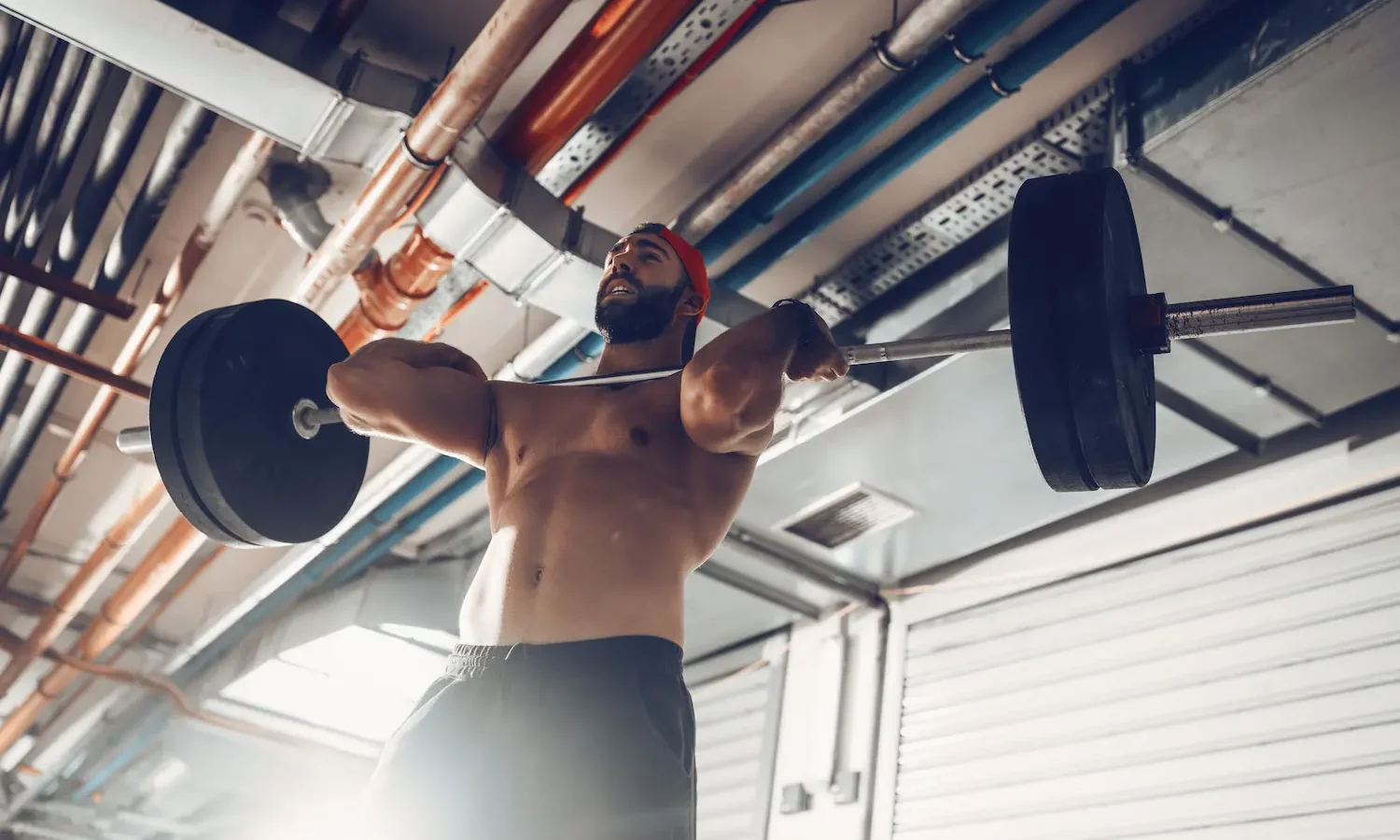
The power clean is the most useful Olympic-style lift in any gym. It trains explosive triple extension (ankles, knees, hips), develops the posterior chain, and teaches force production faster than nearly any other exercise. It’s also the most technically demanding lift — most adults need a coach or 3-6 months of dedicated practice to do it well.
This guide covers the basics of the power clean: the lift from floor to front rack position. The full clean (which catches at the bottom of a squat) is more advanced and beyond this guide. If you’re new to Olympic lifting, find a coach. The lift looks simple from the outside; it isn’t.
What is the power clean?
The power clean is a ballistic lift in which you pull a barbell from the floor to a front rack position (resting on the front shoulders) in one explosive motion. Unlike the full clean, the catch happens at quarter-squat depth — hence “power” clean.
The lift trains explosive hip extension and force production through the entire posterior chain plus the upper body to “pull under” the bar. It’s a CrossFit staple, an Olympic weightlifting basic, and a foundational power exercise in most strength programs.
Muscles worked
| Muscle group | Role | Contribution |
|---|---|---|
| Glutes, hamstrings | Hip extension (the pull) | ~30 % |
| Quadriceps | Knee extension | ~20 % |
| Erector spinae, traps, lats | Posture, bar control | ~25 % |
| Calves | Ankle plantarflexion (triple extension) | ~10 % |
| Shoulders, biceps, forearms, core | Catch and stabilisation | ~15 % |
The power clean is one of the few lifts that meaningfully trains force development rate — how fast you can produce maximum force. That carries over to sprinting, jumping, and any explosive athletic movement. Heavy squats and deadlifts build absolute strength; cleans turn that strength into power.
How to power clean: 5 steps
-
Set up over the bar
Stand with shins about 2-3 cm from the bar, feet hip-width apart. Hinge at hips, bend knees to grip the bar with hands just outside the legs (hook grip if you know it). Shoulders just over the bar, hips above the knees.
-
First pull (floor to knees)
Push the floor away with your legs while keeping the back rigid and torso angle constant. Bar travels straight up, dragging the shins. **Hips and shoulders rise at the same rate** — the slow controlled deadlift portion.
-
Second pull / triple extension
Once the bar passes the knees, **explosively extend ankles, knees, and hips** all at once. Shoulders shrug up. Bar accelerates through the hip crease. This is where the explosion happens.
-
Pull under and catch
After the explosive extension, **pull yourself under the bar** by quickly bending the knees and rotating the elbows under the bar. Catch the bar on the front shelf of the shoulders (front rack position) in a quarter-squat. Elbows high.
-
Stand to full extension
Drive up out of the quarter-squat to full standing. Lock out hips and knees. To finish, drop the bar (if bumpers + platform) or lower controlled. Reset position, repeat.
Common mistakes to avoid
Variations
- Hang clean. Bar starts at hip height (instead of floor). Removes the first pull, focus on the explosive second pull. Good teaching variant.
- Clean pull. Just the pull portion — bar comes to chest height, no catch. Builds the strength to clean heavier weights.
- Clean and Jerk. Power clean + overhead jerk. The full Olympic lift.
- Dumbbell clean. One or two dumbbells. Lower technical demand, similar pattern.
- Kettlebell clean. Different mechanics due to the kettlebell offset, but same explosive hip-hinge.
- Squat clean (full clean). Catch the bar at the bottom of a front squat. The complete Olympic clean.
Sample workout: 4-week power block
Power cleans 1-2 times per week, before strength work. Volume stays LOW — Olympic lifts are technical and explosive, fatigue ruins them.
| Week | Sets × reps | Intensity |
|---|---|---|
| 1 | 5 × 3 | 60-70 % 1RM |
| 2 | 5 × 3 | 70-75 % |
| 3 | 6 × 2 | 75-80 % |
| 4 (deload) | 4 × 3 | 60 % |
Frequently asked questions
Should I learn power cleans without a coach?</h3
If possible, find a coach. The power clean has more technical components than any other gym lift. Self-taught lifters routinely build bad habits that limit progress for years. If a coach isn’t available, film yourself, study high-quality video tutorials, and progress slowly.
Power clean or deadlift — which should I do?</h3
Both, for different goals. Deadlift builds absolute strength; power clean builds power and athleticism. Most balanced strength programs include the deadlift as primary; cleans are the optional power supplement.
How heavy should I power clean?</h3
Most lifters power clean 50-70 % of their deadlift max. So 100 kg deadlift = 50-70 kg power clean. The technique limits the load before the strength does — adding weight without technique just means slower, uglier lifts.
Why does my back hurt after cleans?</h3
Almost certainly because you’re lifting with the back instead of the legs. The first pull from the floor should look like a slow deadlift — knees bent, back flat, hips and shoulders rising together. If the hips shoot up first, the back rounds and takes the load.
Should I drop the bar after each rep?</h3
If you’re using bumper plates on a platform: yes, dropping is fine and protects you on heavy sets. If you’re using regular plates on a regular floor: lower controlled to avoid damaging plates and floor. Most gyms have specific drop policies — check first.
Related exercises
- Hang Clean: easier teaching variant
- Clean and Jerk: full Olympic lift
- Snatch: other Olympic lift
- Deadlift: foundational pulling strength
- Box Jump: lower-body power complement
Published by: Jay — Writer covering back exercises
Reviewed, corrected and approved by: Martin Wood — Editor-in-chief
Updated on September 29, 2026