
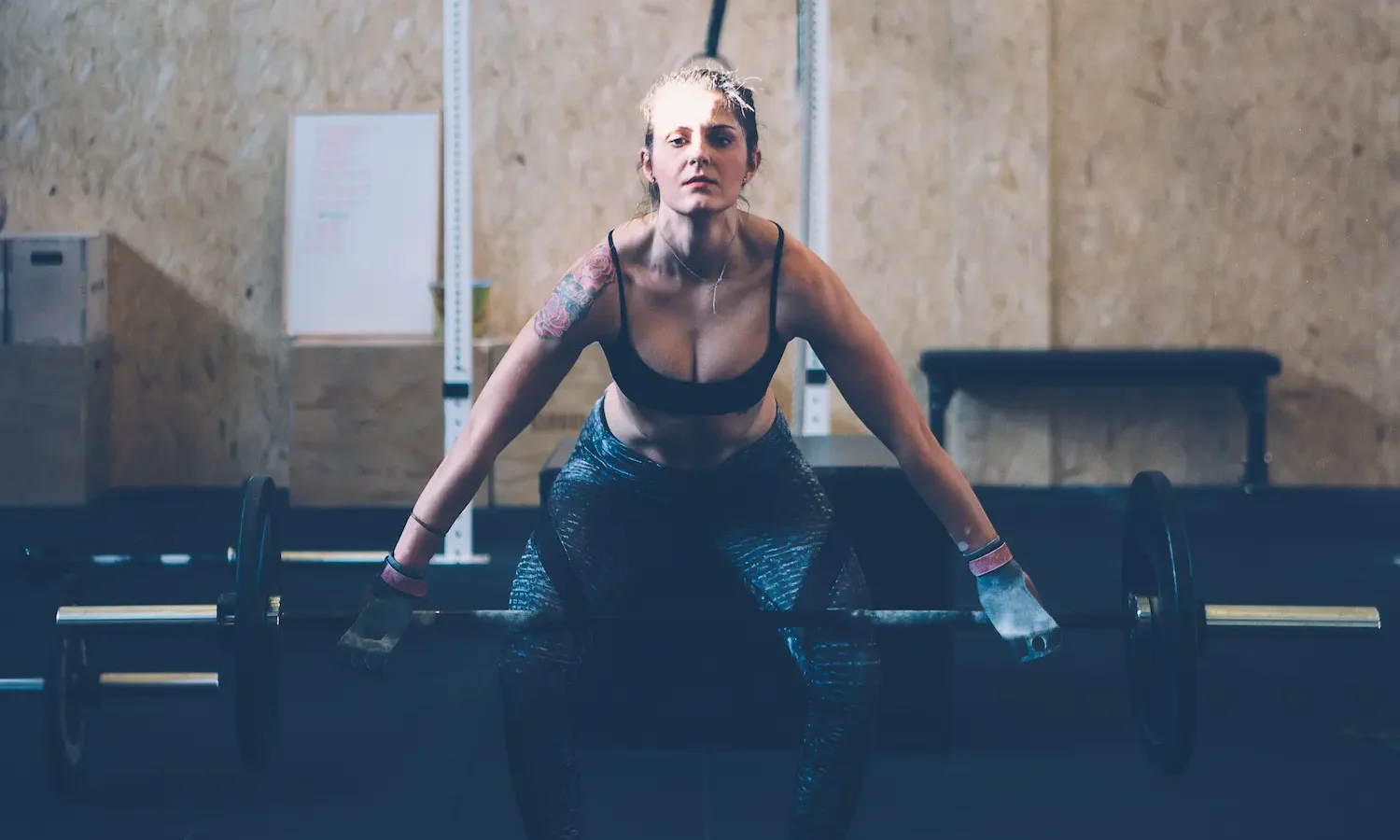
The hang snatch is the snatch started from the hang position — bar held at the hip crease (high hang), above the knee (mid hang), or just below the knee (low hang). Skipping the first pull from the floor lets you focus on the explosive second pull and the catch — the two phases where most snatch errors happen.
For most lifters learning the snatch, the hang variant is where 80 % of the practice happens. It’s also a staple of athletic training programs for non-weightlifters who want power without the complexity of the floor pull.
What is the hang snatch?
The hang snatch is a barbell Olympic lift performed from the hang position. You deadlift the bar to the chosen hang height (high, mid, or low), pause briefly, then explosively pull and snatch the bar overhead in a single motion — catching in a full overhead squat (squat snatch) or quarter-squat (power snatch).
The hang position removes the slowest part of the snatch (floor to knee) and lets the lifter focus on the explosive second pull and catch. Coaches use the hang snatch to teach bar speed, hip extension, and pull-under timing without the complexity of the floor start.
Muscles worked
| Muscle group | Role | Contribution |
|---|---|---|
| Glutes, hamstrings | Hip extension, second-pull drive | ~30 % |
| Quadriceps | Knee extension, catch position | ~20 % |
| Traps, erector spinae | Second pull + bar control | ~20 % |
| Deltoids, triceps | Overhead catch | ~15 % |
| Core, forearms | Stabilisation, grip | ~15 % |
The hang snatch shifts a bit more emphasis onto the posterior chain (glutes, hamstrings, traps) compared to the full snatch from the floor — because the bar starts already past the most leg-dominant part of the pull. It’s an excellent posterior-chain power developer for athletes.
How to hang snatch: 5 steps
-
Deadlift the bar to the hang position
Set up with **snatch grip — very wide, hook grip**. Stand up holding the bar at hip crease (high hang), above knee (mid hang), or below knee (low hang). Brace the core.
-
Set the hang position
**Hinge slightly at the hips** to lower the bar to the chosen hang height. Knees soft, back flat, chest up. The bar hangs at the chosen height, arms straight. Pause briefly — lift starts from a dead-stop hang.
-
Explosive second pull
**Drive the hips violently forward** — full triple extension at ankles, knees and hips. **Shrug aggressively at the top.** Bar accelerates upward with maximum bar speed.
-
Pull under the bar
As the bar travels overhead, **drop into a deep squat (or quarter-squat for power version)** while pulling elbows high and outward to pivot the wrists into the overhead position.
-
Catch and stand
**Catch the bar with arms locked overhead** in a deep overhead squat (or quarter squat). Bar over the back of the head, weight in mid-foot. **Stabilise, then stand up.** Drop or lower the bar. Reset.
Common mistakes to avoid
Variations
- Hang power snatch. Catch above parallel — no full squat. Most accessible variant.
- High hang snatch. Bar starts at the hip crease. Maximum focus on second pull and catch.
- Mid hang snatch. Bar starts above the knee. Standard hang position.
- Low hang snatch. Bar starts just below the knee. Closest to the full snatch.
- Full snatch (from floor). The complete competition lift.
- Dumbbell hang snatch. Unilateral version with a dumbbell. Functional and accessible.
Sample workout: 4-week hang snatch block
Train 2-3 times per week as part of a snatch development block, or alone for athletic power work.
| Week | Sets × reps | Load (% of full snatch 1RM) |
|---|---|---|
| 1 | 5 × 3 hang power snatch | 60 % |
| 2 | 5 × 3 mid hang snatch | 65 % |
| 3 | 5 × 2 mid hang snatch | 70-75 % |
| 4 (deload) | 3 × 3 high hang power snatch | 55 % |
Frequently asked questions
Hang snatch or full snatch from floor?
Hang snatch is the teaching tool. Full snatch is the competition lift. Spend 60-70 % of snatch practice in hang variants if you’re still learning. Advanced lifters reduce that ratio but still use hang work for technical maintenance.
What hang height should I use?</h3
Start with high hang (hip crease) — easiest to learn timing. Progress to mid hang (above knee) for standard work. Use low hang (below knee) only when comfortable with mid hang and ready to bridge to the floor pull.
Can I learn the snatch by only doing hang snatches?</h3
You can build serious athletic power from hang snatches alone. But to compete in weightlifting or perform a true snatch, you eventually need to add the floor pull. For non-competitive lifters, hang snatches are 90 % of the benefit.
How heavy should I hang snatch?</h3
Most lifters hang snatch 75-85 % of their full snatch 1RM. The hang has less momentum than the floor lift, so loads are typically slightly lower. Build technique at moderate loads before chasing peaks.
Why does my back round in the hang position?</h3
Hamstring tightness or weak posterior chain. The hang position requires a hinged back-flat position. Stretch hamstrings, strengthen the posterior chain with RDLs, and work the hang setup itself under light loads.
Related exercises
- Snatch: full lift from floor
- Clean and Jerk: the other Olympic lift
- Power Clean: clean variant
- Overhead Squat: catch position builder
- Snatch Pull: pull-strength work
Published by: Jay — Writer covering back exercises
Reviewed, corrected and approved by: Martin Wood — Editor-in-chief
Updated on May 18, 2026