
The Slingshot bench press uses a piece of training equipment — the Slingshot, a heavy-duty elastic band worn on the upper arms — to assist the bottom portion of the bench press. The band stores energy as you lower the bar and releases it on the press, giving you a 10-20 % bench-press “overload” without putting all that load on your joints. Popularised by powerlifter Mark Bell.
What it is
The Slingshot bench press is a bench press performed while wearing a Slingshot — a wide, heavy-elastic band worn just below the elbows on both arms, joining them together loosely. As the bar lowers, the band stretches and stores elastic energy; as the bar is pressed up, the band assists the lift through the bottom range. The result is a bench press where you can handle 10-25 % more weight than your raw bench 1RM, with the assistance concentrated in the bottom half.
Muscles worked
| Muscle | Contribution |
|---|---|
| Triceps brachii | ~40 % |
| Pectoralis major | ~30 % |
| Anterior deltoid | ~15 % |
| Lats, traps, core | ~15 % |
How to Slingshot bench press: 5 steps
-
Put on the Slingshot
Slip both arms through the Slingshot band so it rests **just below the elbows** on the upper forearms. The band should be snug, the elbows joined loosely by the band.
-
Set up on the bench
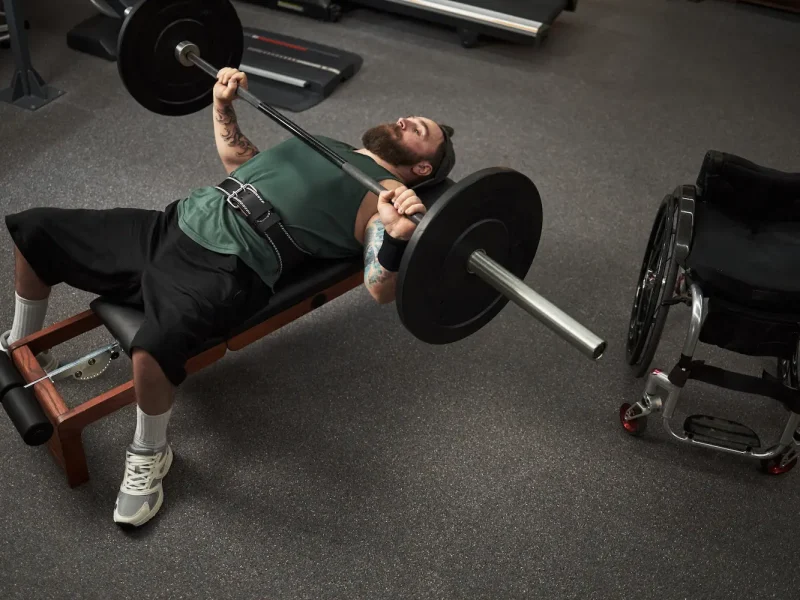
Lie on the bench, retract scapulae, slight arch, feet planted. Grip the bar slightly wider than shoulder-width. The Slingshot stays in position throughout.
-
Lower with control
Lower the bar in 2-3 seconds. As the bar descends, the **Slingshot stretches and stores elastic energy**. Touch the chest gently.
-
Press up with elastic assist
**Press the bar up** — the Slingshot springs back and assists through the bottom range. Above mid-press, the assistance fades and you finish under your own power.
-
Lock out and reset
Lock out at the top. Lower for the next rep. The Slingshot stays on for the entire set.
How it differs from bench press
- Bottom-range assistance. The band’s stored energy releases at the bottom of the rep, where most lifters miss. The top half is mostly unassisted.
- Overload at the top. Because the band helps you off the chest, you can handle 10-25 % more weight to lockout than raw bench — overloading the triceps and lockout.
- Joint-friendly overload. The Slingshot supports the bar through the most stressful (bottom) range, allowing supramaximal loading without joint stress.
- Triceps emphasis. The lockout half is the unassisted half — triceps do more work to finish the press at higher loads.
Common mistakes
When to use this variation
Use Slingshot bench when you want to overload your bench press without joint stress, or when your lockout strength lags behind your bottom-position strength. Common use: weekly bench day uses Slingshot for top-set (105-120 % of bench 1RM for 3-5 reps), then raw bench for working sets. Best for intermediate-to-advanced lifters.
FAQ
How much extra weight does the Slingshot allow?
10-25 % over raw bench 1RM, depending on the band strength and your raw lockout strength. Most lifters add 10-15 kg to their bench top set when using the Slingshot.
Will Slingshot bench help my raw bench press?
Yes — used as overload work, the supramaximal loading at the top half trains the nervous system to handle heavier weights. Most lifters see raw bench gains after a 4-6 week Slingshot block.
Where do I get a Slingshot?
Mark Bell’s Slingshot is the original (markbell.com). Several brands now make versions. Choose the band strength based on your current bench: original Slingshot for bench 100-150 kg, MAD (Mark Allen Dewey) Dog for higher loads.
Related exercises
- Bench Press: standard raw version
- Banded Bench Press: opposite curve (resistance bands)
- Board Press: range-limited overload
- Close-Grip Bench Press: triceps emphasis
Published by: Jay — Writer covering chest exercises
Reviewed, corrected and approved by: Martin Wood — Editor-in-chief
Updated on September 29, 2026