
The reverse pec deck is the rear delt isolation exercise the gym crowd skips. Most lifters bench, press, and curl until their front shoulders dwarf the back, then wonder why they have rounded posture and chronic shoulder issues. The reverse pec deck fixes that — directly loading the rear deltoids and upper back muscles that bench-heavy programs neglect.
Combined with face pulls, the reverse pec deck is the cheapest insurance you can buy for healthy shoulders. This guide covers the standard reverse fly machine — the cleanest way to load the rear delts.
What is the reverse pec deck?
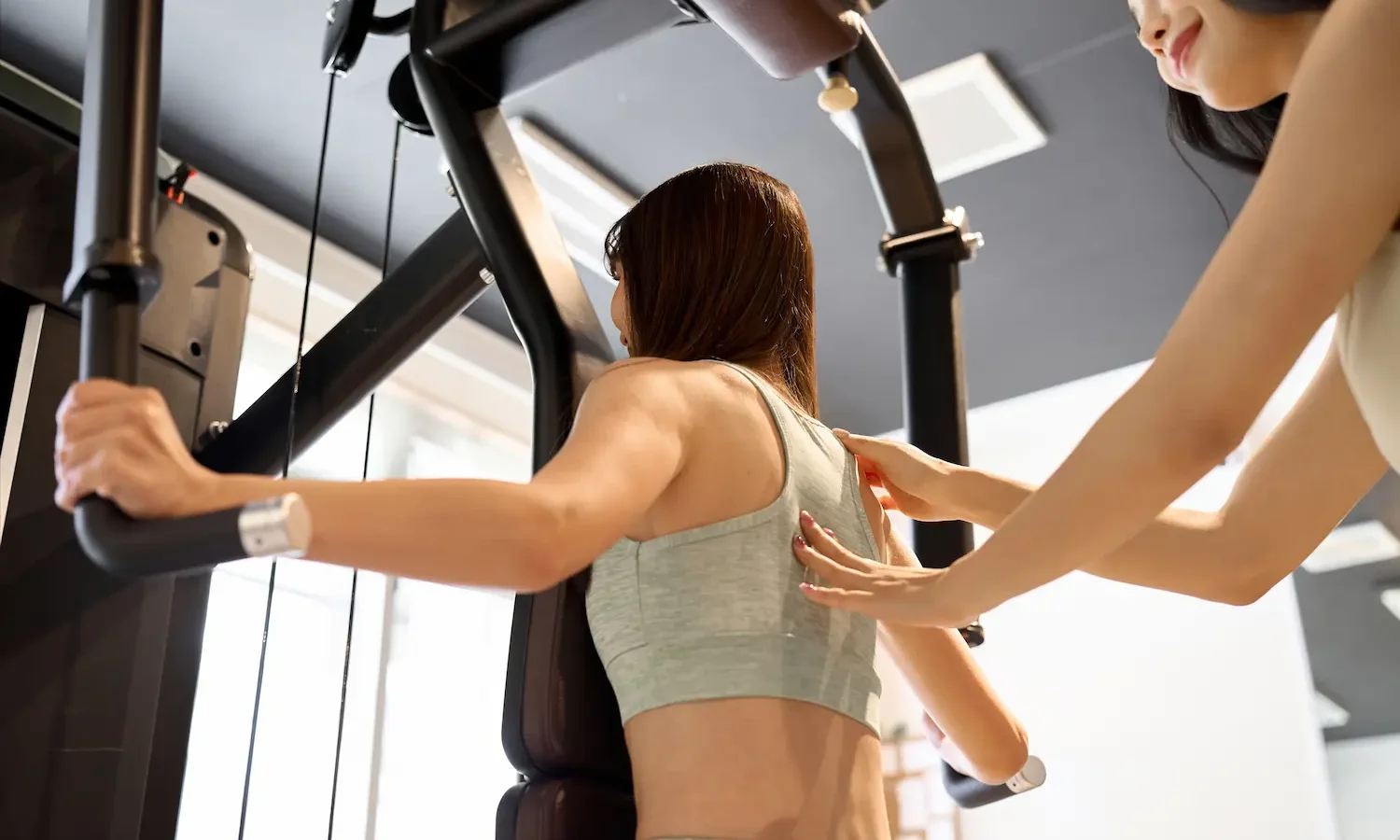
The reverse pec deck (also called rear delt fly machine) is a rear-deltoid isolation exercise performed on a pec deck machine used in reverse — facing the pad instead of away. You grip the handles in front of you and pull them out and back, squeezing the shoulder blades together. The motion isolates the rear deltoid and the muscles between the shoulder blades.
Compared to the face pull, the reverse pec deck is more strict (less body English possible) but trains a slightly narrower muscle range — primarily the rear delts. Face pulls add rotator cuff work and are usually preferred. But the reverse pec deck allows heavier loading and is often easier to feel for beginners.
Muscles worked
| Muscle group | Role | Contribution |
|---|---|---|
| Posterior (rear) deltoid | Primary mover, horizontal abduction | ~55 % |
| Mid-back (rhomboids, lower traps) | Scapular retraction | ~25 % |
| Teres minor, infraspinatus (rotator cuff) | Stabilisation | ~15 % |
| Forearms, upper back | Stabilisation | ~5 % |
The reverse pec deck loads the rear deltoid more isolation-style than nearly any other exercise. Combined with face pulls and rowing variations, it provides complete rear-shoulder coverage that the bench press and press cycles miss.
How to reverse pec deck: 5 steps
-
Set up on the pec deck (in reverse)
Adjust the seat so the handles align with your shoulders when seated. **Face the back pad** (chest against the pad). Grip the handles with arms extended in front, slight bend in the elbows.
-
Set the body position
Sit upright, chest pressed firmly against the pad. Pull shoulder blades down and back. Brace the core. Slight bend in elbows (10-15°), maintained throughout.
-
Drive the elbows out and back
Lead with the elbows. **Move the arms out and back** until they're roughly in line with the shoulders or slightly past. Don't squeeze the shoulder blades together first — let the arms drive the motion.
-
Pause and squeeze at the top
1-second pause when arms are fully extended back. Squeeze the rear delts. Don't shrug — keep shoulder blades down.
-
Lower in 2-3 seconds
Controlled return. Bring the arms forward in a slow arc until they reach the start position. Don't let the weight crash — control the eccentric. Reset, repeat.
Common mistakes to avoid
Variations
- Dumbbell rear delt fly. Bent-over with two dumbbells. Free-weight equivalent.
- Cable rear delt fly. Two cables crossed in front. Constant tension throughout.
- Face pull. Cable + rope. Adds rotator cuff and external rotation work.
- Single-arm reverse pec deck. One arm at a time. Better mind-muscle, asymmetry-fixing.
- Incline rear delt fly. Lying chest-down on an incline bench. Bodyweight-style with light dumbbells.
- Band pull-apart. Resistance band held in front. Home version when no equipment.
Sample workout: 4-week rear delt block
Reverse pec deck 2-3 times per week, after main pressing or pulling work. High volume, light load.
| Week | Sets × reps | Tempo |
|---|---|---|
| 1 | 3 × 15 | 2 sec eccentric + 1 sec squeeze at top |
| 2 | 4 × 12 | 2 sec eccentric + 1 sec squeeze |
| 3 | 4 × 12 + 1 dropset | 3 sec eccentric + 2 sec squeeze |
| 4 (deload) | 3 × 12 | Smooth |
Frequently asked questions
Reverse pec deck or face pull?
Both. Reverse pec deck is more strict and isolates the rear delt. Face pull adds rotator cuff and external rotation, with more functional carryover. Most balanced shoulder programs include both — face pulls 2-3×/week, reverse pec deck once a week.
How heavy should I reverse pec deck?
Light. Rear delts are small muscles that respond to high reps with strict form. Most lifters use 15-25 kg for 12-15 reps. Going heavier means using the lats and traps to cheat the load.
Why don’t I feel my rear delts?
You’re probably squeezing the shoulder blades together (which fires the mid-back) instead of moving the elbows outward (which fires the rear delts). Cue: “drive the elbows back and out”, not “squeeze the shoulder blades”. The arms move first, the scapula follows.
Should I use a wide or narrow grip?
Most reverse pec deck machines have fixed handles. If yours has options, neutral grip (palms facing each other) feels best on the rear delts and is friendlier on the wrists.
How often should I train rear delts?
Frequently. Rear delts recover fast and are usually undertrained. 3-5 sessions per week of moderate volume is fine. Most lifters undertrain them and pay for it with shoulder pain in their 40s.
Related exercises
- Face Pull: cable rear delt + rotator cuff
- Dumbbell Rear Delt Fly: free-weight version
- Lateral Raise: middle delt isolation
- Band Pull-Apart: home alternative
- Seated Cable Row: compound back work