
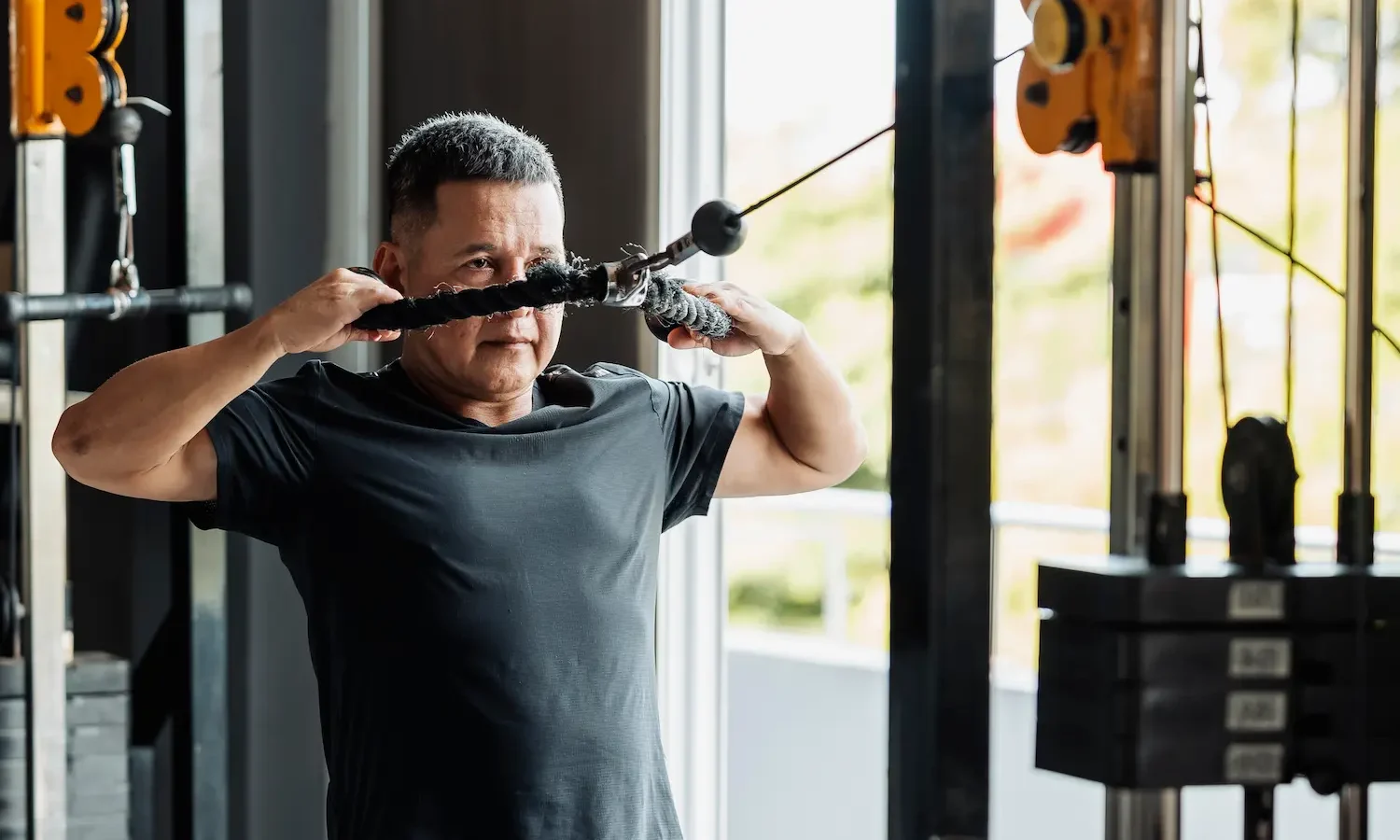
The face pull is the most universally recommended exercise nobody actually does. Every strength coach, physiotherapist and shoulder-rehab specialist puts face pulls in the program. They train the rear delts, fix rounded-shoulder posture, balance the muscle imbalances created by years of bench pressing, and protect the rotator cuff. They also look slightly silly — which is probably why most lifters skip them.
Don’t skip them. Face pulls are the cheapest insurance policy in your training. Three sets of 15-20 reps at the end of every upper-body session, twice a week, will keep your shoulders healthy through years of pressing. This guide covers the standard rope face pull at a cable machine.
What is the face pull?
The face pull is a horizontal pulling movement performed at a high cable machine with a rope attachment, in which you pull the rope toward your face by leading with the elbows out wide. The hands end up at ear level, palms facing inward. The motion is shoulder external rotation combined with horizontal abduction.
It targets a specific muscle group most other exercises miss: the rear delts and external rotators of the shoulder. Bench press, rows, pull-ups — they all bias the front and lats. Face pulls hit the back of the shoulder. Without them, the shoulder joint is unbalanced, which leads to rounded posture and eventually injuries.
Muscles worked
| Muscle group | Role | Contribution |
|---|---|---|
| Posterior (rear) deltoid | Primary mover, horizontal abduction | ~40 % |
| Rotator cuff (infraspinatus, teres minor) | External rotation | ~30 % |
| Mid-back (rhomboids, lower traps) | Scapular retraction | ~20 % |
| Biceps · Forearms | Grip, elbow flexion | ~10 % |
The combination of rear delt + rotator cuff work makes the face pull unique. Most exercises hit one or the other; the face pull hits both at once, in a coordinated movement that mimics how the shoulder actually works in real life.
How to face pull: 5 steps
-
Set up the cable and rope
Set the cable just above face height (about head height when standing). Attach a rope. Grip with both hands, palms facing each other. Step back until the cable is taut at the start position with arms fully extended.
-
Set the stance and posture
Stand tall, feet hip-width. Slight backward lean (10-15°) for stability. Pull shoulder blades down and back. Brace the core. Don't lean forward into the rep.
-
Pull the rope toward your face
Lead with the elbows wide. Pull the rope toward your nose/eye level. **Hands end up at ear level**, palms facing inward (or further externally rotated for more rotator cuff work). Elbows finish slightly behind the ears.
-
Pause and squeeze
Half-second pause at the top. Squeeze the rear delts and shoulder blades together. **Externally rotate** the shoulders further if you can — knuckles toward the ceiling.
-
Lower with control
Reverse the motion in 2-3 seconds. Don't let the cable yank your arms forward. Reset, repeat.
Common mistakes to avoid
Face pull variations
- Seated face pull. Sat on a bench. Removes body English, stricter form.
- Banded face pull. Resistance band anchored at face height. Home version when no cable is available.
- Single-arm face pull. One arm at a time with a D-handle. Better mind-muscle connection.
- Face pull with external rotation. At the top of the rep, externally rotate the shoulders further (knuckles toward the ceiling). Maximises rotator cuff work.
- Rear delt fly. Bent-over with dumbbells. Similar muscle target but no external rotation. Good complement.
- Reverse pec deck. Machine variant. Easier loading, less mobility demand.
Sample workout: high-frequency rear delt protocol
Face pulls are best done at high frequency — 3-5 times per week — with moderate volume per session. Treat them as a standard finisher, not a “main lift”. Add them to the end of every upper-body session.
| Week | Sets × reps per session | Sessions per week |
|---|---|---|
| 1 | 3 × 15 | 3 |
| 2 | 3 × 18 | 4 |
| 3 | 3 × 20 | 4-5 |
| Maintenance | 3 × 15-20 | 3-4 |
Frequently asked questions
Why are face pulls so highly recommended?
Three reasons. First, they hit muscles (rear delts, rotator cuff) that most pressing and pulling movements miss. Second, they balance the imbalances created by heavy bench pressing — without them, the front of the shoulder gets stronger than the back, leading to rounded posture and impingement risk. Third, they’re cheap insurance — 5 minutes of face pulls per session can prevent a year of shoulder rehab.
How heavy should I face pull?
Light. Face pulls are a high-rep technique exercise, not a strength lift. For most lifters: 15-25 kg on the cable for 15-20 strict reps. If you’re using more weight, you’re probably leaning back to help — drop the load.
Can I do face pulls every day?
Yes. The rear delts and rotator cuff recover fast and benefit from daily moderate-volume work. Many lifters do face pulls every training session, sometimes twice a session.
Where should the cable be set — high or low?
Slightly above face height when standing. Pulling from this angle hits the rear delts and external rotators properly. From a low angle, you’re basically doing a high row — different muscle emphasis.
I don’t have a cable machine. What’s the best alternative?
Banded face pulls. Anchor a resistance band to a sturdy point at face height (door anchor, pull-up bar, etc.). Same motion. Slightly less smooth than cables, but very effective.
Related exercises
- Rear Delt Fly: dumbbell rear delt isolation
- Lateral Raise: middle delt isolation
- External Rotation: rotator cuff isolation
- Reverse Pec Deck: machine rear delt
- Band Pull-Apart: home alternative
