
The reverse hyperextension trains the glutes, hamstrings and lower back by swinging the legs up and back from a horizontal starting position. It’s the low-back-friendly posterior chain builder — spinal decompression bonus included.
What it is
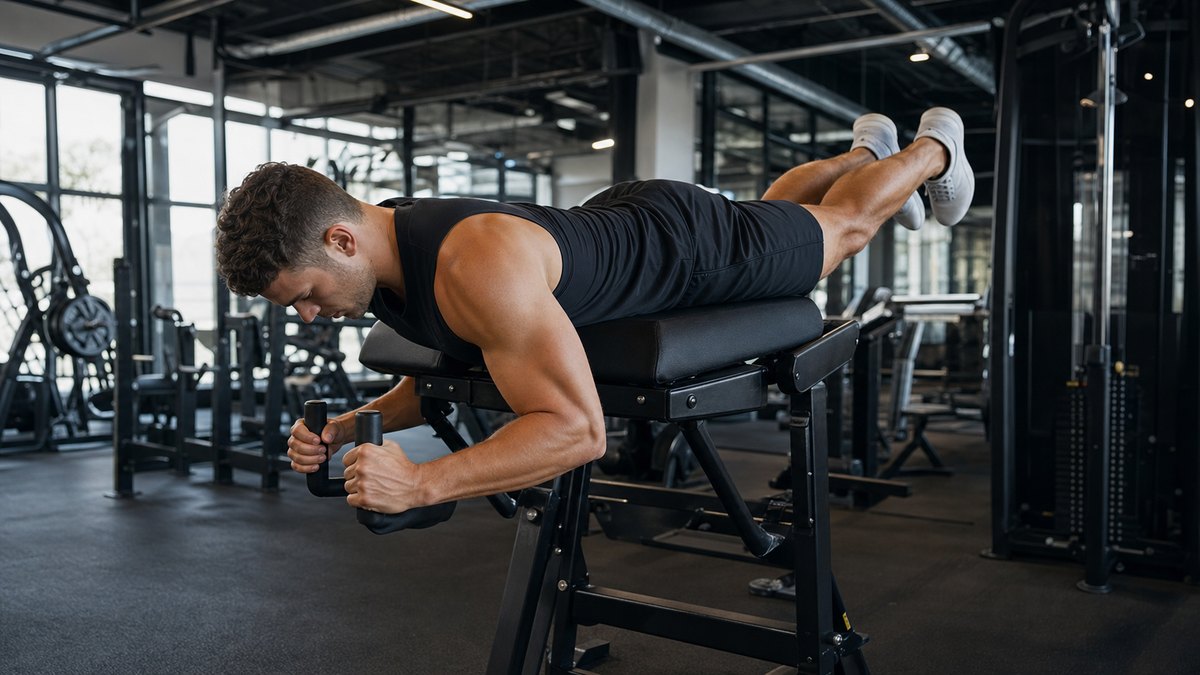
The reverse hyperextension is a posterior chain exercise performed on a specialised reverse hyper machine or bench. The lifter’s torso rests on the pad, legs hanging free below. The lifter raises the legs up and back until they align with the torso, then lowers under control. It builds glutes, hamstrings and erectors while decompressing the spine.
Muscles worked
| Muscle | Contribution |
|---|---|
| Glutes | ~40 % |
| Hamstrings | ~30 % |
| Erector spinae | ~25 % |
| Adductors | ~5 % |
How to reverse hyperextension: 5 steps
-
Set up prone
**Lie prone on reverse hyper pad, hips at edge,** legs hanging.
-
Grip handles
**Grip the handles or bench edge,** shoulders down.
-
Raise legs
**Contract glutes and hamstrings to lift legs up** to horizontal.
-
Peak squeeze
**Squeeze at the top, feel glutes and posterior chain fire.**
-
Controlled descent
Lower legs slowly (2-3 sec) back to starting position.
How it differs from hip thrust
- Prone on pad, legs swing. Hip thrust is supine.
- Spinal decompression. The hanging legs traction the spine.
- Lower back trained isometrically. Erector spinae works to hold position.
- Requires specific equipment. Reverse hyper machine or a suitable bench setup.
Common mistakes
When to use this variation
Use reverse hyperextensions for posterior chain recovery and low-back-friendly training. Program 3 sets of 12-15 reps. Popularised by Louie Simmons for lower back rehab and posterior chain accessory work in powerlifters.
FAQ
What if I don’t have a reverse hyper machine?
Lie prone on a high bench or GHR pad with legs hanging free. Similar movement, less optimal.
How high to raise the legs?
Until they align with the torso — approximately horizontal. Beyond that hyperextends the lumbar.
Is it good for lower back pain?
Often yes — the movement decompresses the spine. But consult a professional for persistent pain.
Related exercises
- Hip Thrust: supine glute-focused
- Glute Ham Raise: another posterior chain builder
- Romanian Deadlift: standing hinge equivalent
- Back Extension: standard hyperextension