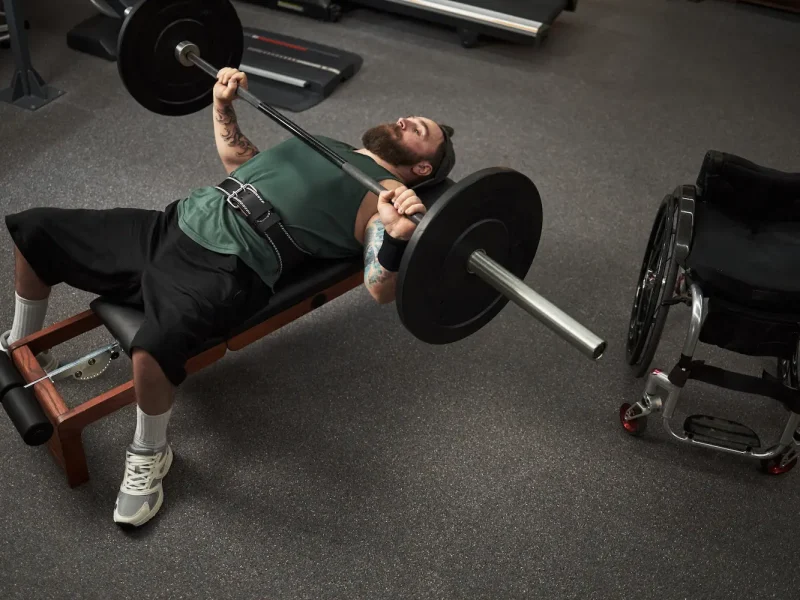


The reverse-grip bench press is the bench press performed with a supinated (underhand, palms-toward-face) grip instead of the standard pronated grip. The grip change shifts the elbow path to tuck closer to the body — making it more triceps-dominant and emphasising the upper chest fibers. It’s a niche but legitimate variation popularised by old-school bodybuilders.
What it is
The reverse-grip bench press is a bench press performed with the hands gripping the bar palms-up (supinated grip). The elbow path naturally tucks much closer to the torso than with the standard grip, the lower bar touch-point shifts further down (around the lower sternum or upper abs), and the upper-chest fibers + triceps get more work than the lower chest. Most lifters can use 75-85 % of their pronated bench weight.
Muscles worked
| Muscle | Contribution |
|---|---|
| Pectoralis major (clavicular / upper) | ~40 % |
| Triceps brachii | ~30 % |
| Anterior deltoid | ~20 % |
| Biceps, forearms, stabilisers | ~10 % |
How to reverse-grip bench press: 5 steps
-
Set up the supinated grip
Lie on the bench. **Grip the bar with both hands palms-up (supinated)**, hands roughly shoulder-width apart. **Wrap thumbs around the bar** for grip security.
-
Unrack carefully
**Get a spotter to lift off** if working heavy. Brace core, retract scapulae. The bar feels much different unracking with a supinated grip — extra caution.
-
Lower with elbows tucked
Lower the bar in 2-3 seconds. **Elbows tuck tight to the torso** (20-30° from body) — much tighter than standard bench. Bar travels to **lower sternum / upper abs**.
-
Touch and press
Touch lightly at the lower sternum, then **press the bar back up** in a slight backward arc toward the face/eyes. Upper-chest fibers and triceps drive.
-
Lock out and reset
Lock out at the top. Lower for the next rep. Always re-rack with spotter help if heavy — the grip can fail at end of set.
How it differs from bench press
- Grip is supinated (palms toward face). Standard bench is pronated (palms away).
- Elbows tuck tighter. The grip biomechanics force a 20-30° elbow tuck — much tighter than standard bench.
- Lower touch point. Bar touches the lower sternum or upper abs, not the lower chest.
- More upper-chest work. The elbow path + tight tuck shift the work toward the clavicular (upper) chest fibers — a region the standard bench underdevelops.
- Spotter essential. The grip is less secure than pronated — a slip can be dangerous. Use a spotter or set safety pins for working sets.
Common mistakes
When to use this variation
Use reverse-grip bench when your upper chest lags despite incline pressing, or as a triceps-emphasis bench variant. It’s a niche tool — not for every program. Most lifters benefit more from incline bench for upper-chest work and close-grip bench for triceps. Try it for 4-6 weeks if you’ve plateaued on standard bench variations.
FAQ
Is the reverse-grip bench safe?
For experienced lifters with secure grip and a spotter, yes. The grip is less stable than the standard pronated grip — a slip could drop the bar on your face. Always use a spotter or set safety pins, and don’t go for heavy max attempts solo.
How heavy should I reverse-grip bench?
75-85 % of your standard bench 1RM for the same reps. The unfamiliar grip makes everything feel weird — start light, build up.
Does it actually hit the upper chest more than incline bench?
Roughly comparable. Incline bench is more proven and allows more load. Reverse-grip bench is a useful variation; not a replacement.
Related exercises
- Bench Press: standard pronated grip
- Incline Bench Press: upper-chest emphasis
- Close-Grip Bench Press: triceps emphasis
- Neutral-Grip Bench Press: parallel grip variant